• العربية
  • فارسی
Brand
  • Iran Insight
  • Politics
  • Economy
  • Analysis
  • Special Report
  • Opinion
  • Podcast
  • Iran Insight
  • Politics
  • Economy
  • Analysis
  • Special Report
  • Opinion
  • Podcast
  • Theme
  • Language
    • العربية
    • فارسی
  • Iran Insight
  • Politics
  • Economy
  • Analysis
  • Special Report
  • Opinion
  • Podcast
All rights reserved for Volant Media UK Limited
volant media logo

Unfair Policies Polarize Iran's Population, Says Sociologist

Iran International Newsroom
May 20, 2023, 18:39 GMT+1Updated: 17:46 GMT+1
An Iranian woman walking in front of regime-sponsored pro-hijab protesters

Mostafa Abroshan, an Iranian sociologist says that young Iranians do not trust the government, as they lost hope in the future.

Abroshan warned the Iranian government that trust in the ruling establishment cannot be restored by decrees and orders. While corruption and favoritism have enriched a small minority, poverty has risen to unprecedented levels.

The sociologist asked: "How can young Iranians trust the government while most of them do not have a job?" He argued that "The distrust is rooted in the country's crisis of management. In order to solve this problem, the government needs to appoint qualified individuals with the right kind of specialization to key jobs, and make knowledge and rationality govern the country's institutions."

Abroshan was referring to statements by Iranian officials including President Ebrahim Raisi, who promised repeatedly during the past two years to create one million jobs annually for young Iranians but broke their promise. Raisi has even claimed that those jobs have been created!

Mostafa Abroshan, an Iranian sociologist (undated)
100%
Mostafa Abroshan, an Iranian sociologist

Also in some cases, officials make outlandish promises without thinking of the implications of what they say. On Wednesday, Telecommunications Minister Isa Zarepour promised that his ministry will make sure Internet speed increases by 80-fold this year.

The astonishing promise was made while people suffer from extremely low Internet speed and the banning of nearly all social media platforms on which many small businesses and more than 10 million families depend for a living. 

In another example, Iranian academic Mostafa Mehraeen complained that young Iranians simply want to live a normal life but as soon as they criticize the authorities’ impolite treatment of the youth, security forces attack them and the officials accuse them of being drug addicts.

Abroshan also said that social capital (government legitimacy) is the spirit of the nation. People learn about it during the process of their socialization. It lends meaning to human communication and boosts solidarity and social participation. He added that mutual trust between the people and government is one of the most important factors of social capital which makes cooperation between various parts of the society possible. 

Trust will be enhanced if the people see that the government meets their expectations, Abroshan said, adding that otherwise the people come to believe that the country's economic and social institutions do not represent their views and expectations. As a result, distrust of the government builds up and the ruling establishment loses all legitimacy. 

Telecommunications Minister Isa Zarepour  (undated)
100%
Telecommunications Minister Isa Zarepour

Explaining the situation of trust in government, Abroshan said, "when the police do not respect citizens and treat them with violence as we have seen, the situation triggers anger and leads to behaviors such as attacking and overturning police vehicles." He added that when he, as a sociologist, criticizes the situation out of sympathy for the people and the government, officials accuse him of portraying a disparaging image of the social situation. 

He reiterated, "Mutual trust between the people and government no longer exists. "The government constantly calls on the people to fulfil their social responsibilities, but at the same time, constantly undermines their citizenship rights." He added: "The distribution of wealth in the Iranian society is unfair and inequality has polarized the society."

Abroshan further pointed out: "Currently Iranian citizens and the government refuse to recognize each other. As a result, any event that hurts the people's feeling can trigger a social 
Most Viewed

Iran diplomacy wobbles as factions compete to avoid looking soft on US
1
INSIGHT

Iran diplomacy wobbles as factions compete to avoid looking soft on US

2
ANALYSIS

The politics of pink: how Iran uses cuteness to rebrand violence

3

Scam messages seek crypto for ships’ safe passage through Hormuz, firm warns

4
EXCLUSIVE

Family told missing teen was alive, then received his body 60 days later

5
INSIGHT

Is Iran entering its Gorbachev moment?

Banner
Banner

Spotlight

  • Diplomacy tolls at Hormuz as conflict returns to its doorstep
    OPINION

    Diplomacy tolls at Hormuz as conflict returns to its doorstep

  • Opposition to US talks grows in Tehran as ceasefire deadline nears
    INSIGHT

    Opposition to US talks grows in Tehran as ceasefire deadline nears

  • Tehran moderates see ‘no deal–no war’ limbo as worst outcome
    INSIGHT

    Tehran moderates see ‘no deal–no war’ limbo as worst outcome

  • The future has been switched off here
    TEHRAN INSIDER

    The future has been switched off here

  • Lights out, then gunfire: Witnesses recount Mashhad protest crackdown
    VOICES FROM IRAN

    Lights out, then gunfire: Witnesses recount Mashhad protest crackdown

  • Is Iran entering its Gorbachev moment?
    INSIGHT

    Is Iran entering its Gorbachev moment?

•
•
•

More Stories

Iran’s Water Dispute Continues With Taliban As They Ridicule Raisi

May 20, 2023, 16:50 GMT+1
•
Maryam Sinaiee

A major water dispute between Iran’s clerical regime and the Taliban continues as a Tehran officials issue warnings and the Afghan rulers ridicule them.

A Taliban official appeared in a video holding a bucket at the edge of a reservoir and saying he wants to give water to Iran. He ridiculed the Iranian regime’s president Ebrahim Raisi who had earlier used threatening language. “I want to give water, so Iran’s president does not launch a military attack.” The video went viral on social media.

Iran's foreign ministry Friday “strongly refuted” Taliban’s claim over lack of enough water in the river Hirmand (Helmand in Afghan) due to draught to release Iran's share of the river’s waters.

The foreign ministry also said Taliban’s statement over the issue contained “contradictory and false information”.

Energy Minister Ali-Akbar Mehrabian said Friday that the government is determined to pursue Iran's water rights according to the Afghan-Iranian Water Treaty of March 1973 to regulate the use of the river.

The Taliban’s claim that there is not enough water to flow from Kajaki dam towards the Iranian border is not acceptable and is in contradiction to the experience of the past few years, he said.

Foreign Minister Hossein Amir-Abdollahian also accused the Afghan government in a tweet Thursday of not allowing Iranian experts to investigate the matter in Afghanistan despite his repeated requests. “Proof of existence or lack of water is technical and actual visit [by experts], not a political statement [by the Taliban],” he wrote.

Spokesman of Iran's Aerospace Organization, Hossein Dalirian, said in a tweet Thursday that images from Iran's Khayyam satellite indicate that the government of Afghanistan has stopped the waters from reaching Iran by changing the course of the river in some areas and building “numerous” barriers.

The halt in the flow of water from Afghanistan has seriously affected the lives of hundreds of thousands in the southeastern province of Sistan and Baluchestan.

A nature reserve in Iran's Sistan turned into desert
100%
A nature reserve in Iran's Sistan turned into desert

While Afghanistan says it needs dams to store water for agriculture or to produce electricity, which it imports from neighboring countries including Iran, many environmentalists are critical of large-scale water engineering projects.

The Iranian government, and environmentalists, argue constructing the dam on Helmand River will deepen problems in Iran’s eastern provinces, particularly in Sistan-Baluchestan where water resources are scarce. Declining rainfall since late 1990s, which caused prolonged droughts in the Helmand basin, as well as water mismanagement both in Afghanistan and Iran, has had serious ecological, economic and social impact.

Wetlands in Sistan have largely turned into salt flats, the once rich wildlife has disappeared, and many local villages abandoned. In 2019, after nearly two decades of drought, water from Helmand reached the wetlands of Sistan and partially revived the Hamoun-e Hirmand Lake. The lake is a UNESCO biosphere reserve.

The dispute between the two countries over water is long standing but it has escalated in the past few years.

In March 2021 in a televised speech inaugurating the Kamal Khan Dam in Nimroz province, former Afghan President Ashraf Ghani said that while Afghanistan remained committed to the treaty but added that "anything beyond the stipulated quota" required further discussion. He suggested that Iran should pay for ‘extra’ water from the Helmand River by providing oil to his country.

His remarks appeared to refer to Article V of the 1973 treaty, which stipulated Iran in "a normal water year" was entitled to a flow of 22 cubic meters per second from the 1,150km (700 mile) long river.

Hirmand rises in the Hindu Kush before flowing west into Iran and feeding an area of wetlands in the Sistan region including Hamoun Lake. Iran has not always received this amount – in 1999, for example, the Taliban turned off the flow completely.

President Ebrahim Raisi's special envoy for Afghan affairs, Hassan Kazemi Qomi, said Tuesday that Iran received 27 million cubic meters of water out of the 820 million cubic meters it was entitled to under the 1973 treaty.

Seventeen Injured As Blaze Engulfs Tehran Warehouse

May 20, 2023, 13:30 GMT+1

A large fire has engulfed a warehouse in Tehran, a regime-affiliated news agency has reported.

According to Fars, firefighters are attempting to extinguish the blaze after the warehouse for automobile and motorcycle parts caught fire in Razi Square, in the south of the Iranian capital.

Seventeen people have been injured, and several have been taken to hospital, Tehran Emergency Service said.

The cause of the fire and the value of property damaged are unknown.

Last month a large fire broke out across three warehouses of a home appliances manufacturer in the northeastern city of Mashhad.

The semi-official ISNA news agency reported that the building belonged to Electrosteel, a large and well-known company in Iran.

There have been a number of explosions and fires near Iran’s military, nuclear and industrial facilities in recent years.

Earlier this month, media in Iran reported that a large fire broke out at a power plant west of the Iranian city Esfahan (Isfahan) and was extinguished within a few hours.

Several unconfirmed sources reported hearing an explosion at the plant, claiming that it was a result of drone attacks, but this was not confirmed by officials.

The Esfahan thermal power plant – also known as Shahid Abbaspour – in Dorcheh near the central city of Esfahan has five units with a total generation capacity of 830 Megawatts.

On January 28, a huge fire erupted at an Iranian military industry factory following a suspected drone strike in the central city of Esfahan.

Iran blamed Israel for the drone attack, vowing revenge.

'Human Trafficker' Hanged By Iranian Authorities

May 20, 2023, 13:04 GMT+1

A man has been executed in Iran for leading a human trafficking and prostitution ring, according to state officials.

The judiciary's Mizan Online news website said that Shahrouz Sokhanvari was hanged Saturday morning after his sentence was confirmed in the supreme court.

The report said that Sokhanvari was charged with "corruption on earth" for "establishing and managing a wide network of prostitution at the international level that has been attracting Iranian and foreign girls".

Sokhanvari left Iran in 1983, living in India, Malaysia, the United Arab Emirates, Ukraine, and the US before authorities captured him overseas and returned him to Iran in 2020, according to Mizan.

The report did not mention the country of detention or the process that led to his arrest.

The execution of Sokhanvari came a day after three men were hanged for killing three members of the security forces at a demonstration in Isfahan on November 16.

Human rights organizations based outside Iran strongly condemned both Friday's executions and the earlier trials that led to the convictions of the three men without any reliable evidence against them.

According to the Oslo-based Iran Human Rights, more than 220 people have been executed in Iran since the beginning of the year.

Human rights organizations, including Amnesty International, claim that the country executes more people every year than any other nation with the exception of China.

This year has seen at least 582 executions in Iran, the highest number since 2015, according to the two groups.

Khamenei Gives Double-Edged Guidance To Iran's Diplomats

May 20, 2023, 12:57 GMT+1
•
Mardo Soghom

An “honorable” foreign policy that rejects supplication should be the guide for Iran’s diplomats, Supreme Leader Ali Khamenei said in a speech on Saturday.

Khamenei addressed foreign ministry officials and ambassadors at a time when his foreign policy of defying the West has become more controversial in Iran amid a serious economic crisis.

Khamenei set out to explain and clarify the principles and standards of “a successful foreign policy” focusing on three keywords: Honor, wisdom, and expediency.

A foreign policy based on supplication in words or in essence, and begging for favors from foreign powers is doomed, Khamenei said. He urged diplomats to respond to the words and actions of others reciprocally and “with honor.”

The 83-year-old authoritarian ruler also emphasized the need for wisdom in foreign policy. In a statement urging caution, he said that “uncalculated and dismissive” decisions and actions in the past have harmed the country.

Iranian officials and politicians, however, usually take their cue from Khamenei, especially in foreign policy matters. His past statements against regional countries such as Saudi Arabia, Israel, or the United States and Europe have led to more provocative statements by his underlings.

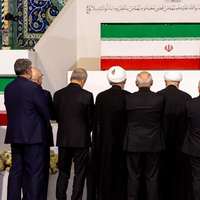
Iran's foreign minister Hossein Amir-Abdollahian and nuclear negotiator Ali Bagheri-Kani listening to Khamenei on May 20, 2023
100%
Iran's foreign minister Hossein Amir-Abdollahian and nuclear negotiator Ali Bagheri-Kani listening to Khamenei on May 20, 2023

But the Supreme Leader often speaks with double meanings, leaving room for himself to shirk responsibility if a certain policy proves to be a failure.

Khamenei used this tactic during nuclear negotiations a decade ago. While approving the policy of talks and compromise, he also warned that other nations could not be trusted, and a nuclear deal might prove to be disadvantageous.

He followed the same tact on Saturday, saying that the principle of using ‘wisdom’ also means not to unnecessarily trust what other countries say, although sometimes they are sincere. He has repeatedly said in the past that the United States and its allies cannot be trusted.

Khamenei in his speech used the Islamic concept of 'Taqiyya' to describe the regime's decision to accept the 2015 JCPOA nuclear deal with the West. Taqiyya means the permissibility to deny or conceal one's real beliefs to secure a worthy goal.

Khamenei’s emphasis on “expediency” as the third principle in foreign policy was particularly notable, as he urged flexibility “in necessary instances” and circumventing “tough barriers” to continue a set course.

His mention of ‘flexibility’ was a reference to his famous phrase of “heroic flexibility” in 2013, when he signaled his permission for nuclear talks to begin.

“Of course, a few years ago when ‘heroic flexibility’ was mentioned, some abroad and in Iran had the wrong take on it. Expediency means finding ways to circumvent difficult obstacles and pursuing the same path,” Khamenei clarified.

In the context of Iran's nuclear program, this remark could mean that Khamenei justifies negotiations as a way of continuing to pursue the same goal by going around the opposition of other countries.

Commentators and many politicians in Iran have been increasingly calling for a flexible foreign policy and accommodation with the West, while the public knows that Khamenei makes all the key decisions.

With annual inflation reported to be near 70 percent and the Iranian currency losing half its value in the past year, with popular anti-regime protests and labor strikes, Khamenei finds himself in a tough position. However, so far, there is no indications of a foreign policy shift, except an agreement to restore diplomatic ties with regional rival Saudi Arabia.

Khamenei in his speech urged his foreign policy establishment to work hard for improving ties with regional countries, blaming “the enemy for doing everything” to drive a wedge between Iran and its neighbors.

In Khamenei’s lexicon, ‘the enemy’ refers mainly to the United States and Israel and to a lesser extent to other US allies, including European powers.

Iran’s Hardliners Work On Draft Bill To Further Restrict Elections

May 20, 2023, 07:10 GMT+1
•
Iran International Newsroom

A prominent politician in Iran says none of the country's political factions can do anything to ensure a high turnout in the upcoming parliamentary election.

Mohammad Ali Abtahi, former reformist President Mohammad Khatami's chief of staff told Rouydad24 website on Wednesday that "if the people do not feel that it is a free election, they will not take part in it." 

"My understanding is that the Guardian Council is not going to soften its policy on the disqualification [of reform-minded candidates]. It is not likely that those who have gone out of their way to create a unified political system will come short of their hardliner policies."

Other Iranian media outlets such as Khabar Online have also pointed out during recent days that ten months before the vote in March 2024, there is no election mood in Iran unlike previous rounds when campaigns started at least a year before the elections. In the meantime, many Iranian officials including Supreme Leader Ali Khamenei have expressed concern about a likely low-turnout next March. 

Mohammad Ali Abtahi, the chief of staff of former reformist President Mohammad Khatami (undated)
100%
Mohammad Ali Abtahi, the chief of staff of former reformist President Mohammad Khatami

Khamenei told Iranian officials in late March that a high-turnout election will make the country powerful and will stop international pressures on the Islamic Republic. He called for a "healthy election" as he was aware of criticisms of the way the latest Iranian elections were held in 2020 and 2021 presumably under his supervision. 

Many politicians, particularly reformist figures such as Abtahi and Mohsen Mirdamadi, the leader of banned reformist party Mosharekat have said that the regime in Iran has lost its social capital, a polite word for legitimacy, as a result of the disputed presidential election of 2009 and the protests that have rocked Iran since 2017. 

Abtahi added that those who currently hold the power in Iran are not interested in increasing the turnout in the upcoming elections, as only a low turnout can ensure their victory.

Meanwhile, lawmaker Gholamreza Nouri Ghezeljeh told Khabar Online website on Wednesday that the current ultraconservative-dominated parliament is working hard in extraordinary sessions to pass an amendment to Iran's Election Law to serve the hardliners by giving even more power to the conservative-dominated Guardian Council to disqualify any candidate who does not belong to the ultraconservative camp. 

Lawmaker Gholamreza Nouri Ghezeljeh (undated)
100%
Lawmaker Gholamreza Nouri Ghezeljeh

Ghezeljeh characterized the new legislation as "a law against the republican system," however, he said that hardliners are working hard to enact the legislation before the upcoming elections. 

On Tuesday, prominent conservative politician Mohammad Javad Bahonar had said that the Majles should not be involved in changing the Election Law, as the incumbent lawmakers tend to manipulate the legislation to ensure their own re-election. 

Ghezeljeh said that in the draft amendment the Guardian Council has been given the power to disqualify even those who get elected. He said such a legislation will weaken the parliament altogether. 

Some Iranian politicians have also expressed concern about the next presidential election which usually takes place in the year after the Majles election. 

Former lawmaker Gholam AIi Jafarzadeh Imenabadi (undated)
100%
Former lawmaker Gholam AIi Jafarzadeh Imenabadi

Former lawmaker Gholam AIi Jafarzadeh Imenabadi said in an interview on Wednesday that President Ebrahim Raisi's chances for re-election is limited. "He can score only if they put him in front of an empty goal post," he said. 

Imanabadi reiterated that "In a competitive election neither Raisi nor 90 percent of current lawmakers have any chance to get re-elected."