Eight Iranian Protesters Indicted On Charges That Can Lead To Death
A scene of protests in the city of Izeh in Ahvaz protests
Eight people arrested during Iran’s nationwide protests in the southern city of Izeh, are indicted for "waging war against God" and "corruption on earth" that can lead to death sentences.
US-based Human Rights Activists News Agency (HRANA) reported Sunday that the case of these people was referred to the fourth branch of Ahvaz Revolutionary Court and all of them are detained in Shiban prison of Ahvaz in the south.
The citizens were arrested in November 2022 by the intelligence agents of the Islamic Revolutionary Guard Corps.
Earlier this month, Iran sentenced another protester to death in Izeh for the killing of a nine-year-old during unrest in November, although the victim’s family insists the killers were security forces and the man is innocent.
Judiciary announced that Abbas (Mojahed) Kourkouri was sentenced to death for the killing of Kian Pirfalak in Izeh in southwestern Iran on November 15.
Kian and his family were targeted by plainclothesmen during a night of protests in Izeh while they were in their car. Kian’s father was also paralyzed as a result of serious injuries he sustained during the attack.
Over 500 protesters and bystanders were killed by security forces during the protests across Iran. The regime executed four young men for their alleged role in the killings of government agents in December and January after hasty trials.
Dr. Hamid Qarahassanlou and his wife Farzaneh. Undated
The ordeal of a doctor and his wife in Iran who evaded execution but received long sentences for simply participating in a protest has caught public attention.
Dr. Hamid Qarahassanlou (Ghara-Hasanlou), a fifty-four-year-old radiologist, and his wife Farzaneh were arrested in November in Karaj during protests in which a member of the Basij militia, Ruhollah Ajamian (27), was beaten to death by angry protesters but both have denied any involvement in the incident.
Qarahassanlou was initially sentenced to death and his wife to twenty-five years prison, but their sentences were later reduced due to a strong backlash on social media and lack of evidence of their involvement in a second trial.
Yazd and Mashhad, where Hamid and Farzaneh Qarahassanlou will serve their sentences respectively, are nearly 1,000, and 670 kilometers away from their hometown of Karaj.
A statement by the family released on social media Friday, after the announcement of the new sentences Tuesday, said even the footage of the incident made by security agents proves that the couple were not involved in the killing and were only present on the scene on the way home from a protest in Karaj, near Tehran, on November 3.
“He now has to be exiled [to a prison] in Yazd for fifteen years for not having saved the life of that Basiji in the fracas [of the moment] as a humane doctor,” the statement said while describing the very violent arrest of the couple which they say has hugely affected the couple’s teenage daughter.
Attack on a car belonging to security agents in Karaj on November 3, 2022
The large protest rally that turned very violent after security forces attacked protesters was held to commemorate a young girl, Hadis Najafi, who was shot to death by security forces forty days earlier.
“The crime [for which they were punished] was and is nothing other than participating in Hadis Najafi’s 40th day memorial,” the statement said.
Two young protesters, Mohammad Mehdi Karami (22) and Mohammad Hossein (39), were executed over Ajamian’s death in January after a hasty trial which human rights activists have called a travesty of justice.
All of the accused, including Qarahassanlou, were reportedly severely tortured to obtain “confessions” and the hardliner Judiciary assigned lawyers despite several prominent lawyers volunteering to defend them.
The lawyers assigned by the court did very little to defend the accused according to family members.
The convictions were not based on a criminal charge related to the murder per se, but they were charged with ‘moharebeh’, meaning “war against God”, a vague religious concept. The Islamic Republic applies the charge to people who might get into a confrontation with security forces during protests.
The first two hangings triggered strong international condemnations and hundreds of lawmakers in Europe and Australia began sponsoring Iranian detainees in danger of execution to generate publicity and impact their fate.
Twelve other protestors have been jailed for up to 15 years for the Basij agent’s death.
The couple were badly beaten during the arrest and later in detention. Qarahassanlou underwent surgery three times for several broken ribs and damaged lung and the family say he has partially lost his eyesight as a result of the beatings.
The couple who belong to the persecuted Sufi Gonabadi Order were known for active involvement in charitable efforts including building schools for underprivileged children.
Canada-based Iranian opposition figure Hamed Esmaeilion
The resignation of Hamed Esmaeilion from the Alliance for Freedom and Democracy in Iran has sparked bitter arguments between monarchists and his supporters.
In a post entitled “Report to the People” Friday, Canada-based activist Esmaeilion announced that he has left the alliance. The council consisted of the exiled Prince Reza Pahlavi, Nobel peace prize laureate Shirin Ebadi , US-based author, journalist and women’s rights activist Masih Alinejad, actress and activist Nazanin Boniadi and Secretary General of the Kurdish Komala Party Abdullah Mohtadi and Esmaeilion.
Boniadi recently deactivated her social media accounts without any explanation and appears to have withdrawn from the alliance too. Alinejad, Mohtadi, and Ebadi have so far not commented on Esmaeilion’s resignation.
The alliance announced its existence in a February event at Georgetown University and issued its charter, the Mahsa Charter, in early March and its members said they had agreed on “minimal positions” that could create the most consensus among the opposition.
Esmaeilion said he joined the opposition in exile council hoping to help create a platform for dialogue and cooperation among various opposition factions but the lack of democracy and transparency in the council and the “domination” of one member over the others disillusioned him.
He claimed that he had tried to keep away from “conflicts, pressures and illogical demands” but was impeded by “pressure groups from the outside” who kept trying to impose their own views on the coalition by “undemocratic methods".
Supporters of Esmaeilion, Alinejad, and Mohtadi have long been accusing the supporters of the exiled Prince of harassment on social media and efforts to defame them. Prince Reza Pahlavi has on some occasions advised his supporters to be more tolerant of others but the disputes and attacks on social media only got worse. They often accuse Prince Reza Pahlavi’s supporters of trying to present the him as the only legitimate leader of the opposition.
Supporters of the Prince who call themselves ‘constitutionalists’ are staunchly against establishing a republic of any form in Iran, particularly federalism, seek the revival of a constitutional monarchy and the Iranian Constitution of 1906. They allege that others, Esmaeilion and Alinejad in particular, have views that will lead to the loss of Iran's national integrity.
Constitutionalists have been particularly angry recently because they believe that Esmaeilion and possibly Alinejad have prevented the Prince from including some opposition figures close to him in the coalition– particularly London-based journalist Amir Taheri, the US-based Amir-Hossein Etemadi, a member of the Frashgard group, and Germany-based musician and activist Shahin Najafi.
"Imposing opinions is not democratic, and the consensus of a group’s members, not just one member, is a precondition of a democratic movement," Esmaeilion wrote without naming Prince Reza Pahlavi directly while further suggesting that there have been efforts to “eliminate” others and impose certain views on others.
He also opined that the opposition abroad should only help to empower the people of Iran, their networks and organizations and that he would personally continue helping young pro-democracy Iranians abroad to organize and work on “unrestricted internet and several other projects” with them.
His critics respond that the six-member council was self-appointed, and no one got elected to block others from joining.
Some social media users have also suggested that the reason for Esmaeilion’s departure from the alliance at this time could have been his opposition to the Prince’s recent visit to Israel.
“Timelines are filled with Esmaeilion’s worthless tweet exactly when articles and tweets must focus on the important and taboo-breaking Israel visit of the Iranian monarch, Prince Reza Pahlavi, and the impact of this visit today and after the reclamation of Iran [from the Islamic Republic]. Isn’t it interesting?” one of the Prince’s supporters tweeted.
Workers of the oil, gas and petrochemical industries in Iran have gone on strike demanding wage increases in the face of more than 50 percent annual inflation.
Countless contract workersin oil, gas, petrochemical and steel industries in the southern cities of Asaluyeh, Dehloran, Gachsaran, Kangan, etc., stopped working on Saturday demanding a raise based on their proposed list which should be 79%.
At the same time, a conference was held in the city of Cologne, Germany, to express support for trade and civil unions of Iran.
According to reports, over 80 parties and organizations as well as 1,500 activists supported the initiative by the conference.
Back in February, twenty independent trade unions and civic institutions in Iran jointly published a charter, outlining their main demands to end the current inhumane situation.
Wages for most workers are around $120-150 a month, while a family of four needs $450 for its bare minimum needs.
In a statement, they said that 44 years after the establishment of the Islamic Republic the country's economic, political and social situation has plunged into a "vortex of crisis and disintegration."
They added that no clear and attainable prospect can be envisioned to end the current situation within the existing political framework, calling for building a new, modern and humane society after the Islamic Republic.
Outlining 12 main demands, they called for the release of all political prisoners, prohibition of criminalizing political, union, and civil activities, public trial of the leaders and perpetrators of the violence against protesters, unrestricted freedom of opinion, expression and thought, assembly, and social media as well as policies to preserve natural resources and ending environmental degradation.
Over 40 political, social and human rights activists from inside and outside Iran for the first time attended a virtual conference called “Dialog To Save Iran”.
The meeting, which was held on Club House social media platform Friday, also heard from eight detained activists who sent messages from inside prisons in Iran.
Hashem Aghajari, a political activist and university professor referred to the last statement of the Green Movement leader Mir-Hossein Mousavi saying that with a deep understanding of the changes in Iranian society, Mousavi came to the conclusion that reform through electoral mechanisms is impossible.
Back in February, Mir-Hossein Mousavi, who was a presidential candidate in 2009 and has been under house arrest since 2011, issued a statement saying that the rulers of the Islamic Republic are not willing “to take the smallest step to meet the demands of the people.” He further added that Iran needs a “fundamental change” based on “Woman, Life, Freedom” motto and constitutional change.
Meanwhile, Mehrdad Khansari, a political activist and former diplomat, emphasized that Iran is facing a huge crisis adding that a strong front must be formed inside the country to challenge the regime.
In a message from prison, Keyvan Samimi, a journalist and political activist, who was rearrested Thursday, said Iranians inside and outside the country should form a united national front to get rid of oppression.
Imprisoned human rights activist Narges Mohammadi also said in a message that “To save Iran, we must end the tyrannical, anti-woman regime and make a peaceful and low-cost transition for the people.”
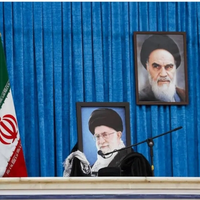
Iran’s Supreme Leader addressing senior officials and military commanders of the country
A speech by a man who is said to be an official of the Islamic Republic’s intelligence ministry suggests that the regime is in panic about opposition it faces.
The audio recording leaked to media, which is full of bizarre remarks, seems to be from a session in which the unnamed speaker is talking about the nationwide protests that have not died down since September.
Echoing conspiratorial propaganda by the regime’s authorities, the speaker blamed other countries for the protests, saying that a select group of protesters had been trained in the US bases in the region.
It appears that the orator is addressing a group of regime loyalists and his strange remarks give the impression of an almost desperate attempt to convince regime insiders that they are besieged by conspirators – an at one point in the speech – even by mythological beings.
He presented no evidence and did not explain how large protests formed is, as he says, only a handful were trained to foment unrest.
“They selected special people from among them and took them to private [social media] channels and taught them urban warfare, for example making grenades,” he claimed, adding that "Among these special people, they chose even more special people and took them to the American bases in Jordan, Turkey and Erbil and trained them."
The intelligence ministry’s official made more bizarre claims, saying that the "training sessions" of these people in the American bases were "mixed-gender and they were provided with sexual attractions, drugs and alcohol."
He added that celebrities and influencers were taken to US bases in Turkey, where they signed contracts in dollars and euros to fight against the regime.
He went on to say that during the protests out of every 200 people, five people were trained by the US. “In these five-member units, one person was in charge of chanting slogans, one person gathered people, one person killed security forces, one person set fire to a place, and one person broadcast the events live on Iran International and BBC,” he added. Following the escalation of protests across Iran, internet access was shut or slowed down regularly and no live broadcasts happened from inside the country.
He also claimed that in the Iranian province of Kordestan "17,000 men and women” trained by Kurdish nationalist groups planned to attack five cities in the province. The Al-Ahwazi Arab Popular Democratic Front (APDF) also planned to launch an armed rebellion and attack the city of Ahvaz, the provincial capital of Khuzestan in southwest Iran, the official told his audience.
He also claimed that members of Jaish ul-Adl -- a Salafi Islamist militant organization that operates mainly in southeastern Iran – also sought independence in Sistan-Baluchestan province. He said that similar attacks were also planned by Iran’s Pan-Turkists. "The enemies worked for years on Pan-Kurdism, Pan-Turkism, Pan-Arabism and Pan-Baluchism,” he said.
Amid all these, the official did not explain how Iran’s multiple intelligence organizations missed all the preparations by alleged enemies and why there was no evidence of protesters taking up arms.
Islamic Republic’s police forces removing satellite dishes from buildings in Tehran
Going to the realm of fiction, he said that “jinns” or malevolent mythological creatures also played a role in the current wave of protests. Jinn – also romanized as djinn or anglicized as genies – are invisible creatures in early pre-Islamic Arabian religious systems and later in Islamic culture and beliefs. “These jinns enter the bodies of unfaithful people and possess them,” he said, adding that during meetings with Islamic experts they found out that reciting the Quran and Islamic call to public prayer can scare them away. “Satellite dishes must be removed from homes because households that have satellites are frequented by evil jinns,” the official said.