Hardline Cleric Says Recent Protests In Iran Unprecedented

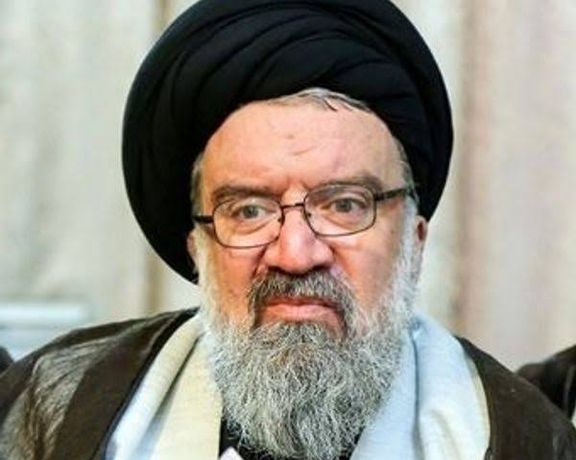
Firebrand Iranian cleric Ahmad Khatami has admitted that "the Islamic Republic has never had [such] tough days like the past 100 days of protests".

Firebrand Iranian cleric Ahmad Khatami has admitted that "the Islamic Republic has never had [such] tough days like the past 100 days of protests".
In a speech on Sunday in the city of Semnan, Tehran’s Friday Prayer Imam called the popular protests of the past six months a "riot" aimed at ousting the regime. He acknowledged that protesters saw no difference between ‘reformist’ and ‘hardliner’ factions of the Islamic Republic and were bent on overthrowing the regime.
In addition, international assessments show the protests in the past six months have been unprecedented in terms of their size, the largest ever since the establishment of the Islamic Republic in 1979.
Ahmad Khatami, who is a member of the Guardian Council and the Assembly of Experts, also made the extreme claim that by the "Woman, Life, Freedom" slogan the protesters are seeking "nudity" in their fight against the hijab.
In its propaganda, the authorities of the Islamic Republic use words such as "nudity" and "bareness" to belittle the fight against the mandatory hijab as women act to defend their fundamental rights and social freedoms.
Following the death in custody of Mahsa Amini in September, rights groups claim that regime forces have killed over 500 protesters including at least 70 children with brutal suppressive measures across the country.
Iran’s judiciary has also sentenced four protesters to death after sham trials where the young men did not have basic access to lawyers.

Iran’s exiled queen has expressed hope that Iran will be free in the coming year in a message on the occasion of Iranian new year, Nowruz.
Farah Pahlavi expressed sympathy with the families of the dead protesters, prisoners and people under pressure in Iran, saying that the essence of Nowruz heralds the victory of truth over lies.
"Nowruz, which always brings joy and hope, will be celebrated this year in a situation in which our nation is mourning its lost ones," she said.
The exiled queen further noted that hundreds of young men and women died with the slogan ‘Women, Life, Freedom’ in confrontation with brutality and darkness, but “their names and memories will be eternal in the history of Iran”.
She further underlined that “my thoughts are with the bereaved mothers and fathers, thousands of Iranians who are imprisoned, and teenagers who have been poisoned in Iranian schools”.
Elsewhere in her remarks, Pahlavi expressed concern over the situation of millions of Iranians who are struggling to earn a living and are victims of the brutality and incompetence of the regime.
She also congratulated the arrival of the ancient Iranian tradition Nowruz which is a “sign of stability, continuity and national identity.”
Iran has been witnessing nationwide protests within the past six months, during which time, regime agents have killed over 500 people so far and executed several who were arrested during demonstrations. Thousands more have been arrested arbitrarily.

Dozens of clerics from seminaries in Tehran demanded the government to take decisive action to enforce the hijab and stop what they called the “spread of nudism”.
“Nudism has been spreading due to the enemy’s trickery more and more but while we are showing patience, there is only passivity and lack of decisive action in the atmosphere of the country,” 46 officials of religious seminaries, including officials of women’s seminaries, wrote in a letter to President Ebrahim Raisi Thursday.
“We will not be able to demand the implementation of other laws in the future if we back down on the Hijab Law now,” seminarians said in their letter while criticizing the withdrawal of the infamous morality police patrols from the streets and demanding “immediate” action.
Morality police patrols were withdrawn from the streets in October amid nationwide protests that followed the death in custody of the 22-year-old Mahsa Amini who was arrested for failing to wear her hijab ‘properly’.
Protests sparked by Mahsa’s death have grown much less fierce and frequent since January while hardliners’ demands for enforcement of the Hijab Law have considerably grown.
Many of the women who burned their headscarves during the protests, particularly the younger generation, are still defiantly appearing ‘hijabless’ in public in unprecedented numbers.
Women’s defiance, which also signals their defiance of the clerical rule, is too vexing to the hardline establishment many of whom are trying to cast the responsibility of enforcement of hijab rules on businesses and encouraging individuals to take the matter into their own hands.
Ayatollah Mohammad-Mahdi Hosseini-Hamedani, the Friday imam of Karaj, criticized businesses for not addressing the hijab issue and said retailers, banks and government offices must enforce the rules.
Last week, the judiciary in Kashan ordered a very popular boutique hotel, Sara-ye Ameriha, in Kashan and Matin Abad Eco Camp about 45km from the same city to shut down on the grounds that their guests had not abided by “Islamic norms and the hijab rules”.
Sara-ye Ameriha, a massive historical house restored and turned into a boutique hotel shut down for failing to force guests abide by hijab rules.
The hotel and eco camp were both reopened Thursday after the tourism minister, Ezzatollah Zarghami, denied his ministry’s involvement and said shutting down such places was unacceptable because it violated the rights of domestic and foreign tourists that had made reservations and promised to resolve the problem.
Local authorities often take the matter of enforcement of hijab into their own hands by threatening businesses and even shutting them down if they fail to force their clients to abide by the rules.
On Thursday, the public and revolutionary prosecutor of Khuzestan Province not only warned to shut down local businesses but also warned that vehicles, presumably taxis and private cars, could also be impounded for passengers’ infringement as this “promoted hijablessness” .
Lawmakers have also drafted a new law that if approved would increase CCTV and social media surveillance of hijab and punish not only “offenders” but also businesses which fail to enforce the rules on their premises.
Bijan Nobaveh, one of the lawmakers behind the plan, said earlier this week that punishments included cutting mobile phone and internet access of “offenders” but Ahmad Naderi, a member of the presidium, later accused the media of using Nobaveh’s personal views to launch “an onslaught against the parliament”.
The plan demonstrates that lawmakers are not learning from experience. “Do not step on people and the society’s nerves,” the reformist Ham Mihan newspaper wrote Thursday, while mentioning other serious problems such as the high rate of inflation plaguing the economy.
In a report to the UN Human Rights Council, Iran has responded to accusations over the mass gas attack poisoning of schoolgirls, declaring itself “innocent”.
Radio Farda, the Persian Service of US government funded Radio Free Europe (RFE/RL) said it has received a copy of the letter sent by Iran’s Mission to the United Nations which is based on the statements of the Ministries of Interior and Health and other government institutions, along with the remarks of the Supreme Leader Ali Khamenei, President Ebrahim Raisi and the judiciary chief.
The letter claims that less than ten percent of the students experienced symptoms of poisoning, and all were transferred to the hospital and discharged in a short time. It further alleges that only four students needed hospitalization for more than two days.

In the letter, the Islamic Republic however noted that students in 250 classrooms in 52 schools in different cities were poisoned.
This comes as Iran's Ministry of Health said early last week that 13,000 students were poisoned in 100 cities of 28 provinces.
Some Iranian media say at least 30,000 students were poisoned within the past couple of months.
Hundreds of schoolgirls -- who have been at the forefront of anti-regime protests - have been chemically poisoned since November 30 when the first case of a mysterious poisoning was reported in the religious city of Qom.
While the Islamic Republic has been fiercely cracking down on dissent, many believe it was involved in the serial chemical attacks on schoolgirls. Activists and right groups have called on the international community to pressure the regime over the issue.
A day after the letter was sent, eight experts of the United Nations said the Iranian regime committed "intentional”poisoning and instead of confronting the attacks and conducting a quick investigation, it put its efforts into covering up the incidents.
Last week, the European Parliament adopted a resolution to decry the regime’s months-long failure to act on the serial poisonings, as well as its deliberate suppression of credible reports of systematic toxic attacks.

Amid reports that Iranians have lost more than $770 million due to deliberate government internet outages in 2022, authorities try to play down the impact.
Iranian Minister of Information and Communications Technology Issa Zarepour said Friday that there is no accurate data regarding the damage from internet access restrictions. However, independent VPN review website Top10VPN said in its annual that the economic impact was about $773 million in 2022.
While in dollars this might not appear to be a staggering figure, in local currency it is hundreds of trillions of rials and a huge loss for an economy straddled by US sanctions, inefficiency and corruption.
As nationwide anti-regime protests began in September, the government started to disrupt access to the internet to prevent news about the unrest being disseminated both inside the country and abroad. It also aimed at preventing protesters from communicating with each other. Internet disruption lasted for weeks.

Intermittent disruption have continued in 2023, mostly coinciding with protests. The latest one occurred on March 7, as Iranians were holding a nationwide rally to protest the regime's inaction or possible involvement in the face of poisonous gas attacks on schoolgirls in recent months.
Drawing widespread criticism on social media, Zarepour, however, rejected the estimates by the company – and any other foreign source for that matter – saying that "there have been dozens of assessments by foreign sources that cannot be relied upon." He added that the Islamic Republic itself has not done any evaluation over the losses caused by the Internet restrictions.
Earlier in the month, Statista -- an online platform specialized in market and consumer data – said Iran’s blocking access to social media sites and news outlets was second only to Russia in 2022, affecting almost 72 million people
A report released in January said that due to extensive internet and social network restrictions, 20 percent of people lost their online jobs in the last four months of the previous year. According to Jobvision website, 46 percent of organizations suspended or postponed more than half of their recruitment programs due to the recent internet restrictions, and 45% of companies or businesses that depend on the Internet have decided to reduce their payments or had to pay wages by delay.
The computer trade union of Tehran -- or Tehran ICT Guild Organization -- announced in November that almost half of the Internet service providers in had seen a 50-percent drop in sales due to disruptions, censorship, and Internet shutdowns during the protests. The union's secretary Alireza Keshavarz Jamshidian went on to say that about half of the Internet providers lost over 500 million rials (around $1,400) a day, as sales dropped. However, he added, one-fifth of the companies say they suffered between $2,800 and $14,000 loss a day.
Curfew-style shut down of the internet has a highly damaging impact on several industries including food, medicine, and steel production, especially on small businesses and farmers. The E-Commerce Association in Tehran announced last year that the internet shutdown costs Iran $1.5 million per hour.
Despite all the losses due to the government restrictions, the cash-strapped administration of Ebrahim Raisi has issued a new decree to collect eight percent royalty fee from video call services of mobile operators in the country.

A human rights group says nearly 30,000 people were arrested for staging protests, political activities, or the expression of their opinions in the Iranian year ending on Monday, March 20.
The report by the US-based Human Rights Activists News Agency (HRANA) states that during the 12 months, 29,688 people were arrested in Iran, of which 28,419 were detained for exercising their rights free expression.
328 women's rights activists, 258 trade union activists, 235 ethnic minorities and 169 people of religious minorities were also among the detainees, according to the report.
Iran’s chief judge announced March 13 that 22,000 people arrested during recent protests were "pardoned" and released in the past 6 months but he declined to mention the total number of people arrested.
In the reporting period, the public and Revolutionary Courts across Iran opened 1,075 legal cases against defendants facing political and national security charges, added the report, saying that the courts issued a combined total of 31,164 months in prison and 2,507 months of suspended jail terms.
HRANA also has described the last Iranian year a difficult one for women, reporting that at least 39 women were murder victims of domestic violence while 11 others were beaten, assaulted and injured by the morality police or religious vigilantes imposing so-called proper hijab in the public.