New US Sanctions Target Iranian Shipping, Petrochemicals
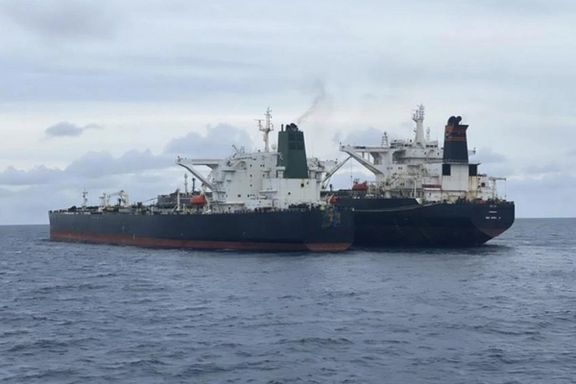
Tankers engaged on oil transfer on open sees to hide origin of cargo
The United States imposed new sanctions Thursday on Iran-linked shipping and petrochemical companies, including two shipping firms based in China.
The sanctions also target 20 shipping vessels linked to firms in China, Vietnam and the United Arab Emirates, the Treasury Department's website showed.
The Biden administration has accelerated the imposition of sanctions on Iran since last September when antigovernment protests were met by a brutal government response. Iran’s weapons supply to Russia have also led to sanctions by the US, the European Union and the United Kingdom.
Iran has been shipping oil and oil products despite US sanctions, imposed since 2018, to China and other buyers, using clandestine methods. Third parties involved in sanctions violations are subject to US punitive measures.
The website did provide details on the new sanctions. A Treasury spokesperson referred questions to the State Department, which did not immediately respond to a request for comment.
The sanctions were issued under a 2018 U.S. executive order that restored sanctions targeting Iran's oil, banking and transportation sectors.
The Treasury Department issued a general license authorizing limited transactions with the sanctioned vessels under what it called a "wind-down" period through June 29, a document on its website showed.
The head of the International Atomic Energy Agency, Rafael Grossi
The head of the International Atomic Energy Agency (IAEA) Rafael Grossi will visit Iran Friday for high-level meetings, the semi-official Fars news agency reported Wednesday.
The visit comes amid discussions with Tehran on the origin of uranium particles enriched to up to 83.7% purity, very close to weapons grade, at its Fordow enrichment plant, a report by the watchdog seen by Reuters confirmed on Tuesday.
Iran has rejected the claims of enrichment up to that level.
Iran began violating the 2015 nuclear deal’s (JCPOA) enrichment limit set at 3.67 percent in 2019 when the Trump administration imposed full oil export sanctions, but until the Biden administration came to office higher enrichment had stayed at around 5 percent.
The head of Iran’s Atomic Energy Organization, Mohammad Eslami, said on Wednesday that the Islamic Republic's production is at 60 percent according to state media.
Iranian officials have been insisting that a few particles are sometimes enriched beyond set limits, but the quantity is negligible. Eslami repeated the same argument on Wednesday. It is not clear if the IAEA agrees with this explanation.
The UN watchdog has been demanding other explanations from Tehran about its secret nuclear work before 2003 and so far there has been no resolution.
Talks to revive the JCPOA reached an impasse last September while Iran continues to stockpile 60-percent enriched uranium. It is estimated that it can reach weapons grade enrichment in a matter of weeks and can produce four nuclear warheads.
Canada says it has imposed sanctions on 12 senior officials from Iran's Islamic Revolutionary Guard Corps (IRGC) and Law Enforcement Forces for their role in "gross and systematic human rights violations."
In a statement Canada's foreign ministry announced on Monday that the targeted officials include Kurdistan Province Governor Esmaeil Zarei Kousha and Morteza Mir Aghaei, Commander of Basij paramilitary forces in Sanandaj, Kurdistan Province.
The measures prohibit dealings with the listed individuals, effectively freezing any assets they may hold in Canada.
They are also inadmissible to Canada under the Immigration and Refugee Protection Act, added the statement.
“Ottawa will continue to coordinate with its international partners to respond to the Iranian regime’s egregious treatment of its people, its deployment of propaganda and its actions that continue to threaten international peace and stability.”
Mélanie Joly, Minister of Foreign Affairs of Canada earlier stated that “The Iranian regime continues to brutally oppress its people and to deny them their fundamental rights and freedoms. We hear the pleas of the Iranian people, and we commend them for their bravery and resilience. Canada will not stop advocating for Iranians and their human rights.”
Iran’s suppression of nationwide protests since the death in custody of Mahsa Amini in September has drawn condemnation from international community with US and EU imposing sanctions on the regime.
File photo of an Iranian man passing in front of a board that shows exchange rates against rial
An Iranian economist says the role of US sanctions in causing economic chaos in Iran has been significant, as the national currency continued its free fall on Sunday.
Iranian government officials, experts and the regime’s opponents have long argued that economic sanctions imposed by the Trump administration since 2018 inflicted a serious blow to Iran’s weak economy, but few have ventured to quantify the impact.
What is clear now is that Iran’s oil-dependent currency, the rial, fell from 35,000 to more than 600,000 against the US dollar in exactly five years. This led to very high inflation, officially at more than 50 percent, which has impoverished tens of millions of Iranians. But how much of the bad news was the result of sanctions and how much was the outcome of a natural trend in Iran’s state-controlled and inefficient economy.
Masoud Nili, an economist in Tehran believes that the impact of sanctions on the fall of the rial has been significant and serious. In a television program reported by Roouydad24 news website. Nili said that if the United States had not withdrawn from the JCPOA nuclear deal and imposed sanctions, the rial would be probably trading at 100,000 against the US dollar, instead of 600,000 and counting.
The economist based his estimate on trends since at least 2000 and concluded that the rial would have lost value in the past 5 years, but at a manageable pace.
Iranian economist Masoud Nili
Iran’s currency was trading at 70 to the dollar right before the 1979 revolution but in the 44 years since the establishment of the Islamic Republic it has steadily declined and now is headed toward a 10,000-fold fall in value.
But in Nili’s estimate, without the ‘Trump’s sanctions’ the Islamic Republic would have faced rial’s natural fall and not a catastrophic decline that it cannot control now.
The economist had a similar appraisal of the rate of inflation. Looking at trends in more than two decades he argued that the average annual inflation rate was around 16 percent, except in the past five years. The latest official figures put the inflation rate at more than 50 percent for January 2023, although there are no independent estimates.
Nili argued that the difference between the 16 percent average since the year 2000 and the current inflation rate is because of US sanctions.
But that difference is exactly what made the current situation an hyper-crisis instead of a weak economy limping along with the steady income from oil exports.
The Biden administration that assumed office criticizing the its predecessor’s decision to withdraw from the 2015 nuclear accord, also argued that sanctions have been ineffective and Tehran has expanded its nuclear program instead of making any concessions.
Critics on the other hand argued that sanctions take time to leave a serious impact and those imposed on Iran would have hardly worked in just two years from 2018-2020.
As the Biden administration entered talks with Tehran in April 2020 to revive the JCPOA, it did not suspend Trump’s sanctions and Iran struggled to sell oil and engage in in international trade. After depleting its foreign currency reserves, the economic situation began to quickly deteriorate, especially as optimism disappeared in the latter part of 2022 in the absence of a new nuclear deal with the US.
Prince Reza Pahlavi, sone of Iran's last king, Mohammad Reza Shah
Iran’s exiled Prince Reza Pahlavi has called on Britain to designate Iran’s IRGC as a terrorist group, saying it would be akin to “pulling out the regime’s biggest tooth.”
Speaking to The Sunday Telegraph during a brief trip to London on Saturday, he argued that when it comes to proscribing the IRGC, Europe is being slow to act because it underestimates the importance of such a move.
Designating the IRGC would mean “more pressure in paralyzing the regime that is depending on this instrument of coercion at home and abroad to do the sinister deeds whether it is Syria or Lebanon, or in Iran itself,” the prince noted.
The United States has already listed the IRGC as a Foreign Terrorist Organization, but debate in Europe continues over such a move.
He said that for the first time since the Iranian revolution in 1979 the factors are in place for the Islamic Republic to be ousted. “I think the alignment of stars is now there. The opportunity is right in front of us,” he underlined.
Not only have the “reformists of yesteryear” from within Iran now come around to the idea of total regime change, but the West has also warmed to the idea, he stressed.
“A lot of people question what can come after, rightfully so,” he said. “But I think that Iran has all the ingredients and tools to fill the void in terms of the intelligentsia, in terms of positions that they can immediately fill for transitional governance, specialists [in] the economy, environment, transitional justice as well as constitutional law.”
The UK has sanctioned 92 individuals and entities over the Russian invasion of Ukraine, including export bans on items Kiev has found Moscow is using on the battlefield.
The new sanctions, which were announced to mark the one-year anniversary of the aggression in Ukraine, designated 80 people, including senior executives of Russian state-owned nuclear power company Rosatom as well as five senior Iranian executives of Qods Aviation Industry, a subsidiary company of Iran Aviation Industries Organization, which manufactures drones used in Ukraine.
Foreign Secretary James Cleverly announced on Friday the new package of internationally coordinated sanctions and trade measures, including import bans on 140 goods such as iron and steel products processed in third countries.
The statement by the Foreign Secretary said that the sanctions on Iranian officials demonstrates their commitment to continue to pressure third countries supplying Russia’s military.
Managing Director of Qods Aviation Industry Company Ghassem Damavandian, and some board members of the company, namely Vali Arlanizadeh, Reza Khaki, Majid-Reza Niyazi-Angili, and Hamidreza Sharifi-Tehrani, are the Iranians included in the new batch of sanctions.
Earlier in February, Britain imposed sanctions on three Iranian judges, three members of Iran's Islamic Revolutionary Guard Corps and two regional governors. Those added to the sanctions list are subject to an asset freeze and travel ban. The list of sanctioned individuals includes IRGC members, such as the commander of provinces in which security forces have severely injured and killed children.