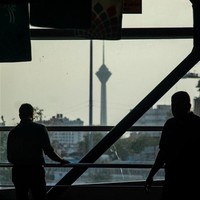
Iran International's broadcast operation in its London studios
After a significant escalation in state-backed threats from Iran and advice from the Metropolitan Police, Iran International TV says it has reluctantly closed its London studios and moved broadcasting to Washington DC.
The station will continue to operate from its offices in Washington DC uninterrupted.
Threats had grown to the point that it was felt it was no longer possible to protect the channel’s staff, other employees at Chiswick Business Park and the general public.
Iran International was warned by authorities in November that its journalists were under threat from Iranian agents and the Metropolitan Police took measures to strengthen security around the network’s office in the area.
The channel's broadcasts have gained special significance since popular anti-regime protests broke out in Iran last September. Iranian officials have repeatedly threatened Iran International and other Persian broadcasters based abroad since the start of protests when the government blocked the Internet to deny the population news and information.
Amid repeated threats by the Islamic Republic against Iran International’s reporters, the UK government vowed in December to step up protection of London-based Iranian journalists.
British Foreign Minister James Cleverly said during a session in Parliament on December 13 that the Foreign and Commonwealth Development Office (FCDO), in partnership with the Home Office, had ensured that the Iranian journalists were protected by the British police.
“The UK remains absolutely determined to ensure that Iran does not intimidate people within this country. We will always stand up to the aggression from foreign nations,” he noted, adding, “We will absolutely not tolerate threats, particularly towards journalists who are highlighting what is going on in Iran, or indeed any other individual living in the UK.”
A man was arrestedin the vicinity of Iran International’s headquarters last Saturday and charged with a terrorism offence. He pleaded not guilty in a court session on Tuesday.
Mahmood Enayat, General Manager of Iran International TV, said after the decision to move broadcasting to Washington:
“I cannot believe it has come to this. A foreign state has caused such a significant threat to the British public on British soil that we have to move. Let’s be clear this is not just a threat to our TV station but the British Public at large. Even more this is an assault on the values of sovereignty, security and free speech that the UK has always held dear.
Day and night our journalists strive to deliver the 85mn people of Iran and its diaspora the independent, uncensored news they deserve.
We refuse to be silenced by these cowardly threats. We will continue to broadcast.
Indian media reported that Iran’s foreign minister has canceled a trip to New Delhi for a conference because a promotional video shows Iranian women cutting their hair.
The Indian Express wrote on Fridaythat Hossein Amir-Abdollahian refused to attend the meeting after India ignored Tehran's request to remove two seconds from the video.
The governments of New Delhi and Tehran have yet to react to this report.
In a situation that Tehran has become more isolated by Western countries, this could be a sign that the Iranian regime is also being further sidelined in its relationship with countries that usually it had friendly ties with.
According to Indian Express, the Raisina Dialogue conference will be held in New Delhi in two weeks with the participation of the ministry of foreign affairs of India and the "Observer Research Foundation" thinktank for two days.
The short teaser of the conference includes images of the most important events of 2022.
In the first months of the "Woman, Life, Freedom" protests, many women and girls in Iran cut their hair in the streets, classrooms and on the graves of their dead loved ones in a move to show anger at the clerical ruler’s brutality. Women in other countries also cut their hair in public as a sign of solidarity with Iranian protesters.
Iranian regime has killed over 500 protesters following the death of Mahsa Amini in police custody in September.
A Bloomberg report says Israel has taken the initiative to advance US-sponsored talks with Saudi Arabia and strengthen the "military and intelligence" cooperation between the two countries with the aim of countering "threats" by Iran.
Citing several informed sources, Bloomberg reported Friday that before the recent meeting of the joint working group of the United States and the Gulf Cooperation Council in Riyadh, Saudi and Israeli officials met to assess the areas of cooperation between the two countries.
“Further engagement is expected to take place in Prague to coincide with the Munich Security Conference this weekend,” the sources told Bloomberg.
In recent years, drone attacks on oil tankers in the Persian Gulf, as well as Saudi oil facilities, which have been attributed to Iran and militias supported by the Iranian regime, have fueled concerns about threats from the Islamic Republic.
“We think that other regions integrating and beginning to sit at the same table with Israel is in the interest of stability and security in the region,” US Deputy Assistant Secretary of Defense for the Middle East, Dana Stroul, said in Riyadh on Monday.
The US government and six Persian Gulf Arab states on Thursday jointly called Tehran a growing threat to regional security.
Saudi Arabia cut ties with Iran in 2016 when mobs attacked its embassy in Tehran after Riyadh executed 47 dissidents including the leading Shiite cleric Sheikh Nimr al-Nimr.
Iran's most prominent Sunni leader Mowlana Abdolhamid has once again called for a referendum in the country, saying people's wish for a secular government must be met.
During his Friday prayer sermon, the outspoken Sunni leader continued to challenge the Islamic Republic and its ruler Ali Khamenei by demanding submission to the popular will, saying that an Islamic government must be democratic according to practices in the early years of Islam.
Pointing to the ongoing disagreement between a large part of the nation and the regime, he said the reasonable way out of this political impasse that would cause the least harm is the submission of the Islamic Republic to rule and the will of the people.
"The Islamic Republic regime was established in Iran 44 years ago and since the 1979 revolution, a particular reading and understanding of Islam has been prevalent in the country and it has been the same until now. But there is another understanding of Islam that we believe in, and that is the justice of Imam Ali,” referring to the fourth Caliph and the first Shiite Imam. “In this view, there is not only one ruler and a permanent government; the ruler should be determined by the people,” he added.
He added, "There is no death sentence in this reading of Islam. Forced confession is rejected and has no place. In this view, people can easily criticize their ruler and government. There is freedom.”
Women should enjoy equal rights as men, so do all ethnic groups, religions, and all human beings, Abdolhamid noted, adding that “The only solution to end the differences is accepting the will of the majority of the people.”
Elsewhere in his remarks, he criticized the regime’s plan to liquidate public assets and grant immunity to the seven-man team responsible for its implementation. Such properties belong to all the people, he underlined, adding that the "Iranian people have a bitter memory of privatization.” Previously, under the guise of privatization, public properties, factories and big companies were sold far below market price to people or organizations with connections and influence, he said.
Moreover, he once again demanded the release of "imprisoned religious leaders of various provinces, especially in provinces of Kordestan and Sistan-Baluchistan" as well as other political and ideological prisoners.
People of Zahedan holding protests rallies after the Friday prayers on February 17, 2023
As is the new normal in Zahedan, where Abdolhamid leads the Friday prayers, people held demonstrations after they left the mosques on Friday and chanted slogans against the Islamic Republic and its ruler Ali Khamenei. Similar rallies were held in another city of the province, Khash.
However, over 1,300 kilometers north of Zahedan, in Golestan province where there are large Sunni Baluch and Turkmen communities, another Sunni Mowlavi (Imam), Mohammad-Hossein Gorgij, has reportedly been put under house arrest. People held a gathering outside the residence of Gorgij and expressed their support for him.
Also on Friday, the security situation was tense in several Kurdish cities, which are predominantly populated by Sunni people, such as Sanandaj in Kordestan province and Sardasht in West Azarbaijan. People were not allowed to visit their cities’ graveyards as the security forces are afraid that any gathering can morph into antigovernment protest rallies.
Government media in Iran report that a police commander has been sentenced to 15 months in prison, without mentioning accusations that he raped a teenage girl.
Last year, Sunni Baluch community leaders and people in southeast Iran had accused Ebrahim Kucheckzaei of sexual assault while he was commander of police in Chabahar port city on the Sea of Oman, near Pakistan.
Public anger over the incident contributed to a protest on September 30 in the city of Zahedan when security forces opened fire and killed more than 90 residents. Coupled with anti-regime popular protests, the people of Zahedan have held demonstrations every Friday since the massacre and their religious leader, Mowlana Abdolhamid has become a fierce critic of the Islamic Republic.
Tehran media said that a military court after hearing from “the plaintiff and the family” and examining evidence convicted Kuchakzaei of “some infringements” including actions that discredited the police and filing a false report. They did not mention the alleged sexual assault.
The arrest and conviction of the police commander can be seen as another attempt by the regime to mollify public anger, as five months of protests continue and Western countries impose sanctions on the regime for its human rights violations.
The government has been releasing some political prisoners after a conditional amnesty was announced recently, while still arresting and punishing others for their role in protests or for criticizing the regime.
Two prominent sociologists in Iran argue that with the decline in political participation, opportunists got concessions from the state and gained the upper hand.
Mohsen Goudarzi and Abdolmohammad Kazemipour told Shargh newspaper: "We reviewed the data for several decades and we found out that with the decline of trust between the people and the government corruption will rise and the rule of law will take a downturn."
Goudarzi maintained that all this will lead to the government's inefficiency and more corruption which will in turn, further damage the people's trust in the government and other institutions.
He argued that this vicious circle will continue, and as the situation worsens, this is not something citizens can tolerate forever. When the people feel that there is no hope for change and no institutionalized way to bring about change, they will take to the streets.
As long as corruption and inefficiency and other shortcomings persist and cause dissatisfaction, and there is no institutionalized outlet for expressing dissent, protests are always probable.
Goudarzi explained that the government, the economy, and social structures are the main ingredients of a coherent society, but many political elites believe that after politics, the economy plays the most important part in the society. In several periods before and after the 1979 revolution, and even before the revolution, Iranian politicians have asked themselves whether economic development should come before political development or vice versa.
Iranian sociologist Mohsen Goudarzi
A 1969 document called "The Principles of Cultural Policy" and several other studies in the mid-70s about the future of Iran have all considered social crisis as the core problem for Iran. At that time, they referred to it as a cultural crisis. In the 1970s, sociologists believed that Iran's problem was that economic growth was prioritized over cultural and political growth.
The social scientists of the 1970s believed that a fast-paced economic change had altered the material aspects of the people's life. With the transition from traditional agricultural economy to modern industrial economy, large parts of the population migrated from the villages to the margins of urban areas, where they found themselves in an environment with different ideals and values.
Social scientists believed that the newcomers to the cities found themselves alien to the new environment. In order to escape the anxiety of this dislocation, they took refuge in the safe haven of traditions, particularly in religion, Goudarzi added. The transforming society pursued material values and looked forward to a modern future, but at the same time, people did not tolerate the resulting cultural changes.
Yet another problem was that while economic growth was creating a well-off middle class, doors to political participation remained closed. Sociologists Majid Tehranian, Ali Assadi and Hormoz Mehrdad in 1970s believed that focusing on the economy and ignoring its social and political implications by the Iranian government was the root cause of tensions. They believed that in that situation the society was not able to remain stable.
Time proved them right in a matter of only a few years. Since then, sociologists made sure that focusing on the economy without paying attention to people's political and social needs will lead to catastrophe. But ruling politicians in Iran, both then and now, thought that political participation could be relegated to the background. In their book, "What happened? The story of decline of Iranian society," Mohsen Goudarzi and Abdolmohammad Kazemipour have challenged this view. We have laid emphasis on the idea of balance, said Goudarzi.