Russia 'To Swarm' Ukrainian Sky With Iranian Drones - Ukraine
Missile traces seen, as Russia's attacks on Ukraine continue in Donbas region, Ukraine.
Shortly after reports surfaced that Iran plans to construct a drone factory in Russia, Ukrainian sources say Moscow intends to "swarm" Ukraine's air defenses.
Newsweek said on Monday that Moscow is set to receive a new batch of Iranian-made Shahed drones, according to a Ukrainian military intelligence official.
Vadym Skibitsky, the deputy head of the Main Intelligence Directorate within Ukraine's defense ministry, told Ukrainian outlet RBC that Russia will shortly receive another delivery of Shahed-131 and -136 drones, or unmanned aerial vehicles, from Tehran.
Skibitsky did not specify a time scale for the reported delivery, but suggested that previously, Russia had received batches of between 250 and 300 "suicide" or "kamikaze" drones. "Stocks need to be replenished," he said, adding that Russia was attempting "to use what they have left in the most effective way."
He added that Russian forces have "used approximately 660 Shahed drones" to date, but will be expecting to have up to 1,750 at their disposal.
Emphasizing that a small amount—5 to10 [UAVs] cannot have such an effect, the deputy chief of Ukraine's military intelligence said that Russian forces were looking to send the drones in "swarms" that could breach Ukrainian air defense systems.
On Sunday, The Wall Street Journal quoted officials from a country aligned with the US as saying that a high-level Iranian delegation traveled to Russia in early January to make preparation for a drone factory. The report claimed that Moscow and Tehran are cooperating on plans to construct afactory that could make at least 6,000 Iranian-designed drones.
Russia is planning a major offensive to coincide with the one-year anniversary of the war in Ukraine on 24 February, according to Ukraine’s defense minister, Oleksii Reznikov.
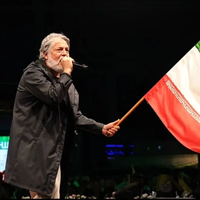
Fatemiyoun brigade fighters showcasing their flag in Syria
Iran International has obtained information that reveals corruption in salary payments to proxy militia fighters in regional countries by their Revolutionary Guard handlers.
IRGC Brigadier General Jamaleddin Aberumand, who is currently serving as an aide to Parliament Speaker Mohammad Bagher Ghalibaf (Qalibaf) and was a former deputy commander for IRGC coordination affairs, has appropriated parts of the salaries that the IRGC meant to pay to its militias in countries such as in Syria and Yemen.
Aberoumand was the head of IRGC Bonyad Cooperative, an entity also known as the Cooperative Foundation of the Revolutionary Guard and under US Treasury Department sanctions since December 2010. He was apparently in charge of paying the salaries of IRGC Quds (Qods) Force militias-- a division responsible for extraterritorial military and clandestine operations.
Zainebiyoun Brigade -- recruited mainly from Shia Pakistanis living in Iran – and Fatemiyoun Brigade – recruited from Afghan refugees in Iran and Afghanistan – were formed in 2014 to fight in Syria along with President Bashar al-Assad forces. These forces, along with Houthis in Yemen and Hezbollah forces in Lebanon are some of the forces that are in fact employed and regularly paid by the IRGC.
IRGC Brigadier General Jamaleddin Aberumand
A senior IRGC commander, who talked to Iran International on condition of anonymity, says the Fatemiyoun, Zainebiyoun and Houthis were paid a monthly salary of $700 in 2018 but the figure has been reduced in recent years. By 2022, the militiamen are paid about $100 to $200 per month. According to this information, Hezbollah fighters receive the highest salaries among the proxy forces, at about $1,300 per month, while the maximum salary of IRGC proxy forces in Syria is $250, and the Yemeni Houthis receive $100 a month.
However, the catch is that although they are paid significantly less than their earlier salaries, Aberoumand – and probably other IRGC commanders working with him – report much higher salary expenses to the government and pocket the difference. The source told Iran International that they overcharge the government to the tune of $500-1000 per month per fighter. The amount lost in the alleged corruption scheme runs into hundreds of millions dollars a year.
According to unconfirmed reports, the Quds force has more than 200,000 forces across the Middle East although the number the IRGC is eager to admit is about half of that. Therefore, to provide the money needed for the salaries of the undeclared forces, the country manipulates the budget figures to make up for the difference.
In early 2022, an audio file of a meeting of IRGC commanders was leaked that revealed that Aberoumand played a key role in a corruption case at Tehran municipality of about 13 trillion rials ($440 million at the exchange rate then), indicating financial irregularities that took place under the watch of Ghalibaf when he was the capital’s mayor from 2005 to 2017. The irregularities may have been a way to provide for the salaries of the Quds forces. Several officials and advisors close to Ghalibaf were arrested over the case but not Aberoumand. In January 2018, a then-City Councilor Majid Farahani disclosed that $5 billion of Tehran’s municipality funds went missing during Ghalibaf’s tenure.
Part of the recording directly implicated Ghalibaf, former Quds Force Commander Qasem Soleimani, Aberoumand, and then Chief of the IRGC Intelligence Organization Hossein Taeb in covering up the embezzlement of 80 trillion rials (around $3 billion at the time) between Tehran municipality and a firm controlled by the IRGC -- Yas Holding.
In the recording, it is revealed that Ghalibaf suggested the IRGC and Tehran Municipality sign a false contract for the same amount to justify the disappearance of the money. An official is heard saying that Khamenei had ordered 90 percent of the money earned by Yas Holding to be used to finance the Quds Force and the remaining 10 percent to go to the IRGC for its general needs.
To prevent such fiascos in the future, the current administration has come up with a new remedy in the country’s state budget. In the budget bill for the next Iranian year, which starts March 21, the government has granted new permits to some departments such as the General Staff of the Armed Forces and other regime entities to sell oil products on behalf of the government and earn some of the income.
According to the Note 1 of the bill – titled “Oil and its relations with the government” -- the National Iranian Oil Company is obligated to deliver “crude oil and gas condensates” to entities introduced by the executive bodies. As per the new measures, the General Staff of the Armed Forces is given the authority to sell and refine oil up to €4.5 billion. It means that the Armed forces can give crude oil to refineries and receive products that should be exported.
The Wall Street Journal reports that Moscow and Tehran are cooperating on plans to construct a new factory in Russia that could make at least 6,000 Iranian-designed drones to be used in the war on Ukraine.
The WSJ quoted officials from a country aligned with the US as saying that a high-level Iranian delegation traveled to Russia in early January to visit the site for the factory and decide on details to kick off the project.
The Iranian delegation was reportedly led by both sanctioned Brigadier Geneneral Abdollah Mehrabi, head of the Islamic Revolutionary Guard Corps Aerospace Force Research and Self-Sufficiency Jihad Organization, and Ghassem Damavandian, the chief executive of Iran’s Quds Aviation Industry.
The Islamic Republic has already provided Russia with hundreds of drones it has used to hit military and civilian targets in Ukraine.
The officials say the drone factory is part of a $1 billion deal between the two allies. Moscow has provided Iran with weapons seized on the battlefield in Ukraine that they are trying to reverse engineer, the officials added.
The Biden administration has warned that Russia and Iran are developing a “full-fledged defense partnership.” The White House says Moscow was training Iranian pilots to fly Russian jet fighters, with the intent of providing Tehran with the fighters by year’s end.
Israeli Prime Minister Benjamin Netanyahu, who recently met with French President Emmanuel Macron, says Europe is closer to alignment with Israel on efforts to prevent Iran from acquiring nuclear weapons.
Netanyahu told the weekly meeting of his cabinet that “At the center of our long conversation, I must say, was our common goal - to fight Iran's attempt to obtain nuclear weapons and a nuclear arsenal.”
Netanyahu further noted that he cannot recall a time when the two sides had been so close to an agreement regarding their positions on Iran.
However, he underlined that it is “not the same position, but the positions are much closer,” adding that the positions of Israel and the United States regarding Iran have also become closer.
Netanyahu, who traveled to France on his first official foreign trip after regaining power, met with Macron at the Elysee Palace February 2, and discussed Iran's nuclear threats and deterring this country's actions in the region.
After the meeting, in a statement released by the Elysee Macron called for “firmness in the face of Iran’s headlong rush, which if continued would inevitably have consequences.”
The French president also reiterated “that Iranian support for Russian aggression in Ukraine exposes Iran to sanctions and increasing isolation.”
Iranians and activists in different European and American cities once again held rallies demanding international support for the uprising in Iran and designating the Revolutionary Guard as terrorist.
In the United States, people in San Diego, California expressed solidarity with the protesters in Iran by holding a demonstration on Saturday.
Activists in Sacramento also held a rally, carrying banners and photos of those killed during protests after the death in custody of Mahsa Amini.
In Canada, the cities of Calgary, Vancouver, and Montreal were scenes of similar protests.
Iranians living in the German cities of Hamburg, Frankfurt, Bremen, Cologne and Kassel also held demonstrations, calling for the designation of the Islamic Revolutionary Guard Corps as a terrorist organization.
In London, a similar demonstration was held to demand that the IRGC be proscribed by the British government.
Iranians and Swedish activists also held rallies in the cities of Gothenburg and Karlstad calling for the expulsion of diplomats of the Islamic Republic.
Iranians in Copenhagen, Denmark, holding pictures of protesters who lost their eyes due to shooting by security agents, demanded the expulsion of the ambassador of the Islamic Republic.
Videos sent to Iran International also show that similar events took place in Vienna, Milan, and Tbilisi.
A big round of rallies is scheduled in many cities for next Saturday.
A cartoon against Iran’s ruler Ali Khamenei published by French satirical magazine Charlie Hebdo
Security researchers at Microsoft say an Iranian regime-backed hacking team apparently stole and leaked data from the French satirical magazine Charlie Hebdo.
Clint Watts, the general manager of Microsoft's Digital Threat Analysis Center, said Friday that the hackers, who called themselves "Holy Souls," were from Iranian cybersecurity firm Emennet Pasargad.
Emennet Pasargad was the employer of two Iranians, Mohammad Hosein Musa Kazemi and Sajjad Kashian, who were indicted by the United States Justice Department in November 2021.
They allegedly conducted a cyber campaign "to intimidate and influence American voters, and otherwise undermine voter confidence and sow discord" during the 2020 US presidential election.
In early January Holy Souls announced they had obtained the personal information of more than 200,000 Charlie Hebdo customers and published a sample of the data as proof.
It came after the magazine published a series of cartoons that negatively depicted Iran's Supreme Leader Ayatollah Khamenei. The caricatures were part of a media campaign that Charlie Hebdo said was intended to support anti-government protests in Iran that swept the country following the death in custody of Mahsa Amini in mid-September.
Iran publicly vowed an "effective response" to the "insulting" cartoons, and summoned the French envoy in Tehran, while also ending activities of the French Institute of Research in Iran and saying it was re-evaluating France's cultural activities in the country.