UK Foreign Secretary Urges Iran To Halt Execution Of Dual National

The UK foreign secretary has called on the Iranian regime to stop the execution of a British-Iranian dual national accused and convicted in secrecy of spying for MI6.

The UK foreign secretary has called on the Iranian regime to stop the execution of a British-Iranian dual national accused and convicted in secrecy of spying for MI6.
In a tweet Wednesday, James Cleverly said the Islamic Republic “must halt the execution of British-Iranian national Alireza Akbari and immediately release him.”
He further called the move a “politically motivated act by a barbaric regime that has total disregard for human life.”
Akbari had been deputy defense minister under the reformist President Mohammad Khatami, from 1997 to 2005. He was also close to Ali Shamkhani, the secretary of the Supreme National Security Council of Iran.
He was an advocate for the Iran nuclear deal known as the JCPOA that was eventually signed in 2015 with world powers.
A source close to the Islamic Revolutionary Guard Corps has provided documents to Iran International showing that the death sentence for Alireza Akbari is an move to weaken Shamkhani’s position in the clerical regime.
It seems that President Ebrahim Raisi, Intelligence Minister Esmail Khatib and Interior Minister Ahmed Vahidi are exerting pressure to remove Ali Shamkhani from the post.
Iranian state media reported Wednesday that Alireza Akbari has been sentenced to death for allegedly spying for MI6.
In a statement published by Iran's Intelligence Ministry, Akbari was described as "one of the most important infiltrators in the country's sensitive and strategic centers".
He was detained more than three years ago and has been in the notorious Evin prison in Tehran since then.
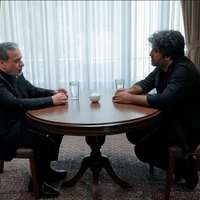
A former Iranian defense ministry official, who holds dual Iranian-British citizenship, has been sentenced to death on charges of spying for the UK.
Iranian state media reported Wednesday that Alireza Akbari has been sentenced to death for allegedly spying for MI6.
In a statement published by Iran's Intelligence Ministry, Akbari was described as "one of the most important infiltrators of the country's sensitive and strategic centers".
He was detained more than three years ago and has been in the notorious Evin prison in Tehran since then.

Akbari had been deputy defense minister under the reformist President Mohammad Khatami, from 1997 to 2005. He was also close to Ali Shamkhani, the secretary of the Supreme National Security Council of Iran.
He was an advocate for the Iran nuclear deal known as the JCPOA that was eventually signed in 2015 with world powers.
Britain's Foreign Office has urged the Islamic Republic to immediately release the dual national.
However, Akbari's wife Maryam said an official asked her to visit her husband in jail for a 'final meeting' before his execution.
Reports say he has been moved to solitary confinement, indicating that his execution is imminent.
However, no details have provided about his specific charges and court proceedings.
"Our priority is securing his immediate release and we have reiterated our request for urgent consular access," a UK Foreign Office spokesperson said.
Nournews, which is affiliated to the country's top security agency reported that Akbari's death sentence has been upheld by Iran's Supreme Court.

The first session of the court of appeal for a former Iranian official guilty of war crimes in connection with mass executions in Iran in 1988 was held Wednesday in Stockholm.
Hamid Nouri, 61, received a life sentence last July for his leading role in the massacre of large numbers of jailed opposition members.
Nouri’s life sentence by the primary court, can keep him in prison for 25 years according to Swedish law 25 years in prison in Sweden. He has appealed the court’s verdict.
According to Iran International’s correspondent from the court of appeal, during the Wednesday session, Nouri constantly complained about not being transferred to the general ward and his lack of access to ophthalmological examination.
However, the judge said this issue has nothing to do with the court and should be discussed with the prison authorities by Nouri's lawyers.
Earlier, Majid Nouri, his son, had complained about his father's glasses and had cited the interruption of serving him tea as examples of torture.
This comes while Nouri’s colleagues in Iran execute innocent young protesters for setting fire to a trash bin.
Sweden arrested Nouri upon his arrival at Stockholm Airport in 2019 and in 2021 put him on trial over the mass execution and torture of prisoners at Gohardasht Prison in July and August 1988.
Most victims were linked to the opposition group Mujahedin-e Khalq Organization (MEK) and also other leftist organizations.

The latest ranking of the Henley Passport Index shows that Islamic Republic’s passport ranked 99th in the world in terms of the access it grants the holder to other nations.
Based on the index’s data published on its website, Iran’s passport grants visa-free or visa-on-arrival access to 43 destinations in the first quarter of 2023.
It means that Iranians need a visa to access 156 countries globally.
Concerns about people fleeing Iran and possible destabilizing actions in other countries by Islamic Republic agents are prime reasons for widespread travel restrictions.
Visa-free countries include those where entry is possible without a visa, and with a visa on arrival.
The Henley Passport Index is the original, authoritative ranking of all the world’s passports according to the number of destinations their holders can access without a prior visa.
The index includes 199 different passports and 227 different travel destinations. Updated quarterly, the Henley Passport Index is considered the standard reference tool for global citizens and sovereign states when assessing where a passport ranks on the global mobility spectrum.
Before 1979 revolution which led to the ouster of Mohammad Reza Shah, Iranians could travel without visas throughout Western Europe, except Austria and Switzerland.
Meanwhile, according to the new report by Henley Passport Index, Japan ranks number one in the first quarter of 2023 with having access to 193 countries.
Singapore and South Korea shared second place in the world's most prestigious passport ranking.

An old row between Iran and regional Arab countries over the name of the Persian Gulf has come to the fore again but this time between Tehran and Baghdad and in a sport event.
Iran’s Foreign Ministry spokesman Naser Kanaani said on Monday that Tehran has expressed its objection to Baghdad over the use of the name of the Persian Gulf incorrectly, using the “fake” misnomer of “Arabian Gulf.”
He made the remarks after many Iranians criticized the government over its inaction when Iraq did not use ‘Persian Gulf’ for an Asian football (soccer) event. The Iraqi southern city of Basra is hosting the return matches of a local competition, and Iraq set up billboards to welcome the foreign teams to the “25th Arabian Gulf Cup.”
Many Iranians oppose the Islamic Republic’s policy of spending money in the region to buy support, including in Iraq where Tehran has been supporting an array of Shiite militias and pretends to have a lot of political influence in Baghdad.
The dispute started in early 1960s, when the Egyptian Arab nationalist president Gamal Abdul Nasser began calling the Persian Gulf the “Arabian Gulf.”
The football cup was kicked off on Friday, January 6, with an extravagant opening ceremony attended by local and regional officials as well as FIFA President Gianni Infantino. “It was great to have attended the opening ceremony and the opening game of the 2023 Arabian Gulf Cup in Basra between Iraq and Oman,” said the FIFA president.

Kanaani said that the country’s diplomatic service protested the action but did not announce it, noting that “a lack of notification does not mean lack of action." “The Persian Gulf is the Persian Gulf, and as soon as we learned about the issue, we announced our protest to the Iraqi government,” he said, adding that the issue was in relation to a sports event, and the Sports Ministry and the Football Federation followed up on the issue.
The Iranian football federation announced on Saturday that it will be delivering a protest statement to FIFA over the naming of the tournament, saying “Persian Gulf is a noble and historical name, which has been applied in all languages and various atlases, including ancient and historical maps.”
The issue was discussed during a session of the Iranian parliament Sunday, when MP Alireza Salimi said, “I want those who use the fake name Arab Gulf in Arab countries to study history. The Persian Gulf is, has always been, and will always be Persian.” Similar remarks were echoed by other members accusing the Arabic countries of trying to “falsify history.”

Bayati called on Iraq’s Prime Minister Mohammed Shia’ al-Sudani and influential Shiite cleric Muqtada al-Sadr to apologize for the naming of the tournament.
Sudani, who was himself present during the opening ceremony of the tournament at the Basra International Stadium, addressed the event and described it as a manifestation of the unity of the “Arab and Gulf brothers.” Iraqi local media said that Sadr and many other Iraqi figures have referred to the tournament as “the Arabian Gulf Cup” in their tweets and statements in the days leading up to the event’s launch.
The tourney has been officially called “Arabian Gulf Cup” but often referred to simply as “the Gulf Cup,” neither of which satisfy Iran that insists on the use of Persian Gulf.”’ Iran’s national football team has never been part of the tournament. Saudi Arabia, Oman, Yemen, Bahrain, Kuwait, Qatar, the United Arab Emirates, and Iraq are the participants.

Global consequences of hanging of two more protesters continue for Iran with the EU and UK summoning the Islamic Republic’s ambassadors on Monday.
Stefano Sannino, the secretary-general of the European External Action Service (EEAS), reiterated the European Union's outrage to the ambassador, Hossein Dehghani, saying that the bloc is appalled by the executions at the weekend of two Iranians arrested in the course of the regime’s crackdown on anti-government protests, ignited by the death of Mahsa Amini in custody of hijab police.
He also repeated an EU call on the regime’s authorities to annul without delay death sentences already pronounced against other protesters. Iran's judiciary said Monday that a court has sentenced three more protesters to death for “war against God”.
Earlier in the day, Britain's foreign minister James Cleverly summoned Iran’s most senior diplomat on Monday after Iranian authorities executed protestors Mohammad Mahdi Karami and Seyyed Mohammad Hosseini."Today I have summoned the Iranian Chargé d’Affaires to condemn in the strongest possible terms the abhorrent executions we witnessed over the weekend," he said in a statement.
The two men were hanged on Saturday for their alleged role in the killing of a government agent during protests that followed the death of Amini, creating uproar in the international community against the Iranian regime.The latest execution brings the number of protesters officially known to have been executed since the unrest to four.