Iran Warns Venezuela Over Improving Ties With US

Iran’s President Ebrahim Raisi has warned Venezuela’s Nicolás Maduro against normalizing relations with the United States, after signs that Caracas entertains the idea.
Iran’s President Ebrahim Raisi has warned Venezuela’s Nicolás Maduro against normalizing relations with the United States, after signs that Caracas entertains the idea.
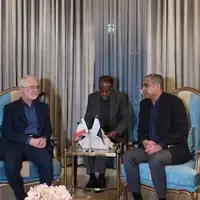
In a meeting with the new ambassador of Venezuela to Tehran on Sunday, Ebrahim Raisi claimed, the Americans want closer ties with Venezuela due to the country's need for energy resources.
Raisi’s warning came as President Nicolás Maduro said in a televised interview on Sunday that "Venezuela is ready, totally ready, to take steps towards a process of normalization of diplomatic, consular, and political relations with the current administration of the United States and with administrations to come."
The Maduro regime has been trying for years to find ways to reduce the impact of US sanctions with help from the Islamic Republic
"We are prepared for dialogue at the highest level, for relations of respect, and I wish a beam of light would come to the United States of America, they would turn the page and leave their extremist policy aside and come to more pragmatic policies with respect to Venezuela," he said.
Venezuela welcomed negotiations with the United States after the Biden administration reduced restrictions on Venezuela's oil sector, and in recent days, the first shipment of Venezuelan oil was sent to the United States.
Maduro cut off ties with Washington in 2019, when the administration of Donald Trump recognized Juan Guaido as Venezuela's interim president.


The German foreign ministry has been criticized for its continued funding of a consultation firm - which is said to be linked to the Islamic Republic - under a two-year contract worth €900,000.
German MP Norbert Röttgen, who previously served as a Chair of the Bundestag Foreign Affairs Committee, said in a tweet that the German Federal Foreign Office is still financing the Carpo thinktank, an institute led by Adnan Tabatabai who allegedly lobbies for the Islamic Republic, under the two-year contract.
Adnan Tabatabai is co-founder and CEO of the Berlin-based Center for Applied Research in Partnership with the Orient (CARPO), and is the son of Sadeq Tabatabaei, the brother-in-law of the Islamic Republic’s founder Rouhollah Khomeini who served as Iran’s deputy prime minister from 1979 to 1980. Adnan is known in international media as an Iran expert who supports the regime.
He has on several occasions talked about normalizing relations between the West and the Islamic Republic and is in favor of reviving the 2015 nuclear deal or the JCPOA. He is consulted by the German Federal Foreign Office, members of the German Bundestag, political foundations as well as journalists and authors.
The move seems contradictory to Berlin’s policies of pressuring the Islamic Republic over its human rights violations. Debate still rages in Germany over listing Iran’s Revolutionary Guards as ‘terrorists,’ with Röttgen tweeting “You have to Decide Now.”
Rottgen, a member of the Christian Democratic Union, has been at loggerheads with Foreign Minister Annalena Baerbock, a Green, since Baerbock announced October 31 that the European Union was considering sanctioning the Guards (IRGC).
The United States Treasury Friday designated six executives or board members of an Iranian company it said were involved in supplying military drones to Russia.
Qods Aviation Industries was itself sanctioned in November. The US also designated Friday the director of Iran’s Aerospace Industries Organization over its role in manufacturing Iran’s ballistic missiles.
“We will continue to use every tool at our disposal to deny [Russian President Vladimir] Putin the weapons that he is using to wage his barbaric and unprovoked war on Ukraine,” Treasury Secretary Janet Yellen in a statement. The action was taken, said the Treasury, under Executive Order 13382, from 2005, ‘Blocking Property of Weapons of Mass Destruction Proliferators and Their Supporters.’
The US argues that supply of drones from Iran violates a provision in United Nations Security Council Resolution 2231, which barred Tehran from trading certain kinds of weapons – including drones “capable of delivering at least a 50kg payload to a range of at least 300km.”But the drones the US and Ukrainian say Iran have sent carry a slightly lighter load.
While Friday’s action may do little - any US assets of those designated can be frozen - it illustrates the Ukraine crisis changing calculations in Washington over Iran policy. The administration of President Joe Biden took office in January 2021 ostensibly committed to restoring the 2015 Iran nuclear agreement, but has shifted its focus towards sanctions over Tehran’s links with Russia and its treatment of internal protests.
‘Pure damage’
In Tehran, opponents of the 2015 agreement, the JCPOA (Joint Comprehensive Plan of Action) take heart. Saeed Jalili, top security official under President Mahmoud Ahmadinejad, has argued the JCPOA brought little inward investment and was “pure damage” even before the US withdrew in 2018.
Jalili advocates a ‘resistance economy,’ based on domestic production and lowering import dependence. But while Iranian domestic employment picked up slightly after the US in 2018 left the JCPOA and imposed ‘maximum pressure’ sanctions according to government figures, some economists suggested this was more reaction to circumstance, including the falling rial, than any strategy.
Likewise, with ‘maximum pressure’ stymying the Rouhani government’s efforts of attracting western European investment, including energy majors, Iran turned elsewhere, an approach crystalized in President Ebrahim Raisi championing a ‘turn east.’
But many analysts argue that the Ukraine crisis – although regime officials forlornly hoped it would make Europe desperate for Iranian energy – has accelerated Iran-Russia rapprochement, which both sides say they would like to base on economics as well as security.
Stoking Iranian skepticism towards Russia
The Washington Institute this week published a policy paper by senior fellow Henry Rome arguing the US should “stoke longstanding Iranian skepticism towards Russia” to combat the “tightening of ties” triggered by the Ukraine crisis. Rome cited November’s statement from 35 former Iranian diplomats calling Tehran’s reaction a “grave mistake” and reiterated allegations that Russia had leaked to the media details about shipments of Iranian drones.
The US, Rome argued, should “emphasize the potential for friction and mistrust between the two partners” to “generate the most intense reaction in Tehran,” as well as extending sanctions over drone shipment, and encouraging European States to designate Iran’s Revolutionary Guards (IRGC) to “impose a greater economic cost on Tehran for supporting Russia.”
European Union foreign ministers are expected to discuss new Iran sanctions at the end of January. In letter published in the newspaper Volkskrant on Friday, leaders of ten Dutch parliamentary parties called for the IRGC to be designated along with officials and their families.
Netanyahu the mediator?
In other fall-out from Ukraine, an aide to President Volodymyr Zelenskyy told Israeli television Thursday that new Prime Minister Benjamin Netanyahu was a potential mediator with Russia. Mykhailo Podolyak said he had “no doubt” Netanyahu “understands precisely what modern wars are and what is the essence of mediation under these conditions.”
While the Ukraine war has boosted Israeli arms sales due to poorly-performing Russian weapons, Netanyahu - who touted his warm relationship with Putin in 2019 elections by slapping a giant picture of the Russian president outside the Likud Party headquarters - has said he was approached while in opposition to mediate but deferred to the government.
An Iranian lawmaker and IRGC officer in December called for the “serious implementation” of a 2011 law to reduce diplomatic relations with the United Kingdom.
At the time the outer walls of the UK embassy in Tehran were defaced by anti-British slogans. This week, hardliner elements did the same to the French embassy after the satirical Paris magazine Charlie Hebdo published a special issue with caricatures of Supreme Leader Ali Khamenei.
The issue of downgrading Tehran's ties with London had also been discussed at the Iranian parliament in 2009 and 2010. In 2010 ultraconservative lawmakers demanded severing ties with London altogether. The motion was sent to the Foreign Relations and National Security Committee of the Majles, but did not go any further.
Esmail Kowsari, an IRGC general who is a member of the parliament (Majles), demanded the implementation of the law against the UK and also called on the government to reconsider its ties with Germany and France.
In 2011, the move was motivated by a set of UK sanctions against Iran and in late 2022 Iranian hardliners began a series of acts of vandalism against the British embassy in Tehran as the United Kingdom, Germany and France took the lead in escalating international actions against Iran's human rights violation and drone deliveries to Russia, as well as passing a resolution at the United Nations to set up a fact-finding committee about Tehran's violations of human rights.
Kowsari told Etemad Online in December that the three European states have sinister ideas about the Iranian nation and their anti-Iranian moves have proven this. Kowsari also said in an interview with the IRGC-linked Fars News Agency: "We wish to expand our diplomatic relations, but we do not want this relation at any price."
Thursday morning in Tehran, vigilante groups vandalized parts of the French embassy in Tehran in revenge for French satirical publication Charlie Hebdo publishing a special issue on Wednesday with cartoons about Khamenei under the title: "Let's take back the mullahs to where they come from."
The Iranian foreign minister called the cartoons "rude and unethical" and summoned the French ambassador to the Foreign Ministry to hand him a note of protest mindless of the fact that unlike the Islamic Republic, the French government does not intervene in the affairs of independent press. Foreign Minister Hossein Amir-Abdollahian threatened to give a firm and effective response to the satirical weekly. Meanwhile, Iran shut down the French "Iranian Studies Center" in Tehran, a prestigious research center whose works are respected by Iranian and French scholars.
The 2011 legislation was followed by an arson attack on the British embassy in Tehran by vigilante groups who were characterized by the government-owned press as "students," but independent sources questioned the characterization. Iran's -then- deputy foreign ministers Hassan Ghashghavi and Ali Ahani went to the Majles to convince the lawmakers that cutting ties with London was not in the country's interest. The Majles subsequently added a clause to the legislation which said that ties with the UK could be normalized if the UK changed its policies toward Iran.
In 2017 Ahmadinejad called the legislation and the attack on the British embassy a move that provided pretexts to the United Kingdom to take action against Iran. He also accused the Iranian state television of broadcasting live the attack on the British embassy.
Hardliner members of the parliament prevented -then- UK Foreign Secretary Jack Straw from taking part in Hassan Rouhani's inauguration ceremony in 2013. But eventually, three years later the two countries’ embassies were reopened after a relatively long closure.
Britain will officially declare Iran's Revolutionary Guard (IRGC) as a terrorist group, the Telegraph reported on Monday, citing sources.
The IRGC announced on December 25 the arrest of seven people allegedly linked to Britain, for their role in recent protests, prompting what could amount to a new hostage situation. The foreign ministry in Tehran accused the UK of a “destructive role” following the news about the arrests.
The move by Britain, which will be announced within weeks, is supported by Britain's security minister, Tom Tugendhat, and Home Secretary Suella Braverman, the report said.
Tehran's allegations of foreign involvement in the protests have been accompanied by arrests of dozens of dual nationals, part of an official narrative designed to shift the blame away from the Iranian leadership.
Foreign Secretary James Cleverly in recent weeks had repeatedly claimed that that the IRGC was already sanctioned “in its entirety.”
The British foreign office tweeted December 27 a clip of Cleverly listing British sanctions against Iran including “the IRGC in its entirety.” Cleverly December 13 said in parliament: “We already sanction the IRGC in its entirety.”
Proscribing Iran's Revolutionary Guard as a terrorist group would mean that it would become a criminal offence to belong to the group, attend its meetings, and carry its logo in public.
The UK Home Office did not immediately respond to a request by Reuters for comment on the Telegraph report.
Britain's Prime Minister Rishi Sunak on Wednesday urged Iran to stop detaining dual nationals, saying the practice should not be used to obtain "diplomatic leverage".
A prominent Iranian analyst says Tehran under tremendous domestic and international pressures is willing to resume nuclear talks, but the West is not.
Hassan Beheshtipour, an Iranian international relations analyst, told Nameh News website in Tehran that there is no positive indication for the resumption of talks over reviving the 2015 nuclear deal, known as JCPOA. He was responding to a question about the possible outcome of Foreign Minister Hossein Amir-Abdollahian's recent visit to Oman in a bid to use its Arab neighbor as a mediator with the US.
The analyst argued although Iran claims that the West has been sending secret messages to Tehran, open-source information show that the West is not interested in resuming the negotiations. He added that the West is mainly waiting to see where the ongoing protests in Iran are headed.
Beheshtipour said despite criticism that the Iranian government does not tie people’s financial hardship the JCPOA and sanctions, Tehran has reached the conclusion that a deal would the most important factor in improving Iran's economy.
Meanwhile, Foreign policy analyst Kourosh Ahmadi told Entekhab News website that Iran's position about Russia's war in Ukraine has changed Europe's stance regarding Tehran. He added that Russia's use of Iranian drones in attacks on civilian targets in Ukraine has left a negative impression on public opinion in Europe and has toughened Europe's stances toward Iran.
Ahmadi added that the negative trend in relations has led Europeans to minimize the importance of trade with Iran which was previously among Europe's priorities. Ahmadi added that the ongoing nationwide protests have also affected Europe's stance on Iran.
The analyst argued that Europe has even adopted a tougher stance toward Iran than the United States, because Tehran has not grasped Ukraine's importance for Europeans and the fact that Ukraine is only 500 kilometers from Germany. He said: "That is why the spokesman for the German Foreign Ministry has said that Germany has no reason to support the continuation of talks with Iran.
Ahmadi said Europeans are extremely sensitive to the fact that Iran is Russia's partner in threatening Europe’s security. He pointed out that in 2011 the volume of transactions between Iran and Europe reached 28 billion euros. The figure dropped by 78 percent in 2020 and finally reached to just over one billion euros in the first six months of 2022.
In another development, Iranian sociologist Bijan Abdolkarimi has said in an interview with Rouydad24 website that "Iran is entangled in a political impasse and Iran's power-house is currently under pressure both from abroad and from within the country."
Abdolkarimi added that the Iranian people are the main victims of this political impasse while the regime has no solutions.
Asked if a possible improvement in the economic situation would reduce the general sense of dissatisfaction among Iranians, Abdolkarimi said: "I cannot answer this question properly because the situation is getting worse on a day-to-day basis. In fact, we are facing an economic collapse in Iran for which officials cannot offer any solution."
He added that the only solution is a return to the JCPOA, but in the current situation reaching an agreement is practically impossible.