Iranian Arrested In Germany On Suspicion Of Planning Terrorist Attack

Anti-terrorist agents in Germany have detained a 32-year-old Iranian man who is accused of planning an Islamist-motivated attack using chemicals.
Anti-terrorist agents in Germany have detained a 32-year-old Iranian man who is accused of planning an Islamist-motivated attack using chemicals.
The DPA news agency reported Sunday that the man along with another one has been arrested in Castrop-Rauxel in Germany's north-western Ruhr area.
Police say he is suspected of having obtained the toxins cyanide and ricin which are highly toxic and listed as biological weapons by Germany.
"The accused is suspected of having prepared a serious act of violence that is dangerous to the state," investigators said.
"Evidence has been secured and is being evaluated," added DPA.
It has not yet been decided whether the 32-year-old will be brought before a court, but police said, it may carry a prison sentence of between six months to 10 years.
Tabloid newspaper Bild reported that German authorities had been watching the men for days, after receiving a warning from a "friendly intelligence agency."
According to local media, the raids were carried out by agents wearing protective suits, due to the chemical hazard.
Germany has been targeted in recent years by several Islamist attacks. In 2016 a truck attack on a Christmas market killed and injured dozens.
German domestic intelligence services say the number of supporters of Islamist causes has decreased by 1.5 percent in 2021, citing the "military breakup" of the ISIS group.




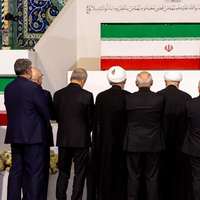

Iran’s hardliner commander of Revolutionary Guard has once again threatened the West to take revenge for the killing of former IRGC General Qassem Soleimani.
Major General Hossein Salami said Sunday during an event to commemorate Soleimani’s death that “sooner or later we will avenge his assassination.”
He claimed that no one can create problems for the Islamic Republic establishment, and addressing the West he said, “stop your miscalculations.”
Soleimani was in charge of supporting and organizing militant proxy forces, including the Lebanese Hezbollah and Iraq Shiite militia groups that were repeatedly attacking US forces in Iraq and eslewhere.
On Saturday, Iran’s Revolutionary Guard said retaliatory military attacks against US targets for the killing of Qassem Soleimani in 2020 are still viable options.
IRGC spokesman Ramazan Sharif was quoted by Iranian media as saying that “moves such as [the attack on] Ain al-Assad base [in Iraq] are still being considered and “will become operational in due time.”
Five days after Soleimani was killed by a US air strike on January 3, 2020, Iran fired ballistic missiles at the Iraqi base hosting US troops. No Americans were killed but reports at the time spoke of dozens of servicemen receiving concussion because of the strong explosions.
At the time, President Donald trump who ordered the killing said that Soleimani presented an imminent danger to US personnel and interests in the region.
Since then, the Islamic Republic has continued threatening revenge for Soleimani, and these threats were repeated during the third anniversary of his killing this week.
Iran's Revolutionary Guard spokesman Ramazan Sharif says Supreme Leader Ali Khamenei sought to support Palestinian militias against Israel through Quds Force.
He said that Ali Khamenei had asked former commander of Qods (Quds) force Ghasem Soleimani to empower the resistant front, a term the Islamic Republic uses for its proxy groups across the region.
Sharif said in remarks this week that a wave of anti-Israeli sentiments in the third and fourth generation of Palestinians, not only in the Gaza Strip but also in the West Bank, was achieved "thanks to Soleimani," without elaborating on how.
However, many documented reports and statements by Iranian officials in the past show that Tehran is the main financial and military backer of Hezbollah and has also provided substantial support to Palestinian militant groups and the Houthis in Yemen.
He added that the Supreme Leader had also assigned Soleimani to supporting the Lebanese Hezbollah, which led to the “victories” of the group.
On January 3, 2020, the US military, on the order of former President Donald Trump, killed Soleimani in a drone strike near Baghdad International Airport, saying that he had been "actively developing plans to attack American diplomats and service members in Iraq and throughout the region."
In a tweet on the occasion of the third anniversary of the targeted killing of Soleimani by the US, the Iranian Foreign Ministry renewed the regime’s pledges to avenge his death, saying the US killing of the former IRGC's Quds Force commander in 2020 failed in bringing Washington its desired outcome.
An audio file shared on social media has revealed that the regime threatens Iranians abroad for taking part in anti-government protests and expressing opposition.
In the audio file published by the VOA Farsi service on Thursday, a security agent of the Islamic Republic, who introduces himself as an agent of the intelligence ministry, threatens "Massi Kamri", an Iranian activist living in France, saying if she does not stop acting against the regime, they will imprison her parents and family members in Iran.
Apparently, she participated in rallies against the Islamic Republic’s bloody crackdown on antigovernment protests that have engulfed Iran following the death in custody of 22-year-old Mahsa Amini.
Using an insulting tone, the agent tells Kamri if she cares about her family and does not want them to be taken to the notorious Evin prison in Tehran she should not engage in anti-Islamic Republic activities.
The agent also says she must stop sharing Instagram stories and posts that encourage people in Iran to chant slogans and hold protests.
In another part of the recording, Kamri says her Instagram page is private and no one except her followers could see her posts, but the person from the intelligence ministry claims he has access to her page, saying “it’s right now open in front of me!”
Kamri insists that she has not done anything wrong according to the laws of France, where she is a permanent resident, but the agent says what she is doing is against the Islamic Republic. She told the regime’s agent that nowhere in the world do authorities hold accountable the family members of someone who commits a crime, but the agent replied this is Iran and they can do whatever they like.
This is not the first time Iranian agents threaten people living abroad for expressing their opinions. The Daily Telegraph recently reported that the Islamic Republic uses mosques and political institutions in the United Kingdom as part of its “spying system” to target dissidents.
Canada's spy agency also launched an investigation into what it calls multiple "credible" death threats from Iran aimed at individuals in Canada.
In November, Israel’s Mossad informed Britain’s spy agency about an impending Iranian plot to carry out terrorist attacks against Iran International’s journalists based in London.
According to information obtained by Iran International, threats against its journalists came from the same team that sought to target Israel’s former consul general in Istanbul, Yosef Levi Sfari, who was rescued by authorities and sent back to Israel.
Faced with nationwide antigovernment protests since mid-September, the Islamic Republic has blamed foreign-based Persian broadcasters such as BBC Persian and Iran International of “fomenting unrest”, while all media in the country are under tight government control and present protesters as “rioters” and “terrorists”. The Islamic Republic is notorious for tormenting the families of dissidents in every way it can think of, from abducting the bodies of the dead ones and burying them in undisclosed locations -- such as the case of late journalist Reza Haqiqatnejad -- to detaining and calling in family members for interrogations to warn them of talking to media about their loved ones.
Iran’s Intelligence Minister Esmail Khatib on November 9 said the Islamic Republic regards Iran International as “a terrorist organization,” adding that its workers and anyone affiliated with the channel will be pursued by the Ministry of Intelligence.
Iran has a long record of targeting dissidents and independent journalists who found refuge in other countries. In the latest example of terror operations abroad, Iranian intelligence abducted dissident journalist Ruhollah Zam who was visiting Iraq in 2019 and took him back to Iran where he was executed in 2020.
The German foreign ministry has been criticized for its continued funding of a consultation firm - which is said to be linked to the Islamic Republic - under a two-year contract worth €900,000.
German MP Norbert Röttgen, who previously served as a Chair of the Bundestag Foreign Affairs Committee, said in a tweet that the German Federal Foreign Office is still financing the Carpo thinktank, an institute led by Adnan Tabatabai who allegedly lobbies for the Islamic Republic, under the two-year contract.
Adnan Tabatabai is co-founder and CEO of the Berlin-based Center for Applied Research in Partnership with the Orient (CARPO), and is the son of Sadeq Tabatabaei, the brother-in-law of the Islamic Republic’s founder Rouhollah Khomeini who served as Iran’s deputy prime minister from 1979 to 1980. Adnan is known in international media as an Iran expert who supports the regime.
He has on several occasions talked about normalizing relations between the West and the Islamic Republic and is in favor of reviving the 2015 nuclear deal or the JCPOA. He is consulted by the German Federal Foreign Office, members of the German Bundestag, political foundations as well as journalists and authors.
The move seems contradictory to Berlin’s policies of pressuring the Islamic Republic over its human rights violations. Debate still rages in Germany over listing Iran’s Revolutionary Guards as ‘terrorists,’ with Röttgen tweeting “You have to Decide Now.”
Rottgen, a member of the Christian Democratic Union, has been at loggerheads with Foreign Minister Annalena Baerbock, a Green, since Baerbock announced October 31 that the European Union was considering sanctioning the Guards (IRGC).
The United States Treasury Friday designated six executives or board members of an Iranian company it said were involved in supplying military drones to Russia.
Qods Aviation Industries was itself sanctioned in November. The US also designated Friday the director of Iran’s Aerospace Industries Organization over its role in manufacturing Iran’s ballistic missiles.
“We will continue to use every tool at our disposal to deny [Russian President Vladimir] Putin the weapons that he is using to wage his barbaric and unprovoked war on Ukraine,” Treasury Secretary Janet Yellen in a statement. The action was taken, said the Treasury, under Executive Order 13382, from 2005, ‘Blocking Property of Weapons of Mass Destruction Proliferators and Their Supporters.’
The US argues that supply of drones from Iran violates a provision in United Nations Security Council Resolution 2231, which barred Tehran from trading certain kinds of weapons – including drones “capable of delivering at least a 50kg payload to a range of at least 300km.”But the drones the US and Ukrainian say Iran have sent carry a slightly lighter load.
While Friday’s action may do little - any US assets of those designated can be frozen - it illustrates the Ukraine crisis changing calculations in Washington over Iran policy. The administration of President Joe Biden took office in January 2021 ostensibly committed to restoring the 2015 Iran nuclear agreement, but has shifted its focus towards sanctions over Tehran’s links with Russia and its treatment of internal protests.
‘Pure damage’
In Tehran, opponents of the 2015 agreement, the JCPOA (Joint Comprehensive Plan of Action) take heart. Saeed Jalili, top security official under President Mahmoud Ahmadinejad, has argued the JCPOA brought little inward investment and was “pure damage” even before the US withdrew in 2018.
Jalili advocates a ‘resistance economy,’ based on domestic production and lowering import dependence. But while Iranian domestic employment picked up slightly after the US in 2018 left the JCPOA and imposed ‘maximum pressure’ sanctions according to government figures, some economists suggested this was more reaction to circumstance, including the falling rial, than any strategy.
Likewise, with ‘maximum pressure’ stymying the Rouhani government’s efforts of attracting western European investment, including energy majors, Iran turned elsewhere, an approach crystalized in President Ebrahim Raisi championing a ‘turn east.’
But many analysts argue that the Ukraine crisis – although regime officials forlornly hoped it would make Europe desperate for Iranian energy – has accelerated Iran-Russia rapprochement, which both sides say they would like to base on economics as well as security.
Stoking Iranian skepticism towards Russia
The Washington Institute this week published a policy paper by senior fellow Henry Rome arguing the US should “stoke longstanding Iranian skepticism towards Russia” to combat the “tightening of ties” triggered by the Ukraine crisis. Rome cited November’s statement from 35 former Iranian diplomats calling Tehran’s reaction a “grave mistake” and reiterated allegations that Russia had leaked to the media details about shipments of Iranian drones.
The US, Rome argued, should “emphasize the potential for friction and mistrust between the two partners” to “generate the most intense reaction in Tehran,” as well as extending sanctions over drone shipment, and encouraging European States to designate Iran’s Revolutionary Guards (IRGC) to “impose a greater economic cost on Tehran for supporting Russia.”
European Union foreign ministers are expected to discuss new Iran sanctions at the end of January. In letter published in the newspaper Volkskrant on Friday, leaders of ten Dutch parliamentary parties called for the IRGC to be designated along with officials and their families.
Netanyahu the mediator?
In other fall-out from Ukraine, an aide to President Volodymyr Zelenskyy told Israeli television Thursday that new Prime Minister Benjamin Netanyahu was a potential mediator with Russia. Mykhailo Podolyak said he had “no doubt” Netanyahu “understands precisely what modern wars are and what is the essence of mediation under these conditions.”
While the Ukraine war has boosted Israeli arms sales due to poorly-performing Russian weapons, Netanyahu - who touted his warm relationship with Putin in 2019 elections by slapping a giant picture of the Russian president outside the Likud Party headquarters - has said he was approached while in opposition to mediate but deferred to the government.