Canada Issues New Sanctions On Iran, For Rights Violations
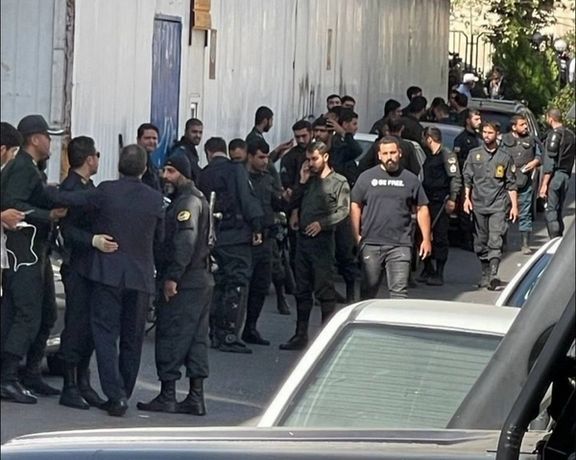
Iranian security forces waiting in Tehran to attack a university on October 3, 2022
Canada imposed fresh sanctions on Iran, Russia and Myanmar Friday, citing human rights violations by their governments.
Sanctions were imposed on 22 individuals in Iran, who included senior members of the judiciary, prison system and law enforcement, as well as political leaders, such as senior aides to Iran's Supreme Leader Ayatollah Ali Khamenei and figures in state-directed media outlets, the statement added.
Sanctions on Iran came a day after the Islamic Republic hanged a man convicted in a sham trial of injuring a security guard with a knife and blocking a street in Tehran, the first such execution over recent anti-government unrest. Nationwide protests erupted after the death of 22-year-old Kurdish Iranian woman Mahsa Amini in police custody on September 16.
Western countries have issued repeated statements condemning the government in Tehran for gross disregard of the rights of protesters and have imposed some sanctions on individuals and entities. But they have not imposed more serious economic sanctions or designation of it top leaders for killing of civilians.
The measures also included sanctions against 33 current or former senior Russian officials and six entities involved in alleged "systematic human rights violations" against Russian citizens who protested against Russia's invasion of Ukraine, the Canadian foreign ministry said in a statement.
Since Russia's invasion on Feb. 24, Canada has imposed sanctions on more than 1,500 individuals and entities from Russia, Ukraine and Belarus.
"There is more work to be done, but Canada will never stop standing up for human rights," Canadian Foreign Minister Melanie Joly said.
Germany summoned Iran’s ambassador Thursday after the Islamic Republic executed the first Iranian arrested during the current wave of antigovernment protests.
A diplomatic source broke the news but did not provide any details about what transpired. Earlier on Thursday, the Islamic Republic hanged Mohsen Shekari, a young protester sentenced to death in a sham trial for injuring a regime supporter and closing off a street in the capital Tehran. The revolutionary court had accused him of Moharebeh, an Islamic-Arabic term meaning ‘fighting against God” which carries the death sentence.
The execution, widely seen as a measure to intimidate the protesters, has drawn international condemnation with EU countries vowing further coordinated action against the clerical regime.
German Foreign Minister Annalena Baerbock described the Iranian regime's contempt for humanity as “boundless," saying that Shekari was “tried and executed in a perfidious summary trial because he disagreed with the regime. But the threat of execution will not stifle people's desire for freedom.”
Moreover, Vice-President of the German Parliament Katrin Göring-Eckardt tweeted that the execution “reacts with all (un)imaginable brutality to protests."
So far, around 500 civilians have been killed by security forces and at least 18,000 arrested. While many have been released, around 1,500 face criminal charges, and at least 80 detainees face the death sentence.
Mohsen Shakeri, hanged by the Islamic Republic on December 8, 2022
After the Islamic Republic started executing protesters on Thursday, global condemnations and calls for action began to pour in from all over the globe.
France's foreign ministry spokesperson said that the European Union is set to approve new sanctions targeting Tehran over human rights abuses in its crackdown on protesters in the country as well as supplying Russia with weapons to be used in the invasion of Ukraine.
Condemning the execution in the “strongest terms,” Anne-Claire Legendre told reporters that “This execution comes on top of other serious and unacceptable violations.”
She added that foreign ministers would discuss new designations on individuals and entities involved in the crackdown and entities exporting drones to Russia. The EU has already imposed two rounds of sanctions since October in the form of asset freezes and travel bans.
Earlier on Thursday, the Islamic Republic hanged Mohsen Shekari, a young protester convicted of injuring a security guard with a knife and closing off a street in the capital Tehran. Nationwide protests that erupted after the death of 22-year-old Kurdish Iranian woman Mahsa Amini on September 16 represent one of the biggest challenges to the Islamic Republic since its establishment in 1979. So far, around 500 civilians have been killed by security forces and at least 18,000 arrested. While many have been released, around 1,500 face criminal charges, and at least 80 detainees face the death sentence.
State Department Spokesperson Ned Price described the execution as "a grim escalation in the regime’s attempt to suppress dissent and quash these protests.” Expressing condolences to his loved ones, he denounced the “draconian sentences and the denial of due process to the accused in the strongest terms.”
Condemning the execution, German Foreign Minister Annalena Baerbock described the Iranian regime's contempt for humanity as “boundless," saying that Shekari was “tried and executed in a perfidious summary trial because he disagreed with the regime. But the threat of execution will not stifle people's desire for freedom.”
European Union flags flutter outside the European Commission headquarters in Brussels, Belgium
Vice-President of the German Parliament Katrin Göring-Eckardt tweeted, "Mohsen Shekari was only 23. The Iranian regime executed him for taking to the streets for a free Iran. It reacts with all (un)imaginable brutality to protests. The death penalty is contrary to human rights, everywhere."
UK Foreign Secretary James Cleverly also expressed outrage, and called on the world not to “turn a blind eye to the abhorrent violence committed by the Iranian regime against its own people.”
Norway’s Foreign Minister Anniken Huitfeldt also denounced the execution, and called on the regime to immediately halt executions, and to end the repression of fundamental freedoms.
Vice-President of the European Parliament Pina Picierno said, “It is the first insane death sentence carried out on a protester in Iran,” and reiterated that the EU will always be “on the side of freedom, on the side of the protesters.”
Former Swedish Foreign Minister Margot Wallström urged the international community to be the voice of Iranians, saying that Sweden and the EU must take action quickly to save others. “The International community needs to speak out loud and clear against this.”
Human rights groups are also condemning the execution. Amnesty International urged the world to make Iranian authorities halt all planned executions and stop using the death penalty as tool of political repression against protesters in their attempt to end the popular uprising. It added that Shekari's execution "[exposed] the inhumanity of Iran's so-called justice system as dozens of others face the same fate".
"The international community must immediately and strongly react to this execution," Mahmood Amiri-Moghaddam, director of the Norway-based group Iran Human Rights, said in a statement, adding, “If Mohsen Shekari's execution is not met with serious consequences for the government, we will face mass execution of protesters.”
Two diplomatic sources told Reuters that the new EU sanctions were expected to be approved and adopted on Monday. According to one of the sources, 21 individuals and one entity would be sanctioned over human rights abuses, while there had been 10 proposals on the drone side.
Mohsen Shakeri, hanged by the Islamic Republic on December 8, 2022
The hanging of a protester after a hasty and unfair trial has sparked deep anger among Iranians who believe his killing was meant to instill fear among the people.
The judiciary announced the execution of Mohsen Shekari, a twenty-three-year-old waiter, on Thursday. By the evening some had taken to the streets, particularly on Sattar Khan Avenue in the west of the capital Tehran where he was arrested, to protest his execution. A video posted on Twitter shows people marching towards the Shekari home in silence.
Many others have taken to social media to express their deep anger of the regime’s sham trial and execution of a young man to instill fear among protesters.
“For every person who is killed there will be thousand rising up,” protesters often chant on the streets. This time they are vowing revenge for Shekari and all those innocently executed or killed on the streets. “Wait for our revenge for Mohsen Shekari!” one of the thousands of tweets posted Thursday with the hashtag Mohsen Shekari said.
Some Iranians called the execution a simple murder by the state.
Reformist pundit Abbas Abdi in Tehran in a tweet argued that legal punishment would only establish justice and placate people if the accused’s trial is held publicly and with due process including the right to appoint an attorney he wishes to represent him. He then added that Shekari’s execution will only exacerbate hatred and animosity among people rather than deterring them from protesting.
Shekari was arrested for allegedly injuring a member of Basij militia of the Revolutionary Guards in the shoulder with a blade during a protest on September 25 after the death in custody of Mahsa Amini in ‘morality police custody. He was also accused of blocking a street to impede the passage security forces’ vehicles.
As in many similar cases, Shekari was tortured into making a self-incriminating “confession” which was aired on the state television during his trial to justify the harsh sentence to be meted out.
Like many others tried on security-related and political charges, Shekari was denied the right to have a lawyer of his choice in his trial on November 1. According to the Judiciary’s statement Thursday, his death sentence was upheld by the Supreme Court soon after.
Before he was hanged nobody knew of his case as authorities intimidated the family into silence, telling them that publicizing the case “would not serve his interests”.
“Prisoners are the Islamic Republic’s hostages … Families abide by whatever the hostage-taker wishes to save the lives of their loved ones. But experience teaches us that silence only worsens the prisoner’s condition because the Islamic Republic is not just targeting a person. They take hostages and issue death and prison sentences to crack down on the whole society,” said rights activist Atena Daemi in a series of tweets Thursday and urged families not to keep a lid on their detained loved ones’ circumstances before it gets too late to do anything.
The Revolutionary Court has sentenced several other protesters to death, including 27-year-old rapper Saman Sayyadi whose family have officially been informed of his imminent execution. Like Shekari, they have been charged with ‘moharebeh’, meaning waging war against God” or “taking up arms against God and the Islamic state”.
Two United States spokesmen said Wednesday that Washington had no evidence Iran had transferred missiles to Russia for use in Ukraine.
Comments from White House security spokesman John Kirby and State Department spokesman Ned Price came after Associated Press reported Moscow was “looking to Iran once again to resupply the Russian military with drones and surface-to-surface missiles.”
AP cited “two officials familiar with the matter.” The news agency also quoted a “UN diplomat” who claimed Iran had “plans to sell Russia hundreds of missiles and drones in violations of the 2015 [UN] Security Council resolution that endorsed the nuclear deal between Tehran and six world powers.”
Price spoke Wednesday of the US “voicing concerns” that “Russia could look to Iran for ballistic missile technology” but said Washington had no “information to share at this point regarding current deliveries of ballistic missiles.”
Kirby said that with Russia’s “defense industrial base…being taxed…We know they're having trouble keeping up with that pace…[and] having trouble replenishing specifically precision guided munitions.”
However, Price reiterated US concerns over the close military cooperation between Moscow and Tehran. “We’ve voiced our concerns that Russia could look to Iran for ballistic missile technology. We’ve voiced our concerns that cooperation between Iran and Russia could extend to other realms – sharing knowhow, expertise, I hesitate to say best practices but perhaps worst practices when it comes to the suppression of peaceful protesters.”
Iran support cannot ‘tip the balance’
Price said it was not the US assessment that Iranian military support could “tip the balance” in the Ukraine war, and referred back to the first US claims, made July, that Iran was planningto send “dozens” of drones, or UAVs (unmanned aerial vehicles). Tehran said early November these had been supplied before the current phase of the Ukraine conflict, which began February.
“I’m not in a position to go beyond that,” Price said, “but Iran has indeed provided at least dozens and perhaps much more of these Iranian drones to Russia for use inside of Ukraine. The Ukrainians, using their own capabilities but also using the air defense capabilities that the United States and many of our partners have provided, have in fact been able to…neutralize many of these UAVs.”
Price suggested that Iran should use revenue, which has been depleted by four years of ‘maximum pressure,’ to prioritize “the needs of its own people” rather than make “important contributions to Russia’s war effort.” Iranian drones had helped Moscow’s attempt to “weaponize winter,” Price said, “to turn off the lights, to turn off the water, to attempt to freeze Ukraine and Ukrainians into submission.”
Meanwhile reports this week said the United Nations is also investigating Iran’s delivery of drones and possibly other weapons to Russia to see if they constitute any violations. Reuters quoted Guterres as saying that “any findings will be reported to the Security Council, as appropriate, in due course.”
Mohsen Shekari a protester who was executed on December 8, 2022
The Vice-President of the European Parliament has strongly condemned the execution of a protester by the Iranian government calling it “insane”.
Hours after a young Iranian, Mohsen Shekari, was hanged without a real trial, Pina Picierno reacted to his death in a tweet saying, “It is the first insane death sentence carried out on a protester in Iran.”
The Italian politician threw her weight behind the Iranian demonstrators stating that “you will find us on the side of freedom, on the side of the protesters. Always.”
Meanwhile, the Former Minister for Foreign Affairs of Sweden urged the international community to be the voice of Iranians.
Margot Wallström said in a tweet that “Mohsen Shekari was executed today in Iran by the Islamist regime. He was 23 years old.”
She went on to say that Sweden and the EU must take action quickly to save others. “The International community needs to speak out loud and clear against this,” reads her tweet.
Social media users are also raising concerns about the fate of other Iranian detainees saying thousands of other arrested protesters may have the same fate.
Mohsen Shekari, who was convicted of injuring a security guard with a knife and closing off a street in the capital Tehran, was hanged as the first detained protester to receive the death penalty on Thursday.