FBI Warned Of Threats By Iranian Cyber Group, Offers $10mn Reward

The FBI has warned that the Iranian cyber group Emennet Pasargad is conducting hack-and-leak operations involving a combination of hacking and theft of data.

The FBI has warned that the Iranian cyber group Emennet Pasargad is conducting hack-and-leak operations involving a combination of hacking and theft of data.
In a statement released on Thursday, the US agency said that since at least 2020 the with cyber-enabled information operations that included an initial intrusion, theft and subsequent leak of data followed by amplification through social media and online forums, and in some cases the deployment of destructive encryption malware.
The FBI added that the Iranian group used false-flag campaigns under the guise of multiple personas like hacktivist or cyber-criminal groups. The company, previously known as Eeleyanet Gostar and Net Peygard Samavat, has regularly rebranded to evade US sanctions
The FBI added that the group’s techniques may be used to target US entities, as was the case during their cyber-enabled information operation to attack the 2020 US Presidential election. Saying that the FBI has identified a destructive cyberattack against a US organization, it underlined that the group remains a threat to the US.
On Wednesday, October 19, the US State Department announced a $10-million reward for information about the group’s operations or its members.
Back in February, the US offered up to $10 million for information leading to the arrest of two of the group's members for trying to influence and interfere with the 2020 presidential election.
In November 2021, the Treasury Department sanctioned six Iranian officials as well as the company for their involvement in the planned cyberattack.
The US military made an unusual disclosure Wednesday, revealing the location of its submerged nuclear-powered ballistic missile submarines in the Arabian Sea near Iran’s waters.
In a move likely to make waves across the region, the US Central Command (CENTCOM) released photos showing its commander General Michael “Erik” Kurilla onboard the west Virginia. It has been described as a rare decision, as the US military seldom, if ever, acknowledges where its ballistic missile subs are operating, particularly when they are stationed near an adversary's shores.
Praising the submarine and its crew, Kurilla called the vessel “the crown jewel of the nuclear triad,” and said that “The West Virginia demonstrates the flexibility, survivability, readiness, and capability of USCENTCOM and USSTRATCOM forces at sea.”

Kurilla's visit may be seen as sending a message to US adversaries in the region, including the Islamic Republic, of Washington's capabilities, including submarines that can carry up to 20 ballistic missiles with multiple warheads.
In June, US officials said attacks by Iranian proxies against bases housing American military personnel in Iraq and Syria were increasing. In August, the US military carried out retaliatory air strikes in Syria against facilities used by groups affiliated with Iran's Revolutionary Guards Corps (IRGC).
Late August, the US Navy prevented an IRGC navy support ship from capturing an unmanned vessel operated by the US 5th Fleet in the Persian Gulf.

Iran’s Revolutionary Guard in a provocative move has launched a pontoon bridge on the northwesternmost river of Aras near the border with Azerbaijan Republic.
A video published by the IRGC-affiliated website Tasnim shows on Wednesday the ground forces set up pontoon bridges on the river for the armored vehicles and tanks to pass.
It has also been said in the video that installing these bridges have a message and the target audience will receive and understand.
The IRGC special forces also conducted heliborne operations with Mil Mi-17 helicopters on the third day of their wargames in the Aras region.
On the sidelines of the maneuvers Commander of the IRGC Hossein Salami threatened the neighbors that “Iran’s fraternity policy continues as long as there is no plot hatched by the enemies.”
“We have interests in this region, so if something happens in any corner of it, our interests will be jeopardized, then we won’t remain neutral and will defend our interests,” said Salami.
In the meantime, the IRGC has also published a tweet in Arabic saying, “When we split the waters and rescue you!”
Some social media activists have interpreted this tweet as a threat aimed at Azerbaijan Republic saying that since its establishment in 1979 the Islamic Republic has always tried to create crises outside its borders to make up for its inability to deal with domestic problems.
“That’s why the Islamic regime launched a war with Iraq to crack down on its opposition inside Iran back in the 1980’s,” says a video tweeted by a user.
In mid-September, Iran warned that it would not tolerate any seizure of territory from Armenia by Azerbaijan after military clashes broke out between its two northern neighbors.
Azerbaijani troops entered Armenia’s southern region in a move that seemed aimed at seizing territory and cutting off Armenia from Iran. Tehran has warned that it will not tolerate losing its land connection with Yerevan.
Armenia accuses Azerbaijan of attacking its towns to avoid negotiating over the status of the mainly Armenian-populated enclave of Nagorno-Karabakh inside Azerbaijan.
Tehran in the past has also expressed alarm at alleged Israeli military presence in Azerbaijan.
The provocative launch of pontoon bridge and Iran’s message to its neighbors come at a time that the clerical regime has received the strong message from protesters who now shout, “Death to Khamenei” and “Death to Dictator” every day and night to topple the regime.

European Union governments have provisionally agreed to impose sanctions on eight people and entities over Iran’s supply of drones to Russian to be used against Ukraine.
Three diplomats said that sanctions experts from the 27 EU members agreed to the list in a meeting on Wednesday. It will be further discussed by national ambassadors at a meeting scheduled for later in the day.
EU governments have until Thursday morning to decide whether to approve the sanctions, the goal being to agree the package before leaders convene in Brussels for a summit starting later in the day.
Ukraine has reported a spate of Russian attacks using Iranian-made Shahed-136 drones in recent weeks, while Tehran and Kremlin deny the supply of drones to Russia.
A European Commission spokesperson said there was consensus on foreign ministers meeting in Luxembourg October 17, that the EU should react swiftly. "Now that we have gathered our own sufficient evidence, work is ongoing in the Council with view to a clear, swift and firm response," the spokesperson told the EU's executive's daily news conference.
In addition to supplying drones, Iran has promised to send its own Fateh-110 and Zolfaghar surface-to-surface missiles to Russia for strikes on Ukrainian cities and troops. A deal was agreed on October 6 when Iran's First Vice President Mohammad Mokhber, two senior officials from Iran's Revolutionary Guards and an official from the Supreme National Security Council visited Moscow for talks with Russia about weapons deliveries.
Iranian Foreign Minister Hossein Amir-Abdollahian announced on Wednesday that four institutions and 15 foreign officials that had a hand in the sanctions against the Islamic Republic would be added to the country’s blocklist.

A British member of parliament says international football (soccer) governing body FIFA should stop Iran from participating in the World Cup for its supply of weaponry for the Russian invasion of Ukraine.
Labor MP Chris Bryant, the chair of the All-Party Parliamentary Group on Russia and former Foreign Office minister, told Telegraph Sport on Monday that any country founded to have “provided military support” for Russian President Vladimir Putin’s invasion should be banished from world sport.
He called on FIFA to make a move before Iran’s national football team’s opening match against England.
Referring to FIFA and UEFA’s decisions to throw Russia out of the international football events in the wake of Putin’s invasion of Ukraine, including from March’s World Cup play-offs and the entire 2024 European Championship, he said, “Sporting authorities around the world and in every sport should be looking very carefully at Iran’s direct engagement and support for Putin in his illegal invasion of Ukraine.”
“Dictatorial regimes relish sporting success. We should deny them that opportunity,” he noted.
Since March, many Iranians themselves have been urging FIFA to ban Team Melli from the World Cup for forcibly barring women from entering stadiums to watch matches. Under FIFA pressure, Iranian authorities started to let in a cherrypicked group for women so they would not face bans and penalties. However, since the start of the current uprising across Iran and a lackluster support from the national squad, the calls on FIFA to ban Iran have become stronger.

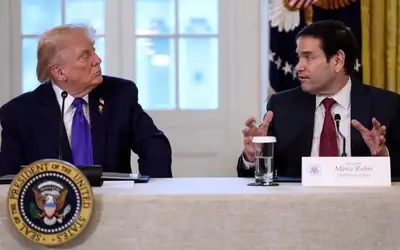
US officials have reiterated their support for the ongoing protests in Iran with Special Envoy Robert Malley saying that the talks to revive the nuclear deal are no longer on the agenda.
“This is grass roots, this is bottom up,” Antony Blinken, the Secretary of State said in remarks tweeted by the State Department Tuesday, referring to protests that began mid-September. “This is a reflection of huge frustration and anger towards the direction of their country and their leadership. This is not made in the USA, it’s not made anywhere else…”
Malley told CNN on Monday that "Right now the talks on revival of JCPOA are not on the US agenda; the focus is on what's happening in Iran as the talks are stalled," adding that “Iran has taken a position in those talks for the past two months, which is simply inconsistent with a return to the deal.”
However, he insisted that “diplomacy is the way” to prevent Iran from acquiring a nuclear weapon, noting that “We will see whether this is a government that is interested in reaching a deal.”
Malley said Iran’s leaders should “stop pointing the finger at external actors who have nothing to do with what’s happening in their country and listen to their people…” President Ebrahim Raisi Sunday said the US was “inciting chaos,” while Iranian politicians have generally denounced foreign-based media and social-media operations.
Malley went on to say that in a struggle of “peaceful protestors” against “a government using brutal repression” there was “no doubt” where the US stood. Malley denied that the US sought “regime change [in Iran] instigated in the US.” He said Washington supported human rights in Iran “just as we support human rights of citizens across the globe.”
Malley also defended the approach of President Joe Biden in seeking to revive the 2015 Iran nuclear agreement, the JCPOA (Joint Comprehensive Plan of Action), arguing the talks were “stalled” because Tehran was “making demands that have nothing to do with the JCPOA.”