Jailed Dissident Journalist’s Life Is In Danger – Family
Civil activist Hossein Ronaghi
The family of Hossein Ronaghi, a civil activist who was arrested and imprisoned during the clampdown on the ongoing protests in Iran, say his life is in danger.
His brother Hassan Ronaghi wrote in a tweet on Friday that "the Islamic Republic intends to kill my brother Hossein."
“They kept him in prison without treatment and medicine, with a broken leg and a sick body, while he is vomiting blood,” he said, emphasizing that his life is in danger.
He was arrested several times in the past decade and has staged hunger strikes in prison. Ronaghi was first arrested, along with his brother Hassan, in the aftermath of the disputed presidential elections in 2009 for helping journalists and political activists to circumvent internet censorship. He was also charged with insulting Supreme Leader Ali Khamenei in his blog posts.
In an interview with Germany's Bild published on January 28, Ronaghi spoke about losing his kidney while in Evin Prison. "I'm still suffering from the effects of the torture, but the good thing is that I'm still alive and can continue," he said.
While many top officials in Iran are adamant that the current uprising – sparked after the death of 22-year-old Mahsa Amini in hijab police custody -- must be crushed violently, some regime insiders are beginning to explore peaceful alternatives, as protesters take to the streets daily.
Iranian activist Masih Alinejad has written to US President Joe Biden urging him to isolate the Iranian regime, while empowering the Iranian people to fulfill their democratic aspirations.
“Decades of repression under reformist, pragmatic, and conservative presidents have made life there unbearable,” she said, adding that “The problems of the regime stem from its revolutionary ideology, ossified leadership, antisemitism, and a structural anti-woman mindset.”
Describing the Islamic Republic as “a radical cause, not an ordinary country," she said, “Iran’s Supreme Leader has consistently prioritized the welfare of his terror proxies over his own people.”
She also called on the US government and its allies in the E3 (the United Kingdom, France, and Germany) to halt nuclear negotiations with the Islamic Republic while it is suppressing protests and throttling the internet.
Alinejad also urged the US to introduce human rights as a condition of continuing nuclear negotiations, emphasizing that Washington should refuse to greenlight release of Tehran’s frozen funds in foreign banks, “conditioning doing so on tangible improvement of the human rights situation.”
She called for the establishment of an independent UN investigative mechanism to hold Iranian leaders and security forces accountable, noting that the Islamic Republic “is incapable of mounting independent investigations on its own" as it has been the case for the downing of the Ukrainian International Airlines Flight 752 in 2020.
Protesters in a main Tehran street on September 24, 2022
While many top officials in Iran are adamant that the protests must be crushed violently, some regime insiders are beginning to explore peaceful alternatives.
This comes while the protesters who take to the streets daily, risking their lives, freedom and property insist that the uprising should continue until the Islamic Republic is toppled.
On Thursday, October 13, the editor of the Islamic Republic newspaper, Masih Mohajeri, wrote in an editorial that "protesters may end the uprising and get closer to state officials if they see that their economic problems are solved and their citizenship rights are respected by those officials."
Without explaining how that would be possible, the editorial stressed that the protesters' demands must be met. Also, without mentioning the government's inefficiency, the editorial pointed out, "There are many individuals in the country who are ready to serve the people, but radical elements have kept them away from the government for various reasons. So, they are isolated, and their capabilities are not used in the management of the country."
Meanwhile, senior cleric, Ayatollah Abdollah Javadi Amoli called on the government"to solve the country's economic problems as everybody issuffering from the painful poverty that is imposed on the people." He further stressed: "There is no whip more painful than poverty." He warned that economic problems will not be solved as long as there are embezzlements and astronomical salaries.”
However, neither Mohajeri, nor Javadi Amoli mentioned that the current government and to a great extent its predecessor were unable to tackle the economic problems which are largely the outcome of counter-productive decisions made by Supreme Leader Ali Khamenei, his hard-line followers and inner circle.
Cleric Masih Mohajeri editor of Islamic Republic daily
They did not say how can Iran's economic problems be solved without an effective foreign policy that can end the country's international isolation and lift international sanctions that have paralyzed the country's economy. They also ignored the fact that without abiding by international financial regulations banning sponsorship of terrorism and money laundering, the country's economy will not be linked to global markets.
Insiders who give some constructive advice, however, often do not cross the regime’s red line of calling out Khamenei for imposing an anti-US and anti-West foreign policy on the country. They do not say that without coming to terms with the United States, limiting its nuclear program and stripping it of military dimensions, promising not to intervene in the affairs of regional states and stopping ballistic missile development, Iran will have no future.
Individuals such as Javadi Amoli and Mohajeri, regardless of their goodwill, keep forgetting that there is no visible sign in Khamenei's remarks and other officials' statement to respect citizens’ rights. Instead, there are plenty of defiant and arrogant remarks in the daily news from Iran that show neither Khamenei nor any other official has the slightest inclination to respect civil right. Many analysts have noted that their behavior is similar to those who have occupied a country and are exerting pressure on its residents.
Regardless of the severity of Iranians' financial hardship in recent months, not even a single slogan has been chanted in four weeks of uprising calling for improvement in people's livelihood. Instead, nearly all of the slogans chanted point out that what Iranians want is an end to clerical rule and Khamenei's dictatorship.
Iran’s ruler Ali Khamenei delivering a speech on October 14, 2022
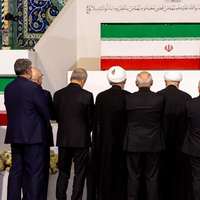
Iran’s Supreme Leader Ali Khamenei delivered a speech to an Islamic gathering in Tehran on Friday speaking about regional issues without mentioning the current protests.
Marking the birthday of Prophet Mohammed, Khamenei spoke at an Islamic conference that Tehran organizes annually by inviting clerical and religious figures from its orbit of influence in different countries.
Khamenei who has twice recently mentioned the nationwide protests rocking Iran saying that they were “minor events”, focused on the issue of Islamic unity from the perspective of the Islamic Republic.
The 83-year-old cleric who has ruled Iran for 33 years, said the establishment of relations with Israel by some Arab countries was “the biggest treason” and it is not possible to create unity with them.
Khamenei who is presented by his clerical regime as “the leader of Muslims” has some influence among Shiites who are a small minority among Muslims, but not among Sunnis, many of whom regard the Shia sect as a deviation from the true religion.
Khamenei also praised Iran’s efforts in helping Palestinian groups confronting Israel and said that the Islamic Republic stood up against world powers and can be an example to other Muslims.
He reiterated his support for the “Resistance Front”, a term coined by Tehran to refer to militant groups in Iraq, Syria, Yemen, Lebanon and elsewhere that enjoy its financial and military assistance.
A human rights group says security forces have killed at least 224 people in Iran’s antigovernment protests ignited by death of a 22-year-old woman in custody of hijab police last month.
The US-based Human Rights Activists News Agency (HRANA) said Friday that at least 29 minors were among the casualties.
The group added that at least 24 government agents, including from the Revolutionary Guards, paramilitary Basij forces and police, have also been killed during the unrest.
According to HRANA, about 6,000 people are estimated to have been detained, among whom over 670 people have been identified. About 170 of the detainees are students, it added.
Also, HRANA reported that over 420 city and university protest gatherings have been held in 112 cities and 70 universities during the last four weeks, while the protest rallies show no sign of abating in the boldest challenge to Iran's clerical regime since the Islamic revolution of 1979.
Young activists in Iran have formed a protest organizing group that seems to represent a new opposition force, successfully issuing calls for demonstrations nationwide.
The group calling itself Tehran Youth (Javanan-e Tehran) mobilized thousands of protesters in several towns and cities on Saturday and Wednesday through social media at a time of serious internet disruptions.
In their latest statement, Tehran Youth have called on people in Tehran and other cities to gather after midday Saturday “in all places where mercenaries and repression forces are not present” to chant “Down with the Dictator”.
Protesters set fire to a motorcycle of security forces in Tehran on September 19, 2022
Young activists in Iran have formed a protest organizing group that seems to represent a new opposition force successfully issuing calls for demonstrations nationwide.
The group calling itself Tehran Youth (Javanan-e Tehran) mobilized thousands of protesters in several towns and cities on Saturday and Wednesday through social media at a time of serious internet disruptions.
In their latest statement, Tehran Youth have called on people in Tehran and other cities to gather after midday Saturday “in all places where mercenaries and repression forces are not present” to chant “Down with the Dictator”.
Sources in Tehran say security forces are now continually present in all busy streets and squares to prevent people from convening to protest and do not let any pedestrian stop even for a short time. Footage of recent protests generally shows smaller, mobile groups that join together, chant, and separate again in a flash-mob style whenever they find a chance.
The mobility of protesters and their distribution in various neighborhoods, however, has now turned into a big problem for the security forces who are seen in some videos aimlessly running around to confront protesters and exhausting themselves even more after long hours of deployment.
Tehran Youth have stressed “neighborhood-centered presence” of protesters in their statement to minimize harm and casualty among protesters. “The best [Internet] anti-blockage tool now is [presence] on the streets,” they said referring to the internet curfew that sometimes turns into total blackout.
Young protesters, all in black to make identification by police difficult, on a Tehran street in October
Observers in Tehran say the movement to overthrow the Islamic Republic, as protesters’ slogans indicate, has yet not grown to its full potential and that currently it is the younger generation that is carrying both the burden of the protests and the brunt of the violence.
Security forces have violently cracked down on students in various universities and arrested hundreds. They have targeted the students both inside the universities and outside. Footage posted on social media Wednesday showed a female student outside Tehran University whose eye was seriously injured with a steel pellet directly aimed at her.
“They have managed to scare the students into silence in some universities in the past few days, but the anger is there like burning coals under ashes. It can resurface any minute,” a student from Tehran’s Amir-Kabir University told Iran International.
Authorities claim that the protesters are only a minority in the Iranian society and that most Iranians are supportive of the establishment. “It is true that the numbers on the streets is not really huge but dissent is overwhelming in magnitude. The momentum is growing by the day like an avalanche,” a source in Tehran who asked not to be named said.
The Supreme National Security Council (SNSC) has dictated such strict censorship guidelines to the media that one would think nothing at all has been happening in the country if they looked at frontpages of newspapers.
Authorities are hoping that by internet and media censorship they can limit people’s sources of information to state and and IRGC-linked media which accuse protesters of rioting and destruction of public property without any mention of the violence against them.
“The media crisis in the Islamic Republic has turned into a national security crisis the continuation of which will be costly to the system and the country,” Elias Hazrati, managing director of the reformist Etemad newspaper warned the SNSC Secretary, Ali Shamkhani, in an open letter Wednesday. “Let domestic media report freely,” he wrote.