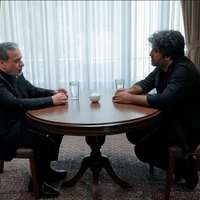
IAEA director Rafael Grossi and Iran nuclear chief Mohammad Eslami in Tehran on March 5, 2022
The US has rejected linking a revival of the Iran nuclear deal with the closure of probes by the UN nuclear watchdog a day after Iran reopened the issue, a Western diplomat said.
Iran on Thursday sent its latest response to a European Union proposed text to revive the agreement known as the JCPOA.
Former US President Donald Trump abandoned the deal in 2018 and re-imposed US sanctions, prompting Iran to start breaching the deal's nuclear curbs and reviving US, Arab and Israeli fears it may be seeking an atomic bomb.
"There should not be any conditionality between re-implementation of the JCPOA and investigations related to Iran's legal obligations under the Non-proliferation Treaty," White House press secretary Karine Jean-Pierre said.
Jean-Pierre was alluding to investigations by the Vienna-based International Atomic Energy Agency (IAEA) into uranium traces found at three undeclared Iranian sites.
Resolution of the so-called safeguards investigations is critical to the UN agency, which seeks to ensure parties to the Nuclear Non-Proliferation Treaty are not secretly diverting nuclear material which they could use to make a weapon.
A senior US official on Aug. 23 said Iran had "basically dropped" some of the main obstacles to reviving the 2015 deal, including on the IAEA, but the issue seems to have been deferred.
A Western diplomat who spoke on condition of anonymity said on Friday Iran had reopened the issue in its latest response, which Washington characterized as “Not constructive”.
Iran's foreign minister this week said the IAEA should drop its "politically motivated probes" of Tehran's nuclear work.
US Envoy Rob Malley and Russian Ambassador Mikhail Ulaynov meeting in Vienna on Iran's nuclear issue, December 15, 2021
Three weeks after the European Union August 8 circulated a ‘final text’ for reviving the 2015 Iran nuclear deal, analysts are left interpreting hints and leaks.
A European diplomat told Iran International Friday there was nothing to add to Josep Borrell’s hope expressed Wednesday of reviving Iran nuclear deal in “coming days.” Borrell, the EU foreign policy chief, had said after a meeting of EU foreign ministers in Prague that near-17 months of talks had led to “common ground” and the basis for “an agreement that takes into account…everyone’s concerns.”
Since then, however, US State Department spokesperson Vedant Patel said late Thursday that Iran’s latest input, made Thursday, was “not constructive.” Politico cited a “senior Biden administration official” saying: “Based on their answer, we appear to be moving backwards.”
The latest stage in the 17-month effort to revive the 2015 Iran nuclear deal, the JCPOA (Joint Comprehensive Plan of Action), has essentially become a US-Iran, EU-mediate, indirect dialogue based on the EU text circulated August 8. Iran responded August 15, and then the US August 24. Iran’s latest input, sent as usual through EU mediators, was Friday described as “constructive” and “aimed at finalizing the negotiations” by Foreign Ministry spokesman Nasser Kanaani.
The Iranian website KhabarOnline has a piece based on a recent Clubhouse discussion in which Hasan Behestipour, political analyst at the Institute for Iran-Eurasia Studies (IRAS), called the current process “ping pong diplomacy.” While Behestipour acknowledged that in an ongoing diplomacy, “it is not possible to discuss the details,” he suggested that “media management” could be better.
Hasan Behestipour, political analyst at the Institute for Iran-Eurasia Studies (IRAS), September 2, 2022
‘People are waiting to know how long this takes’
“Whether we like it or not, these talks and negotiations have affected people’s lives [in Iran],” Behestipour said. “If America has given an answer, people are interested to know what the answer of America is generally about…People are waiting to know how long this process will take…I think that the evidence shows that both Iran and America need an agreement and both are trying to reach an agreement with maximum points.”
The weeks of ‘ping pong’ has given space for a wide airing of views, including from those wary of compromise. Mehdi Sa’adati, a hardliner parliamentary deputy who was a high-ranking IRGC commander for many years, quoted in the official news agency IRNA, argued Iranian negotiators needed to stand firm on verifying the lifting of US sanctions, ‘guarantees’ over Washington’s commitment to a renewed agreement, and clarity that any US sanctions against Iran’s Revolutionary Guards would not affect “other economic areas.”
Mehdi Sa'adati, IRGC general and parliament deputy
Sa’adati also demanded the removal of the “safeguards issue,” an apparent reference to the International Atomic Energy Agency (IAEA) probe into mysterious uranium traces found in Iran and linked to pre-2003 work. This is line with public statements by Iranian officials, including President Ebrahim Raisi, that the IAEA enquiry should end before the JCPOA is revived.
But Sa’adati rejected the idea these issues might be dealt with “later,” insisting they had to be “clarified in these talks.” This put him at odds with a raft of recent reports suggesting the Iran-US talks were looking at a stage-by-stage return to the JCPOA, with the IAEA probe dealt with perhaps 120 days after the initial agreement to restore the JCPOA.
‘A much longer stick’
Sa’adati also criticized the IAEA director-general Rafael Mariano Grossi for his June visit to Israel, which holds nuclear weapons clandestinely and has refused to sign the Nuclear Non-Proliferation treaty. Iran has charged that the IAEA probe into Iran’s pre-2003 activities was closed in 2015 and then revived only after Israeli allegations.
In Israel, Ram Ben-Barak, head of the parliament’s foreign affairs and defense committee, told the 102 FM radio station that “a much better deal” was needed with “a much longer stick.” Ben-Barak, former deputy director of the Mossad extraterritorial force, emphasized the importance of the IAEA probe to get “honest and real answers about what they did there,” but also referred to an option of military force to end Iran’s nuclear program.
“What Israel wants is something better in place of this deal,” he said. “Something better means telling the Iranians ‘Listen, you will not have a nuclear program’.”
Ram Ben-Barak, head of Israeli parliament's foreign affairs and defense committee, and Prime Minister Yair Lapid
Israel believes Western powers can reach a better nuclear deal with Iran, a senior lawmaker said on Friday, as attempts to revive a 2015 pact continue with no final deal yet.
"We must draft a much better deal with a much longer stick. And this is what we're not seeing," Ram Ben-Barak, head of parliament's foreign affairs and defense committee, said in a radio interview in Israel.
Tehran's insistence that the International Atomic Energy Agency (IAEA) close its probes into uranium traces found at three undeclared sites before the nuclear pact is revived is one key hurdle.
After 16 months of indirect talks between Tehran and Washington, the European made a proposal in August but key differences remain between Iran and the US. The open probes and future inspection were Israel's main concerns with the current deal, Ben-Barak said.
"We must get honest and real answers about what they did there," he said. Ben-Barak, who once served as deputy director of Israel's Mossad spy agency, said Iran is not as strong as some people may think and has been struggling under sanctions. This could lead Tehran to give up on its nuclear ambitions entirely, whether by diplomacy or military power, he added.
Israel has pledged never to allow Iran to obtain atomic weapons, saying Tehran advocates its destruction. Iran denies ever seeking nuclear arms.
"What Israel wants is something better in place of this deal. Something better means telling the Iranians 'listen, you will not have a nuclear program'," he said.
The Palais Coburg, the venue of Iran nuclear talks in Vienna
The United States took a “hasty” step by calling Iran’s latest response in the nuclear talks “not constructive”, the official government news website IRNA said on Friday.
In a long unsigned article, IRNA insisted that Iran’s positions in the nuclear talks have not changed and quoted remarks by President Ebrahim Raisi made earlier in the week. It said the president had insisted on four conditions: Removing United States’ sanctions, verification, reassuring guarantees and shelving IAEA demands on safeguards.
IRNA said that based on the four conditions Iran sent its response on Thursday to the EU coordinator of the talks, Enrique Mora and hours later the United States in a “hasty” move called Iran’s response “not constructive”. It claimed that earlier Western sides had agreed that Iran’s demands on lifting sanctions and closing the IAEA file were reasonable.
The article concluded by saying that the delay in an agreement is solely due to “America’s internal problems” and “weakness in the Biden Administration's decision making.”
Mohammad Marandi, who acts as de facto spokesman for Iran’s nuclear negotiating team
An advisor to Iran’s negotiating team has criticized Washington’s reaction to Tehran’s latest position on reviving the 2015 nuclear deal, saying for the US "constructive" means accepting its terms.
Mohammad Marandi, who acts as de facto spokesman for the Islamic Republic’s nuclear negotiating team, said in a tweet on Friday that “It's time for the Biden team to make a serious decision.”
Noting that If the United States makes “the right decision, an agreement can be swiftly concluded,” he said that “For the US 'constructive' usually means accepting US terms; for Iran it means a deal that is balanced and protected.”
"We can confirm that we have received Iran's response through the EU," a White House National Security Council spokesperson Adrienne Watson said. "We are studying it and will respond through the EU, but unfortunately it is not constructive,” adding that "Some gaps have closed in recent weeks, but others remain."
Also on Friday, Tasnim news, affiliated with the Revolutionary Guard, quoted Ebrahim Azizi, the deputy chairman of the Iranian Parliament's National Security and Foreign Policy Committee, as saying that the US should decide whether it wants to finalize the agreement or not. “Iran's most important demand is economic benefit,” he said, reiterating that “the safeguard issues must be also resolved and all allegations about Iran's nuclear issue must be dropped.”
A hardliner lawmaker in Tehran, IRGC General Mohammad Esmail Kowsari, has threatened that Iran can boost Uranium enrichment to weapons grade 93 percent purity.
Iranian analysts speaking to Iran International TV said that they believe the threat is aimed at making the United States even more eager than before to forge an agreement with Tehran.
Kowsari said in his remarks, as reported by Etemad Online, that Iran can boost uranium enrichment from the current 60 percent to the bomb-grade 93 percent. He added that it is the United States that needs Tehran and not vice versa.
Meanwhile, he denied that Iran's ailing economy badly needs the benefits of an agreement that would lift sanctions on its oil exports and international banking.
In another development, conservative website Nameh News wrote in a commentary on September 1, that although officials and media on both sides are hopeful, it is unlikely that an agreement can be concluded in the next few days. However, the commentary reminded that the delay would lead to losses for Iran, for which the opponents of agreement should be held accountable.
Iran submitted its response late on September 1 and a US official’s first response was that Tehran’s reply was “not constructive”.
The commentary also reminded that Israeli's are working hard in the meantime to dissuade the United States from signing a deal to revive the 2015 nuclear deal, JCPOA. The commentary further claimed that France is also against a nuclear agreement with Iran and is trying to obstruct the deal. The website claimed that if an agreement is made, Iran will be able to export 2.5 million barrels of oil per day and earn $7.5 billions per month.
Rouydad24, another Iranian website claimed based on Israeli media reportsthat the new agreement is a weaker document than the original 2015 deal. The website argued that difference between the new and old agreements is not simply about a change in political situation, but it is also the fact that the new version is not as strong as ‘JCPOA-1’.
The website also wrote that the fast-changing international political situation has cast a shadow of doubt on the fate of the agreement, and it is difficult to make a prediction with a good degree of certainty. What is certain, wrote Rouydad24, is that currently more observers who believe the JCPOA can be revived only if a dead man can be returned to life. The website called the revival of the nuclear deal "a fantasy."
The website added that any agreement, if and when it is reached, will not be something like a JCPOA-2. It will certainly be a new deal.
Meanwhile, proreform news website Fararu wrotethat given the existence of numerous differences and disputes between Iran and the United States, a stand-alone nuclear deal cannot be long-lasting.
“Even if this happens, as in 2015, it will only be an expression of tactical tolerance of the other side, and the foundations of such an agreement will be shaky. Chances of Iran and the US reaching a sustainable agreement will remain very low as long as the problems between them are not addressed in a fundamental manner,” Fararu said.