Russia To Use Spy Satellite For Ukraine War Before Passing Helm To Iran
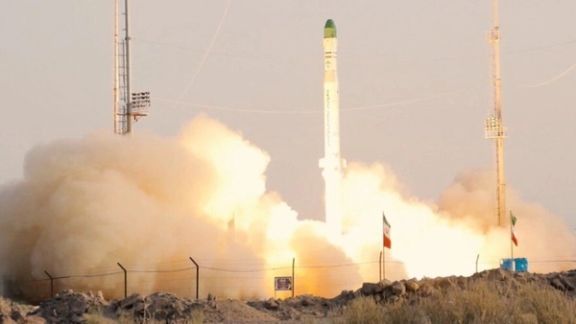
Russia intends to use the satellite that it will launch on Iran's behalf to assist its own war effort in Ukraine before relinquishing its control to Tehran.

Russia intends to use the satellite that it will launch on Iran's behalf to assist its own war effort in Ukraine before relinquishing its control to Tehran.
Two Western security officials told The Washington Post on the condition of anonymity on Thursday that the satellite, dubbed “Khayyam” after a 12th-century Persian polymath, will greatly enhance Tehran’s ability to spy on military targets across the Middle East, including near-continuous monitoring of sensitive facilities in Israel and across the Persian Gulf.
Russia's Roscosmos space agency has announced August 9 as the launch date of the satellite by a Russian Soyuz rocket from the Baikonur space station in Kazakhstan to fulfill a deal negotiated with Iran over nearly four years. Russia agreed to build and launch the Kanopus-V system but Iran may not be able to take control of the satellite right away as Moscow has told Tehran that it plans to use the satellite for several months, or longer, to enhance its surveillance of military targets for its invasion of Ukraine.
The pending launch is the latest indicator of increased military and political cooperation between Moscow and Tehran.
US National Security Adviser Jake Sullivan warned twice in July that Moscow appears to be looking at buying Iranian drones and Russian officers even visited a drone base in Iran’s Kashan to review their options.
The developments come as talks have resumed in the Austrian capital Vienna in what some officials describe as a last-ditch effort to salvage the 2015 Iran nuclear accord. The Biden administration is pressing Iran to return to compliance with the deal, which Tehran essentially abandoned after the Trump administration unilaterally withdrew from the accord in 2018.


The former head of Iran’s Revolutionary Guard intelligence, who was replaced in June has re-emerged with bluster, saying Israel “will not see its 80th anniversary.”
Hossein Ta’eb, the long-time head of IRGC Intelligence Organization was suddenly removed from his post on June 23 after a series of mysterious and well-planned sabotage and assassination operations in Iran blamed by officials on Israel. A series of other personnel changes followed, signaling the weakening of IRGC-IO and the possible strengthening of the Intelligence Ministry.
Fars news website affiliated with IRGC reported Thursday that Ta’eb gave a speech to a group of Revolutionary Guard political commissars, with a sweeping analysis of regional and world politics.
US President Joe Biden, Ta’eb said, wants to drag Iran into nuclear talks to get concessions and “again control the region, because this is the only way in which they can ensure the security of the Zionist regime and get hold of cheap oil.”
The statement reveals the conviction of Islamic Republic’s hardliners that they have seriously dented US power and influence in the Middle East, by supporting a large web of militant, anti-West proxy forces. They fear that the nuclear talks might eventually expand to include other demands by Washington and its allies, including a drastic change in Iran’s malign behavior.
Ta’eb’s well-publicized speech, besides re-habilitating his image, coincided with the resumption of negotiations in Vienna on Thursday aimed at concluding 16-month-long negotiations to revive the 2015 nuclear agreement, the JCPOA.
The United States insists that a reasonable offer was made to Iran in December 2021 to resolve the nuclear issue, but Tehran has been dragging its feet and making “extraneous” demands. Many observers have increasingly voiced concern that the Islamic Republic is delaying an agreement to gain time for the further expansion of its nuclear program, which is “fast galloping forward,” according to the head of the International Atomic Energy Agency, Rafael Grossi.
Ta’eb also strongly backed the favorite foreign policy theme of Supreme Leader Ali Khamenei to draw closer to Russian and China. He insisted that if the US and Europe guarantee the Islamic Republic’s interests and security, “we are in it”, but if “China and Russia can guarantee these two, we will accept it,” and this would not contradict the regime’s original dictum of “Neither West nor East”, he said.
Insisting that Israel suffers from deep internal divisions, Ta’eb said that the demise of the Jewish state is near, and it will not see its 80th anniversary. But he admitted that Israel began “a secret war against us,” which “we responded to.”
The former all-powerful intelligence chief, who is now an advisor to the IRGC chief commander, did not speak about his removal, which is widely attributed to repeated intelligence failures in preventing acts of sabotage.
Ta’eb’s speech also once again revealed the strategy of the Islamic Republic to blame internal problems and contradictions on “the enemy”, which usually means the United States, Israel and the West in general. The former intelligence chief reiterated the recent arguments of other hardliners that the resistance of many Iranian women to forced hijab is a campaign orchestrated by foreign enemies.
“The final aim of the enemy is to sow doubt in our trenches. We have to be mindful to respond to questions raised within our ranks, because not to respond to doubts will make the enemy’s arguments superior to ours…”

A leading US cybersecurity firm said Thursday a cyberattack that temporarily shut down numerous Albanian government digital services and websites in mid-July was done by Iran-backed hackers.
Cybersecurity firm Mandiant expressed “moderate confidence” the attackers were acting in support of Tehran’s efforts to disrupt a conference of the exiled Albania-based opposition group Mujahideen-e Khalq (MEK).
In its report, the company said that several factors reveal that the attack was carried out by pro-Iran hackers, including the timing, the content of a social media channel used to claim responsibility, and similarities in software code used with malware long used to target Farsi and Arabic speakers.
On July 18, Mandiant identified a new ransomware family dubbed ROADSWEEP, which drops a politically themed ransom note suggesting it targeted the Albanian government, and a group named “HomeLand Justice” claimed credit for the disruptive activity.
The “HomeLand Justice” posted a video of the ransomware being executed on its website and Telegram channel alongside documents purported to be Albanian residence permits of MEK members.
The July 23-24 conference by the dissident group, titled The Free Iran World Summit, was canceled following warnings from local authorities of a possible terrorist threat. The conference was scheduled to be held at Ashraf 3 camp in Manez -- 30 kilometers (19 miles) west of Albania’s capital, Tirana – where 3,000 MEK members live. Several US lawmakers were also among the invitees.
In July, Iran's Foreign Ministry sanctioned a group of US officials and lawmakers over their alleged support for the MEK group, that Tehran considers a terrorist organization.

Saudi Arabia has reiterated worries over Iran’s lack of transparency with international nuclear inspectors, and its non-compliance with obligations under international nuclear agreements.
Speaking at NPT Review Conference in New York on Wednesday, Saudi Arabia’s new permanent representative to the UN Abdulaziz Al-Wasil warned of the repercussions of "Iran's nuclear practices" and Israel's non-accession to the Treaty on the Prohibition of Nuclear Weapons.
"Iran's lack of transparency with the IAEA violates the UN Charter," he said, adding that "transparency is necessary for the peaceful use of nuclear energy". "The danger of nuclear weapons spread threatens the Middle East and the world."
Noting that the Islamic Republic’s nuclear activities constitute a threat to the non-proliferation regime and to international peace and security, he expressed his country’s “deep concerns” over Iran’s nuclear program.
Citing the recent International Atomic Energy Report which cast doubt on the supposed peaceful nature of Tehran’s plans, he added, “The Kingdom of Saudi Arabia supports all international efforts to prevent Iran from possessing nuclear weapons.”
In a ministerial statement released for the Tenth NPT Review Conference on Monday, August 1, the United States, France, and the United Kingdom also reiterated their position that the Islamic Republic should never achieve the capability to build nuclear weapons, saying that said the Nuclear Non-Proliferation Treaty has reduced the risk of a devastating nuclear war, and further reduction of that risk must be a priority for all NPT states parties.
Late in July, Iraqi Foreign Minister Fuad Hussein announced that Saudi Arabia and Iran have agreed to hold the first public meeting at the level of foreign ministers in Baghdad following rounds of closed reconciliation meetings.

Iran’s intelligence ministry said Thursday it has arrested a group of 10 Islamic State (ISIS) militants, hired by Israel to plan attacks on religious mourning ceremonies during Muharram.
A statement by the ministry said that the arrests took place over the past three days in two locations in western and southern Iran, adding that the 10 were captured in possession of explosives, communication devices and weapons.
The militants injured two Iranian intelligence agents in an exchange of fire before being detained, the statement added, without specifying where or when the clash took place.


The ministry claimed that it had them under surveillance before they entered the country from Iraq and Turkey to bomb the gatherings for the Islamic month of Muharram, which started on July 30.
It also alleged that the militants were hired by Israel to make up for a failed attack at a facility in the central Iranian province of Esfahan last month by a Mossad-linked sabotage team who were purportedly members of an outlawed Kurdish rebel group Komala.
Recently the Intelligence Ministry claiming has been making similar claims of uncovering alleged spy networks and thwarting operations following a major reshuffling of it rival, the IRGC intelligence and counter-intelligence leadership, widely attributed to reported Israeli infiltration and the inability of Iran’s security bodies to deal with the situation. Since May, several Revolutionary Guard personnel were killed or died in Iran, which Iran blamed on Israel.

Iran’s Supreme Leader's adviser Ali Akbar Velayati has called for closer ties between Tehran and the Palestinian Islamic Jihad, designated a terrorist organization by the US, EU, and UK.
Velayati made the remarks during a meeting with the leader of the group Ziyad al-Nakhalah in Tehran on Tuesday, saying, “We have a close and serious relationship with the Islamic Jihad movement and the Palestinian resistance.”
The senior international affairs adviser of Ali Khamenei also highlighted the significance of visits by officials of neighboring states to Tehran.
Praising the support by the Islamic Republic and the growing power of the regional resistance front against Israel, Nakhalah said that today Israel has found itself encircled from all directions by the resistance axis.
He added that the enemies and the United States have adopted a “very weak” policy in the face of the Islamic Republic’s influence, claiming that Iran plays a very effective role in the region.
Earlier on Tuesday, Nakhala also held a meeting with the Iranian foreign minister, in which Hossein Amir-Abdollahian reaffirmed the Islamic Republic’s commitment to continue to support Palestinian groups against Israel.
Nakhala also met with Kamal Kharrazi, the head of Iran's Strategic Council on Foreign Relations, who also told the Palestinian official that Israel has been caught off guard and is besieged by the resistance front.
Israel and most regional Arab countries have been concerned over Iran’s support for militant groups and its interference in affairs of other countries.