Hardline Tehran Daily Urges Taking More European Hostages
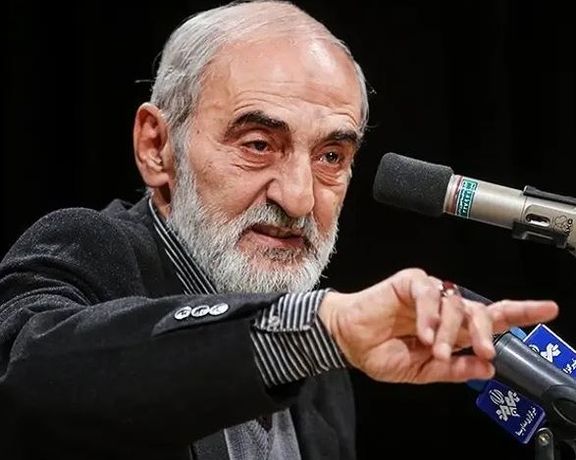
The editor of a hardliner daily, operating under the aegis of Islamic Republic's Supreme Leader, has implicitly called for detaining more foreigners in Iran.

The editor of a hardliner daily, operating under the aegis of Islamic Republic's Supreme Leader, has implicitly called for detaining more foreigners in Iran.
He urged authorities to remove obstacles for “punishing Sweden in a regrettable way”.
Earlier in the day, Iran’s foreign ministry spokesperson Nasser Kanaani called the court “a show” in line with “purification of a terrorist organization,” adding that the court violates the rights of an Iranian citizen as well as Iran's sovereignty. Sweden must stop supporting this terrorist group, referring to Albania-based opposition group, Mujahedin-e Khalq Organization (MEK).
Iran accused Sweden of giving into pressure by the MEK that Tehran considers a terrorist organization. Most of the approximately 5,000 prisoners summarily executed in prisons were members of MEK serving their sentences.
Nouri -- a former deputy prosecutor at Gohardasht Prison in Karaj at the time of the killings -- was charged with “war crimes, crimes against humanity, torture, and participating in the continued crime of refusing to return the bodies of executed prisoners to their families.”
Witnesses have told Swedish prosecutors that Nouri, who went by the alias Hamid Abbasi at the time, was responsible for handing down death sentences and taking prisoners to where they were hanged or shot.


Iran's Foreign Ministry criticized on Wednesday recent remarks by Russian envoy in Tehran about Iran owing a lot of Money to Russia and the West promoting homosexuality in Iran.
Ministry spokesman Naser Kanaani said, “We definitely expect that respected foreign ambassadors residing in Tehran do not comment and intervene on Iran's internal issues.”
Iranian media have often perceived Levan Dzhagaryan's (Jagarian) controversial behavior as intervention in Iran's internal affairs or as flat insults although he does not seem to be bothered by the accusations.
Kanaani added that the foreign ministry is absolutely sensitive to these issues and will act based on its inherent responsibility.
“We must refrain from fueling issues that cause unnecessary problems in our relations with our neighbors,” he emphasized. “We must read Dzhagaryan's statements carefully and see how much his opinion is consistent with his statements.”
On social media and recently in Tehran media, however, Iranians have been demanding an answer to the ambassador's outrageous and provocative remarks.
“Where are the government and the foreign ministry?" Khabar Online, a moderate conservative news outlet in Tehran asked on Sunday, July 17, after Dzhagarian told Sharq newspaper a day earlier that "We have always been on Iran's side, but the West want to bring their absurd values such as homosexuality and other dirty things to Iran but we object to that!"
Many Iranians on social media reminded the ambassador that Russia is a large producer of pornography in the world.

The White House says Russian President Vladimir Putin's trip to Iran on July 19 shows how isolated Moscow has become in the wake of its invasion of Ukraine.
John Kirby, the White House's chief National Security Council spokesman, told reporters on Tuesday, “I would say three things about this trip. One it shows the degree to which Mr. Putin and Russia are increasingly isolated. Now they have to turn to Iran for help.”
“Two, it shows the degree to which his own defense industrial base is having a hard time keeping up with his unprovoked war in Ukraine,” he went on, highlighting Russia’s troubles regarding precision guided munitions and advanced systems, tanks, even aircraft, particularly with the microelectronics due to the sanctions and export controls. He said the pace of operations in Ukraine has also become a challenge.
Kirby said the third thing is Russia “has absolutely no intention of stopping the war” and negotiating a settlement with Ukraine, because he wants to buy several hundred UAVs from Iran “to continue to kill Ukrainians.” Putting prefers to turn to Iran rather than just doing the right thing... and ending the war, he added.
However, Kirby said there is no indication yet that the sale has actually occurred, and that Iran has started training Russian forces to use armed drones, referring to remarks by Jake Sullivan, the US National Security Adviser, who said last week that Tehran planned to supply “several hundred UAVs, including weapons-capable UAVs, on an expedited timeline.”
He said the US is watching the situation closely, as “the Iranians have a domestic production capability of drones and those drones have lethal capabilities. We've seen that for ourselves in the attacks that they have perpetrated in Iraq and in Syria against our own troops and against our own facilities there.”

US President Joe Biden signed Tuesday an executive order empowering government departments and bodies to impose sanctions over Americans detained overseas.
A statement from the United States State Department said the presidential order, dubbed ‘Bolstering Efforts to Bring Hostages and Wrongfully Detained United States Nationals Home’ was intended to “deter and disrupt hostage-taking and wrongful detentions” by creating “new ways to impose costs on terrorist organizations, criminal groups, and other malicious actors.”
Pressure on the Biden administration from families of detainees has been gaining more publicity since February’s arrest in Russia of basketball star Brittney Griner on drugs charges, which has provoked debate in the US.
While the government has no official figures for Americans detained abroad, the James W Foley Legacy Foundation, named after the journalist captured and killed by the Islamic State group (Isis) in Syria in 2014, has identified 64 US citizens and lawful long-term residents it says are unjustly detained in 18 countries.
These include Emad Shargi, and Siamak and Baqer Namazi in Iran, as well as detainees in Saudi Arabia, Russia, Pakistan, China, Turkey, Cuba, and Nicaragua. Rights groups have suggested Iran has held as bargaining chips other dual nationals, including Swedish-Iranian doctor Ahmadreza Djalali and British-Iranian environmentalist Morad Tahbaz. Tehran in March released British-Iranians Nazanin Zegari-Ratcliffe and Anoosh Ashoori the day after London honored a 40-year-old debt of £400 million ($480 million).
While directing government officials to work more closely with detainees’ families, Biden’s executive order gives an option of imposing financial and travel sanctions on those deemed “responsible for unjustly holding US nationals, whether their captor is a terrorist network or a state actor,” Secretary of State Antony Blinken said in a statement. The State Department will also add a new category to travel advisories that warn of countries where it says there is greater risk of wrongful detention, beginning immediately with Myanmar, China, Iran, North Korea, Russia, and Venezuela.
‘Nothing constructive on our hostages’
Relatives of detainees have criticized US successive governments for what they see as inertia. Following a video call between officials and family members Tuesday, Neda Shargi, sister of American-Iranian businessman Emad Shargi, jailed in Tehran since 2018, said she had heard “nothing constructive on our hostages.”
Several detainee relatives taking part in the video call said they felt the executive order was aimed more at deterring the future detentions of Americans than at securing releases of those currently jailed.
A prisoner swap with Russia in April saw Washington exchange former US marine Trevor Reed for Russian pilot Konstantin Yaroshenko, whose sentence for drug-smuggling Biden commuted. The swap came despite high tension between Moscow and Washington with the Ukraine war, which encouraged families of other detainees.
The US has conducted talks with Iran over a possible prisoner swap in parallel to but independent from – according to both sides – year-long talks to revive the 2015 Iran nuclear agreement, the Joint Comprehensive Plan of Action.

Iran’s Revolutionary Guard says an Iranian LGBTQ rights activist detained since last October has been slapped with new charges of "trafficking Iranian women" to Erbil, in Iraqi Kurdistan.
The intelligence organization of the IRGC made the accusation in a statement on Monday about Zahra Mansouri Hamdani, also known as Sareh, who was previously arrested on charges linked to an appearance in a BBC documentary on gay rights in Iraqi Kurdistan.
The statement described her "the leader of the biggest gang of Iranian girls trafficking to Erbil,” saying that following months of surveillance, the IRGC intelligence tracked her to the trafficking gangs that had “sold hundreds of Iranian women and girls” to customers in Erbil.
The IRGC also accuses her of promoting homosexuality, gambling and fraud as well as de-stigmatization of illicit sexual relations in cyberspace.
The organization added that her gang was run in collaboration with a man identified as "Alireza Farjadi-Kia" and another woman that goes only by the name "Kati".
She was arrested while trying to cross the border and seek asylum in Turkey on October 27, 2021. She was held in solitary confinement for 53 days, during which, the Revolutionary Guard subjected her to intense interrogations, insulted her identity and appearance, threatened to execute her and to take away custody of her children. On January 16, Sareh was accused of “spreading corruption on earth,” including through "promoting homosexuality”, “communication with anti-Islamic Republic media channels” and “promoting Christianity.”
Rights group Amnesty International appealed to Iran’s Chief Justice Gholamhossein Mohseni-Ejei on January 25, calling for release.

Iran’s judiciary says award-winning Iranian film director Jafar Panahi has been sent to Evin prison to serve his six-year sentence.
Judiciary spokesperson Masoud Setayeshi made the remarks on Tuesday, about a week after Panahi was arrested as he was protesting the detention of two other filmmakers -- Mohammad Rasoulof and Mostafa Alehahmad -- at the prosecutor’s office of the Evin prison.
Setayeshi said that Panahi is sentenced to six years in prison – five years for “conspiracy and collusion against national security” and one year for “propaganda against the system,” adding that the decree is final and binding, according to which he was detained in Evin prison to serve his sentence on July 11.
Panahi, who has won numerous awards, including the Golden Leopard at Locarno Festival, the Golden Lion in Venice, and the Silver Bear at the Berlinale, was once arrested in March 2010 and in December 2010, he was sentenced to six years in prison and a 20-year work ban.
Rasoulof – another prominent filmmaker with several international awards such as the Golden Bear – and Alehahmad – who is known in international film galas for his short works -- were arrested July 8 as part of the Iranian crackdown on the signatories of a collective statement titled “Lay down the gun” issued by more than 100 film industry personalities in the end of May.
Earlier in the week, the Cannes Film Festival, the Berlinale, the European Film Academy and the International Coalition for Filmmakers at Risk also called for the immediate release of the filmmakers. France has also urged Tehran to release the three.