Iran Asked Hezbollah To Respond If Israel Attacks Nuclear Sites- Report

Hezbollah leader Hassan Nasrallah traveled to Iran around two months ago when Tehran asked him to respond to any possible Israeli strike on Iran nuclear sites.

Hezbollah leader Hassan Nasrallah traveled to Iran around two months ago when Tehran asked him to respond to any possible Israeli strike on Iran nuclear sites.
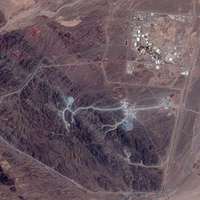
Israel’s Channel 12 News reported on Wednesday that during his rare visit the Iranians told him they expect Hezbollah to respond militarily in case of a possible Israeli strike on Iran’s nuclear facilities.
The report, which did not cite sources, described Nasrallah’s trip from his secure, secret location in Beirut to Tehran as “definitely unusual”, noting that the Islamic Republic informed the Hezbollah chief that it is time that the Shiite group returns years of Iran’s investment.
The Israeli site did not say what the outcome of the meeting was or what Nasrallah agreed to with the Iranians.
In an interview with Iran’s Arabic-language al-Alam news network earlier in February, Nasrallah said Hezbollah would not necessarily become involved if Israel hits Iran’s nuclear sites but noted he didn’t think Israel was serious about attacking.
In a televised speech to followers earlier on Wednesday, Nasrallah said for the first time, that it can convert thousands of rockets into precision missiles within Lebanon.
"We have been producing drones in Lebanon for a long time, and whoever wants to buy them, submit an order," he said.
Hezbollah and Israel fought a month-long war in 2006 and have at times in the years since traded fire across Lebanon's southern border.

In his first reaction to an audio file revealing a corruption scandal in Iran’s Revolutionary Guard, Ali Khamenei has blamed “enemy think tanks.”
In a video speech on Thursday, the Supreme Leader defended the commanders implicated in the scandal and said that the enemy spends billions of dollars in their think tanks for slander and lies against the Islamic Republic.
Khamenei said that the enemy’s smear campaign targets “the foundations of the revolution”, adding that “one day they slander the parliament, one day they slander the Guardian Council, and today it is the turn of the IRGC and martyr (Qasem) Soleimani”.
The 50-minute audio-file includes a conversation between the former Revolutionary Guards (IRGC) Commander Mohammad-Ali Jafari and his Economic Affairs Deputy Sadegh Zolghadr in 2018 about corruption involving IRGC's Qods Force, Tehran municipality and Parliament Speaker Mohammad-Bagher Ghalibaf, a former IRGC commander himself, who was Mayor of Tehran from 2005-2017. The $3 billion embezzlement took place during Ghalibaf’s tenure as mayor.
In the recording, Zolghadr tells Jafari that Ghalibaf suggested the IRGC and Tehran Municipality sign a false contract for the same amount to justify the disappearance of the money.
Jafari tells Zolghadr that Soleimani was aware of the embezzlement, which prevented the funds from reaching the Qods Force and had spoken to Supreme Leader Ali Khamenei about it.

Israeli forces say two UAVs launched from Iran were shot down in Iraq amid fears that the drones were intended to reach Israeli territory and explode.
It is not clear who shot down the drones. US forces in Iraq are equipped with air defense weapons, but there has been no confirmation that they engaged the drones
According to Arutz Sheva on Thursday, the Iranian drones were downed on Tuesday while reports by Iranian media say Israel is helping American forces to attack the Houthi rebels and militant organizations affiliated with Iran.
Israel’s Kan 11 News reported on Wednesday that the Israeli defense establishment is preparing for the possibility of a drone attack from Iran and believes that Iran will continue its attempts to carry out such an attack.
Earlier on Thursday, Israel targeted a Syrian army base near Damascus used by Iranian forces with surface-to-surface missiles fired from Golan Heights.
In early February, the Israel Air Force held a drill to simulate an attack on Iran’s nuclear facilities with dozens of warplanes, as tensions remain high in the region.
The Israelis touted the participation of a US official as an observer as evidence of a shift in Washington’s approach to Tehran’s nuclear program as the Vienna talks to revive the deal seem to falter.

Israel has targeted a Syrian army base near Damascus used by Iranian forces with surface-to-surface missiles fired from Golan Heights.
According to Syrian state media, the attack hit targets near the town of Zakyah, located to the south of the capital Damascus in the early hours of Thursday.
The strikes caused property damage but there were no immediate reports of injuries.
Israel’s Channel 12 cited local sources that the target was a military base used by Iranian and Syrian forces.
This is the second attack attributed to Israel on the Syrian soil in the space of a week. Last Wednesday, some areas in the western province of Homs were attacked, in which one soldier was killed and five were wounded.
In a rare statement acknowledging attacks inside Syria, the Israeli army said it struck Syrian facilities used in targeting Israeli aircraft, including a radar and anti-aircraft batteries.
Israel has conducted hundreds of strikes on targets in government-controlled parts of Syria mostly since 2017, but its government rarely acknowledges or discusses such operations.
Israel has mounted hundreds of such strikes against what it has described as Iranian-linked targets in Syria, where Tehran-backed forces including Lebanon's Hezbollah have deployed in support of President Bashar al-Assad during Syria's war.

An Iranian human rights group and a UK barrister have submitted a request to the International Criminal Court to examine Iran's role in the Syrian conflict.
The Iran Human Rights Documentation Center (IHRDC) has brought the request to open a Preliminary Examination of the role played by Iran and the armed groups it controls in crimes committed during the conflict in Syria to the office of the ICC prosecutor in conjecture with UK barrister Haydee Dijkstal.
In a statement Wednesday, the IHRDC said that it had submitted the request in accordance with Article 15 of the Rome Statute. The Rome Statute refers to the treaty adopted at a diplomatic conference in Rome in 1998 that established the International Criminal Court. Neither Iran nor Syria are parties to the Rome Statute.
The IHRDC has alleged that agents from the Islamic Republic of Iran and its Revolutionary Guards (IRGC) have perpetrated, aided and abetted the commission of certain crimes such as deportation and persecution against Syrian civilians which forced them to flee to Jordan for safety.
In its statement, the IHRDC said it has included evidence of Syrian victims directly impacted by the Syrian Government and the armed groups from Iran or controlled by Iran who attacked and intimidated them.
The IHRDC said forces led or supported by Iran were involved in hostilities across the entirety of Syria that led to more than 650,000 Syrians fleeing to Jordan from the violence.
According to The Guardian, the victims, including Syrian journalists, were targeted between 2011 and 2018 for their professional journalistic activities and for their actual and perceived opposition activities and came from predominantly Sunni towns and cities in Syria that the Alawite Assad regime and Shia Iran perceived as opponents.
The Guardian called the move to bring the case to the ICC "a groundbreaking attempt" to make Iranian and Syrian military officials answerable for war crimes.
“Up until now, little public attention has been paid to the legal responsibility of the Islamic Republic of Iran in the decade-long Syrian conflict, despite the significant intervention of Iranian officials in Syria and perpetration of atrocities,” Gissou Nia, the board chair of IHRDC said in the statement.
Nia said Iran has provided a vast range of military and non-military support to prevent the fall of Bashar al-Assad at any cost. "Unfortunately, that goal has been fought at the cost of hundreds of thousands of killed, injured and displaced Syrian civilians,” she added.
In the civil uprising phase of the Syrian Civil War, Iran provided technical support to the Assad regime to suppress the protests. The IRGC's Qods Force then began providing combat troops to support the Syrian military. Since then, Iran has spent tens of billions of dollars to send troops, arms, and equipment to Syria and to train Syrian forces as well as Iran-back militia groups including the Lebanese Hezbollah to assist the Assad regime.
In May 2020, a member of the Iranian parliament, Heshmatollah Falahatpisheh, in an interview with Etemad Online said Iran spent between $20 and $30 billion in Syria which he said has to be reimbursed.
Registered in 204 as a non-profit organization, IHRDC is based in Connecticut, United States. The organization which aims to document the patterns of human rights abuse in Iran and promote accountability has received funds from the US State Department, the government of Canada as well some private foundations and individual donors.

Tehran is set for severe drinking water supply shortages in the coming summer due to low precipitation and evaporation from dams.
Mohsen Mousavi Khansari, board member of NGO aimed at raising awareness of Iran’s water and soil issues, made the projection in an interview with Tasnim news agency Wednesday.
Khansari said that the five dams around Tehran, the main sources of drinking water for the metropolitan region, currently have 300 million cubic meters (m3) of water, which is not enough to avert a water shortage in the summer.
Latyan and Lar dams, which supply water to the eastern parts of Tehran province, have a total 20 million m3 of water that will run out in coming days, he said. Water in Amirkabir Dam, in the west of Tehran, is down two thirds from a year ago to 30 million m3, “which is deeply worrying,” Khansari told Tasnim.
“If we add Mamlu and Taleqan Dams to the other dams, there will be a total of 300 million cubic meters of water, and if we consider the rate of evaporation and decrease in precipitation, we will definitely have many problems in the summer to supply drinking water to Tehran,” Khansari concluded.