France Says Vienna Talks Will Be Futile With Current Pace
French foreign minister Jean-Yves Le Drian.
France says it is “vital” that Vienna talks to revive the 2015 nuclear agreement “succeed” because if negotiations continue with the current speed there will be nothing left to negotiate.
French Foreign Minister Jean-Yves Le Drian made the remarks on Friday stressing that the pace of the talks is “way too slow” to be able to reach a result.
Le Drian said, “The choice is to return to the JCPOA agreement very quickly, or [to accept] a new [nuclear] proliferation crisis with Iran”.
He underlined that Iran is continuing its production of fissile materials and soon will be able to build a nuclear bomb, which makes any agreement useless.
Le Drian, however, added that if Iran wants to reach a deal, “we have the impression that there will be flexibility in the Americans' stance”.
He sounded less optimistic than EU foreign policy chief Josep Borrell who said that a renewed deal with Iran is still "possible" as the talks are advancing in a "better atmosphere".
"We're arriving at the end of a long process... there's a better atmosphere since Christmas — before Christmas I was very pessimistic. Today I believe reaching an accord is possible… in the coming weeks", Borrell said.
On Friday, chief negotiators of Iran and the three European participants in the Vienna nuclear talks returned to their capitals to hold consultations and update their respective governments.
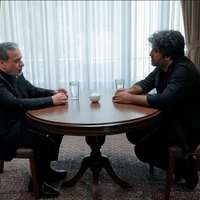
Iranian negotiators meeting with EU and E3 diplomats in Vienna. January 9, 2022
Chief negotiators of Iran and the three European participants in the Vienna nuclear talks have returned to their capitals to hold consultations and update their respective governments.
European Union envoy Enrique Mora, who is the coordinator of the negotiations, told Iran International on Friday that he stays in Vienna where expert-level talks will continue over the weekend.
Russia’s top negotiator Mikhail Ulyanov said it is a two-day recess and doesn’t mean that the eighth round is over.
EU foreign policy chief Josep Borrell also said that a renewed deal with Iran is still "possible" as the talks are advancing in a "better atmosphere".
"We're arriving at the end of a long process... there's a better atmosphere since Christmas — before Christmas I was very pessimistic. Today I believe reaching an accord is possible," he said after an informal meeting of EU foreign ministers.
Borrell expressed hope to revive the agreement "in the coming weeks" so that it functions as it did before the American withdrawal.
Also on Friday, an unnamed source close to the talks told Reuters that “we are in the nitty gritty, it is the most tedious and demanding stage of negotiations as we’re increasingly dealing with the sequencing of nuclear and sanctions steps”, adding that the problem is not the issues but time “as we do not have all the time in the world”.
Former Secretary of State Mike Pompeo slammed the Biden Administration for continuing talks with Iran while Tehran is threatening former US officials and attacking US targets.
In an interview with Fox News Friday, Pompeo drew attention to an animation video published on the official website of Iran’s Supreme Leader Ali Khamenei showing a man targeting former President Donald Trump playing golf.
Pompeo said, “I have seen a little clip of a video where they are threatening to kill President Trump and myself, and yet we have negotiators sitting at the table in Vienna.”
The White House warned Iran on Sunday [Jan. 9] after numerous threats by Islamic Republic officials to take revenge from American and Israeli officials they hold responsible for the targeted killing of Iranian operative Qasem Soleimani in January 2020.
National Security Advisor Jake Sullivan said Iran will face severe consequences if it attacks any Americans, but negotiations to revive the Obama-era nuclear deal with Iran continue in Vienna.
On Soleimani’s killing Pompeo said, “We kept Americans safe. Today we have negotiators with the Iranians willing to give them money, resources, power tools to continue to build their terror network. It is an enormous mistake.”
If the talks in Vienna succeed, the United States will lift most economic sanctions imposed by Trump in 2018 when he withdrew from the nuclear agreement arguing that it was a weak deal, which would not stop Tehran form acquiring nuclear weapons in the future.
“I can't figure out why we're in Vienna negotiating with an Iranian regime attacking diplomats in Baghdad and threatening senior officials,” Pompeo, who has always expressed a hardline position toward the Islamic Republic, asked.
The Fox News reporter asked Pompeo what he thinks about the Biden Administration spokesperson Jen Psaki blaming the nuclear standoff with Iran on Trump’s decision to pull out of the JCPOA.
“She's living in a fantasy world disconnected from the real world that was the JCPOA,” the former secretary of state said, and added, “It created a clear path for a nuclear weapon and an entire program of nuclear weapons that the Iranians would have had possession.”
Pompeo continued with the argument that the Trump administration made the right decision to pull out of the agreement and given four more years, Supreme Leader Ali Khamenei would capitulate and sign a new agreement which would ban Iran “from enriching uranium and
threatening Israel and the United States.”
The Biden Administration argues that Trump’s sanctions did not have the desired effect and pushed Iran to increase its uranium enrichment and malign activities in the region.
In reality, both are right in a sense, but there are two issues. First, is the dimension of time. If US sanctions were kept in place and enforced, Iran’s current economic crisis could force it to negotiate even with a second Trump administration. But in less than three years from mid-2018 to January 2021, Tehran resisted and refused to negotiate with Washington.
Second, Iran’s dangerous expansion of uranium enrichment accelerated after President Joe Biden said he wanted to revive the nuclear agreement and lift sanctions. Also, the Biden administration has not enforced sanctions strictly and China sensing a weakness has doubled its illicit oil imports from Tehran, helping it to adopt a tough position in Vienna.
US Secretary of State Antony Blinken says Iran is advancing its nuclear program in increasingly dangerous ways, and its malign activities in the region have also increased.
In an interview with NPR on Thursday, Blinken reiterated that the US policy remains preventing the Islamic Republic from acquiring a nuclear bomb, noting that the 2015 agreement, JCPOA, had managed to “put Iran’s nuclear program in a box”.
Admitting that Iran is closer than ever to threshold capability to build atomic bombs, he said, “Iran is getting closer and closer to the point where they could produce on very, very short order enough fissile material for a nuclear weapon”.
He said that Washington is in this “challenging situation” due to “one of the worst decisions made in recent American foreign policy” that was walking away from the nuclear agreement, officially known as the JCPOA.
Blinken said “the best thing for our security and the security of our allies and partners in the region” is getting back to the JCPOA “in the weeks ahead – not months ahead, weeks ahead” since Iran is “making advances that will become increasingly hard to reverse because they’re learning things, they’re doing new things” without the constraints of the deal.
More than 100 Republican members of the US Congress have written to President Joe Biden urging him to end nuclear talks with Iran and enforce sanctions.
The signatories have pointed out that Administration officials say the talks are not progressing and Biden should stop the attempt to revive the 2015 nuclear agreement, the JCPOA, and instead strongly enforce existing sanctions, “particularly with respect to the oil trade between Iran and the People’s Republic of China (PRC).”
Chinese illicit imports of Iranian oil in contravention of US sanctions at least doubled in 2021, as Iran’s daily exports now stand at around 600,000 barrels.
The lawmakers also highlighted Iran’s advancement in enriching uranium at 60 percent, which started one year ago as the Biden Administration was preparing to enter talks with Tehran. Calling Iran’s actions and delaying tactics “provocations” the letter says this behavior is “the epitome of bad faith,” and calls for a strong enforcement of existing sanctions.
“If Iran is not prepared to negotiate as things stand, we need to build our leverage to compel them to negotiate a better, stricter deal with no sunsets,” the lawmakers say.
As Republicans criticize the Administration’s policy toward Iran, the White House is trying to blame former president Donald Trump’s withdrawal from the JCPOA, as the reason for the current situation.
Chairman of Iranian Parliament's National Security and Foreign Policy Committee, Vahid Jalalzadeh
The chairman of Iranian Parliament's National Security and Foreign Policy Committee has said that an "interim deal" could be considered in Vienna nuclear talks.
Speaking to the Iranian Labour News Agency (ILNA) Wednesday, Vahid Jalalzadeh said the other parties to the 2015 nuclear agreement, the Joint Comprehensive Plan of Action (JCPOA) want an interim deal and have made some proposals. "This is not ideal although we have not ruled it out and are considering it," Jalalzadeh said.
Jalalzadeh insisted that Iran does not want a new deal and said the United States wants the JCPOA to be restored because it will bring advantages to it such as limiting Iran's nuclear capabilities and added that the Islamic Republic would only allow the return of the US if it can be assured that Iran can also reap the benefits of the deal.
Russian Foreign Minister Sergei Ryabkov said Monday after Russian-US talks that "various schemes were possible" for reaching the ultimate goal in the Vienna talks. "A step-by-step approach based on reciprocity [is likely to be used] to achieve the main goal," the top Russian diplomat said according to Tasswhile reiterating that that he saw no need for setting any deadlines for reaching a final decision on the JCPOA.
The US and its European allies have warned that the window for further talks in Vienna could close by the end of January or the beginning of February. Following high-level talks with Israeli officials in Jerusalem on December 22, US National Security Advisor Jake Sullivan told Haaretz that Washington and others have not publicly put a date on the calendar “but behind closed doors, there is a deadline, and it is not far away.”
On Monday, Foreign Ministry Spokesman Saeed Khatibzadeh told reporters that Tehran would not agree to any deals without the lifting of US sanctions and "verification and receiving guarantees" and it only wants a "lasting and reliable agreement". Khatibzadeh said Tehran was not satified with the pace of the talks and would not accept any "forged dates" to conclude the talks.
Tasnim news agency which is affiliated with the Revolutionary Guards (IRGC), said Wednesday that it has been informed by its sources that "a major part of the talks" in Vienna in the past few days were focused on "verification" of the lifting of sanctions and "receiving guarantees" that the other sides will not renege on the deal.
Tasnim also reported that "non-papers are exchanged on a daily basis" with the US delegation through the European Union representative Enrique Mora. The Iranian delegation insists on these two demands, Tasnim said, to make sure the US would not fail to deliver its commitments “as occurred during the presidency of Barack Obama”, or withdrawal as his successor Donald Trump did. "The stability factor in the agreement is of a higher importance," Tasnim said to ensure any prospective agreement would have lasting results.
"During the Obama period Iran's compliance was meticulously and quantitively verified by the International Atomic Energy Organization (IAEA) whereas there was no mechanism for verification of the other sides' compliance with the lifting of sanctions. This was the reason that the lifting of sanctions did not bear tangible outcomes for Iran," Tasnim wrote.