Iran’s Friday Prayer Imams Vow Revenge, Urge US To Leave Region

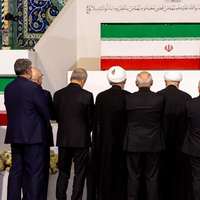
Many Friday Prayer Imams in Iran have talked about revenge for the targeted killing of Qasem Soleimani in their weekly sermons and urged American forces to leave the region.

Many Friday Prayer Imams in Iran have talked about revenge for the targeted killing of Qasem Soleimani in their weekly sermons and urged American forces to leave the region.
Tehran’s interim leader of the weekly Friday congregation, Kazem Seddiqi, said the United States had thought that killing Soleimani would weaken the ‘resistance front’ but it proved to be the opposite.
He said that Soleimani created a united front for the resistance forces in Iran, Iraq, Yemen, Lebanon, Pakistan, and Afghanistan that provided new ways for the resistance forces.
Seddiqi praised recent attacks on Iraq’s Ain al-Asad base as revenge for the killing of Soleimani and Abu Mahdi al-Muhandis, the Iraqi commander of the Popular Mobilization Forces in January 2020.
Such remarks against the presence of American troops in the region were echoed by many other Friday Imams, which usually serve as a platform to promulgate the official policies and views of supreme leader Ali Khamenei.
The ongoing Vienna nuclear talks and restriction on the Internet were apparently among the other directives on agenda for today’s Friday prayers.
During numerous ceremonies and publications to mark the second anniversary of Soleimani’s killing in a US drone strike, the Islamic Republic tried to claim ultimate victory by saying that the US is leaving the region, by emphasizing the American departure from Afghanistan.
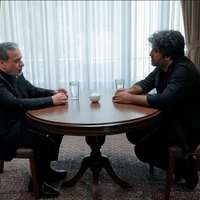
An Albanian male soccer coach has received a police text message over violating Iran’s hijab laws after being caught by a traffic camera while in a car.
Shpejtim Arifi, a Kosovar Albanian with German citizenship, manages the Persepolis junior team. He was a prolific goal-scorer transferred to Persepolis for $850,000 in 2009 after joining Payam the previous year.
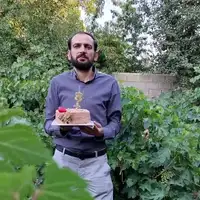
Fluent in Persian, Arifi is well known, partly for football, and partly through fashion modelling and appearances in television and cinema films. He was riding in a friend's car in Tehran when the friend’s phone bleeped.
"The text message shocked us at first because I had been mistaken for a woman flouting her hijab,” Arifi told Sports News . “I think it was the traffic camera that took my image. My friend was taken aback at first but then we laughed a lot…Later, many other friends called or sent text message to joke about this incident.”
Arifi explained he had grown his hair long since he was 18 and had no intention of cutting it.
“I've lived in Iran for many years looking the same and never had a problem,” he said. “I think it was a misunderstanding and nothing can be done about it.”
Iranian morality police who dress code and other “un-Islamic” behavior have an easier job in the streets, where they stop violators and order them to fix their hijab or even arrest them, but it is harder to control people riding in cars.
A method to deal with this started a few years ago when police monitoring cameras became prevalent. The morality police who notice a hijab violation send text messages – citing the vehicle's plate number, time, date, and location – to female drivers or passengers who drop their headscarf when driving, and drivers are responsible for their passengers. On the second offense, drivers must report to a police station within ten days, and may have their vehicle confiscated by court order if they fail to do so.
Women who break hijab laws while in a car can face a cash fine, penalty points on their license, and a maximum two months’ jail.
While the long black veil (the chador) is promoted as the best hijab in many government offices and educational establishments, a headscarf covering hair and shoulders and a long coat (manteau) coming below knees are generally acceptable. Many women, however, twist the rules. Headscarves that show hair in the front and back often slip down on the shoulders, while manteaus can be very tight.
A report by the parliament's research center in 2018 said the number of Iranians who believed in compulsory hijab had waned. According to the report those who considered the hijab a value that could be defined by law had fallen from 85 percent in the early 1980s to around 35 percent.

A well-known Iranian cleric has talked about the growing hatred and grudge towards the clergy in Iran, warning of a crisis unfolding in society.
In an Instagram post on Friday, Mohammad-Reza Zaeri said that a taxi driver refused to pick him up and told him “I will not give rides to mullahs.”
Zaeri, who often appears on state-controlled television programs, added that he had been spat on and sworn at a few times only in the last 10 days.
He said that those officials who have chauffeurs and bodyguards should be aware of this level of hatred and grudge that is creating a social crisis, stressing that “we had warned about this for years.”
The cleric, who is a former editor of the popular Hamshahri daily and head of the House of Young Journalists, has sometimes talked against compulsory hijab. During a lecture in Qom seminary in 2015, he described the policy of enforcing hijab as a failure.
Earlier in the week, Mohammad Taghi Fazel Meybodi, a member of the Assembly of the Qom Seminary Scholars and Researchers, said that clerics and seminary students are avoiding their usual garb for fear of being insulted in public.
Last week, a woman in the religious city of Qom was arrested for arguing with a clericand trampling on his turban after he and another cleric warned her over her hijab.

Saudi Arabia’s ambassador to Lebanon has condemned remarks by Hezbollah leader Hassan Nasrallah, expressing hope that Leabnese will end the group's "hegemony" in the country.
Earlier this week, Nasrallah called King Salman a “terrorist” and accused Riyadh of exporting Islamic extremism.
Saudi envoy Waleed Bukhari, who left Lebanon in late October, said on Thursday that “Hezbollah’s terrorist activities and regional military behavior” threaten the security of Arab countries.
“Riyadh hopes that political parties will give priority to the supreme interest of Lebanon… and end Hezbollah’s terrorist hegemony over every aspect of the state,” Bukhari said, stressing that ties with Lebanon are too deep to be affected by “irresponsible and absurd statements.”
Lebanese Prime Minister Najib Mikati said criticism of Saudi Arabia by the leader of the Iran-backed Hezbollah group did not serve the national interest or represent the country’s official stance.
Late in October, Saudi Arabia severed diplomatic relations with Lebanon following statements by the then-Lebanese information minister criticizing Riyadh’s military intervention in Yemen. The Saudi foreign minister later said that Hezbollah’s dominance in Lebanon, and not just the minister’s comments, had prompted the Sunni kingdom to cut ties.
Saudi Arabia and other wealthy Arab states always assisted Lebanon, which is struggling with an unprecedented economic crisis since 2019.

Syrian President Bashar al-Assad has issued a message on the second anniversary of Qasem Soleimani’s killing, saying that the United States targeted him because he was spreading “the spirit of sacrifice” in the region.
Special Adviser to the Syrian Presidency Bouthaina Shaaban read out Assad’s message on Thursday, noting that Soleimani was an obstacle hindering the realization of Washington’s plans for the Middle East.
“Soleimani was a danger to the interests of Washington and its allies in the region” the statement read, adding that in each mission, Soleimani tried to destroy the foundations of the US strategy.
Soleimani intervened early in Syria in 2011, as opposition to Assad was gaining momentum, and began giving advice and support for military confrontation with opponents. Later he spearheaded Iran’s large-scale military intervention in the civil war. Some see him as responsible for the deaths of thousands of civilians.
Shaaban stressed that Soleimani “loved Syria”, which will be “the beacon of resistance”, and will continue the war in the economic and cultural fronts in honor of the blood of “martyr Soleimani”.
“We must remain loyal to Soleimani and work to increase cooperation between Syria and Iran”, she added.
Soleimani, who was Iran’s top military and intelligence operator in the Middle East, was killed by a targeted US drone strike on January 3, 2020, directly ordered by former US president Donald Trump.

Instagram has apologized for a mistake in hiding a hashtag used to highlight those who died when Iran's IRGC shot down a Ukrainian airliner January 8, 2020.
In separate tweets Thursday, BBC Persianand Voice of America's Persian servicereported that in response to enquiries, Meta, mother company of Instagram, has said it had become aware these hashtags had been mistakenly restricted and had taken remedial action.
Instagram hid the hashtag #IWillLightACandleToo and its equivalent in Persian on January 4 in line with its policy of deleting offensive, explicit, or otherwise inappropriate content.
The hashtag was proposed by Hamed Esmaeilion, spokesman of a Canada-based association representing some victims of the downed flight. He lost his wife and daughter in the incident.
"The cyber-army is not leaving the families alone in these black days," Esmaeilion wrote in a tweet, alleging that people “affiliated to the Iranian government” had reported the hashtag to Instagram.
Flight PS752 was hit by two surface-to-air missiles in the tense aftermath of Iran's missile attack on United States military bases in Iraq retaliating for the US killing with a drone strike Iranian general Qasem Soleimani and nine others in Baghdad.
Iran failed to close the civilian airspace, although it said it was expecting a US response. This led to the tragic downing of the plane. Iran claimed a radar mis-alignment and human error.
Ten military personnel involved in the action went on trial in November, but some victims' families boycotted proceedings saying they lacked transparency and due process.
Hackers and heroes
On Tuesday hackers interrupted a video briefing by lawyers for some victims' relatives, playing clips of loud, obscene rap music and showing images including a doll with sharp teeth, a dog with shining eyes, and a man running towards a camera and pretending to kick it.
In recent days, some social media users supporting the Islamic Republic have protested against Instagram, the only major social-media platform not blocked in Iran, for restricting the hashtag #hero used to commemorate Soleimani, commander of the Revolutionary Guards (IRGC) extraterritorial Quds Force, on the second anniversary of his death and for removing photos of the general.
"To take revenge on Instagram, we will take action together to eliminate this malware," read a poster for the Campaign to Eliminate Instagram promoted by Fars News agency, which is affiliated to the IRGC.
According to Fars, the campaign has succeeded in dropping Instagram's rating in the region on Google Play from 4.4 out of five to 2.2 in ratings. The lower rating, Fars wrote, would reduce Instagram’s market value.
Fars said the “more important point” was “the loud message given to Instagram by the Iranian people in protest against censoring their national hero…[and in showing] that they will not remain silent about this cyber terrorism.”
On Thursday the International Coordination and Response Group for the victims of Flight PS752 − made up of Canada, Sweden, Ukraine, and the United Kingdom − issued a statementaccusing Iran of avoiding international legal responsibilities, including by refusing to negotiate with it.
The group said further negotiation was futile and it would “focus on subsequent actions…to resolve this matter in accordance with international law.”Iran has offered to pay $150,000 in compensation for each person lost.