Iran’s Chief Negotiator Arrives In Vienna To Resume Nuclear Talks

Iran's negotiation team has arrived in the Austrian capital Vienna to resume talks with world powers over the country’s nuclear program.
Iran's negotiation team has arrived in the Austrian capital Vienna to resume talks with world powers over the country’s nuclear program.
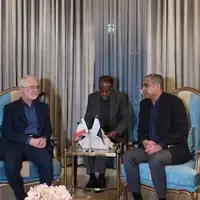
Chief negotiator Ali Bagheri-Kani and his accompanying delegation will soon go to Palais Coburg to hold diplomatic consultations ahead of a meeting of the JCPOA Joint Commission.
During the fresh round of talks that will kick off Monday afternoon, the sides are expected to discuss the contents of a new text and the possible roadmap for revival of the July 2015 nuclear deal.
Iranian Foreign Minister Hossein Amir-Abdollahian said on Monday morning that this round of talks will focus on a new joint draft, adding, “Today we have an acceptable joint document on the table”.
He noted that the most important issue in the new document is achieving proper guaranties that Iran can sell its oil easily and without any restrictions as well as receiving the proceeds in foreign currency in Iranian banks.
In addition to US sanctions on Iran’s oil exports, there are also banking sanctions that have cut off most of Tehran’s financial ties with the world.
Bagheri-Kani said earlier that if the other sides accept the Islamic Republic’s demands, the eighth round could be the final round.
Many Iranian pundits have expressed doubt about the success of this round in achieving tangible results.




Iranian media and commentators continue to assess the Vienna nuclear negotiations, as the country’s dire economic situation breeds a sense of urgency.
Ebrahim Mottaqi, an academic and political commentator in Tehran, has said that another round of talks in the last week of December is unlikely to be a turning point in Iran's nuclear negotiations with world powers.
Motaqqi said diplomacy is less likely to bear fruit during the final days of the year although it appears that Iranian, European, Russian, Chinese and American delegates have enough motivation to continue their efforts.
Meanwhile, according to Mottaqi in an interview with Fararu news website, the President Ebrahim Raisi Administration is adamant to further the talks in a way that would have a positive impact on Iran’s economy. However, he says, although Iran seems to have the necessary willpower to pursue the talks, it is unlikely that the negotiations could lead to tangible results in the short run.
According to Mottaqi, what Iran wants in the negotiations is to have the US sanctions lifted, and to make sure that the danger of another US pull-out from the nuclear deal is minimized.
Meanwhile, US-based former Iranian diplomat Hossein Mousavian has saidin an article that "Iran's strategic patience has come to an end and the United States can no longer play with time to get non-nuclear concessions from Iran."
Iranian official news agency IRNA quoted Mousavian's article in the Journal of the Russian Academy of Science as saying that although everyone expected President Joe Biden to break the deadlock in relations between Iran and America by returning to the 2015 nuclear deal, it turned out that his plan was to continue President Donald Trump's ‘maximum pressure’ policy.
This is similar to what Tehran has been demanding all along, that Washington should first lift its sanctions and then negotiate – albeit without leverage.
Iran's former ambassador to Germany, Ali Majedi, on the other hand, believes that the new round of talks in Vienna is going to have a determining impact on the fate of the negotiations. However, Majedi stressed that the talks have a better chance to succeed if instead of the 4+1 Iran agrees to hold the meetings with the P5+1, that is the three European states, Russia, China, plus the United States, which is currently indirectly involved in the talks through European mediators.
State-controlled media in recent days have been launching scathing attacks on the three European parties to the 2015 nuclear deal (JCPOA) accusing them of “sabotaging the negotiations. Clearly Tehran is unhappy that Europeans have been demanding Iran show more willingness to compromise. Majedi in his interview with Khabar Online website in Tehran followed the same argument but said that Europe can still play a positive part in the talks. However, he agreed with other commentators that even Germany has not been playing “a positive part” in the latest round of talks.
Majedi stressed that at the time being, it is not clear whether the Western sides wish to return to the 2015 agreement, or they want to add some new items to the JCPOA.
Asked about the divide between Europe and the United States under President Trump, Majedi pointed out that Democratic administrations in the United States usually maintain better ties with Europe and this will also affect the fate of the Vienna negotiations.
Head of Iran's Atomic Energy Organization has told Russia that Iran hopes to replace Russian fuel for its Bushehr nuclear power plant with domestic uranium..
"We had talks with Rosatom and we hope that as part of our cooperation, based on the plans and contracts we will sign, we will be able to do this and start using Iranian fuel in the reactor in Bushehr", Mohammad Eslami was quoted Saturday by Russia's state-owned Sputnik as saying.
The United States had expressed reservations about Russia building the Bushehr nuclear power plant but finally relented in late 2000s, saying that as long as Russia controls the fuel it did not see the project as a proliferation risk.
It is not clear what the US reaction would be if Iran starts using domestic fuel.
Russia was also responsible to take away the spent fuel and it is not clear that if Iran supplies the uranium fuel it would still be willing to send the spent fuel to Russia.
Iran is not known to have built facilities that would be able to separate plutonium from spent reactor fuel. Moscow and Tehran have an agreement to send back the spent fuel from the Bushehr plant to Russia. Russia last supplied fuel for the reactor in April 2020.
Eslami’s statement comes amid sensitive nuclear negotiations in Vienna to restore Iran’s 2015 nuclear agreement with world powers, known as JCPOA, which was meant to limit Tehran’s nuclear program. Although the Bushehr plant had nothing to do with that agreement, Iran’s plan to replace Russian fuel with domestic uranium can inject a new element in Western calculations.
Rosatom, Russia's State Atomic Energy Corporation, carried out most of the construction of the first reactor of Bushehr and has provided the reactor's fuel under the supervision of the International Atomic Energy Agency (IAEA) since it began operating in 2011. The company is now constructing a second reactor at the site and has signed a contract to construct a third power unit.
Pointing out that the construction of the second and third power units of the Bushehr power plant is around 23 months behind schedule, Eslami said Iran is expecting Rosatom to speed up the project's implementation and make compensation for its delay.
Construction began in 2017 on the two new nuclear reactors, due for completion in 2024 and 2026, at Bushehr with a projected combined capacity of 2,100 MW. The work follows a 2014 agreement between Iran and Rosatom.
Eslami was also asked by Sputnik Friday whether Iran will continue to enrich uranium beyond 60 percent if the country does not return to the 2015 nuclear deal and sanctions are not lifted, to which he replied "no."
With electricity generation at around 50,000-56,000 MW in the past few years, rising no more than 2,000 MW a year, Iran has struggled to meet consumption that has been rising and is encouraged by subsidized prices.
Bushehr nuclear power plant was connected to Iran's national power grid in September 2011. During a visit on 2 October to Bushehr, in southern Iran, President Raisi (Raeesi) said the current 1,000-megawatt (MW) capacity of Iran’s sole nuclear power plant would be tripled with further development, and that the AEIO was committed to increasing production from nuclear power to 10,000 MW.
With an annual average of 300 sunny days in over two-thirds of the country Iran has great potential for solar energy, but renewables including hydro-power account for 7 percent of Iran’s energy generation compared to 90 percent from natural gas and dirty oil fuels.
Iran's foreign ministry Friday evening slammed the British foreign office's statement in condemnation of Iran's ballistic missiles, calling it "meddlesome".
"Iran has not designed its missiles for nuclear purposes since it did not have and does not have any plans to use nuclear energy militarily,” spokesman Saeed Khatibzadeh said in a statement, claiming that the peacefulness of Iran's nuclear program is completely evidenced by the International Atomic Energy Agency (IAEA).
“The British know better than anyone else that Iran's missile program has nothing to do with UN Security Council Resolution 2231 and its provisions,” Khatibzadeh said, while accusing Britain of practically violating the UNSC resolution through “arbitrary interpretation.”
In a statement Friday, the foreign office condemned Iran's use of ballistic missiles in a test launch which it said was confirmed to have been conducted on the same day. "The launch is a clear breach of UN Security Council Resolution 2231, which requires that Iran not undertake any activity related to ballistic missiles designed to be capable of delivering nuclear weapons – including launches using ballistic missile technology," the statement said.
The 2015 resolution which sanctioned Iran's nuclear agreement, Joint Comprehensive Plan of Action (JCPOA), called upon Iran "not to undertake any activity related to ballistic missiles designed to be capable of delivering nuclear weapons, including launches using such ballistic missile technology".
Iran's Revolutionary Guards (IRGC) on Friday simultaneously launched 16 ballistic missiles on the last day of largescale five-day military exercises dubbed Great Prophet 17 in in the Persian Gulf region, the Strait of Hormuz, as well as the coastal areas of the southern province of Hormozgan, Bushehr, and Khuzestan.
The UK Foreign Office called the test launch of the missiles "a threat to regional and international security" and urged Iran to immediate cease such activities.
Chief of the Armed Forces' Joint Staff Major General Mohammad Bagheri (Baqeri) Friday described the exercises as "the most successful missile [launch] exercises so far" and said they were "an appropriate response to the Israeli regime’s latest empty threats".
“The message of this exercise is a serious and real warning to the threats of the Zionist regime officials,” the IRGC Commander-in-Chief Major General Hossein Salami also warned Friday. "The difference between real operations and the IRGC's missile launch exercises is only a matter of adjusting the launch gradient [towards Israel]."
In recent weeks Iran and Israel have escalated their war rhetoric against each other. Israel staunchly opposes the revival of the JCPOA. US National Security Adviser Jake Sullivan and Israeli Prime Minister Naftali Bennett Wednesday discussed Iran and the ongoing nuclear talks, stressing the need for a joint strategy.
Israeli officials have repeatedly said Israel has the capability to strike Iran's nuclear facilities. The incoming commander of the Israeli air force, Major General Tomer Bar, said Wednesday that if need be, Israel can successfully destroy Iran’s nuclear facilities “tomorrow.”
Iran's missile capabilities are also a cause of great concern to Saudi Arabia and other regional countries. The CNN reported Friday that it has learned that the US intelligence agencies have assessed that Saudi Arabia, Iran's regional rival, is also now actively manufacturing its own ballistic missiles with the help of China. This can complicate Western efforts to limit Iran’s missile program, as Tehran can claim other regional countries should also give up their ballistic missiles.
Iran's nuclear chief says even if talks to revive the 2015 deal fail and sanctions remain, Tehran will not exceed the 60 percent limit on uranium enrichment.
In an interview with the Russian news agency Sputnik on Saturday, Mohammad Eslami said that Iran does not intend to enrich uranium to higher levels no matter the results of negotiations aimed at salvaging the 2015 Joint Comprehensive Plan of Action (JCPOA).
"All our nuclear activities are carried out according to the agreements, statutes and regulations of the International Atomic Energy Agency", the AEOI chief stressed.
The JCPOA banned Iran from enriching uranium beyond 3.65 percent, but Tehran argues that because the US left the agreement and imposed sanctions, it is not bound by the limitation.
Tehran says it has increased its stockpile of 60% enriched uranium to 25 kilograms, potentially complicating efforts to revive the nuclear deal with world powers.
"So far we have produced 25 kilograms of 60% uranium, which, except for countries with nuclear weapons, no other country is able to produce," AEOI spokesman Behrouz Kamalvandi announced early in November.
The next round of Vienna talks to bring Iran and the US back to the deal is scheduled for Monday after seven rounds with no tangible results.
Western powers have expressed grave concern over the acceleration of uranium enrichment closer to weapons grade, saying Iran has "no credible civilian need for enrichment at this level".
Hardline media in Iran accuse the three European participants in the Vienna nuclear talks, particularly France, of working against Iran and preventing an agreement.
IRGC-linked news agency Fars said in a January 24 report that "Europe's destructive measures against an agreement between Iran and world powers is no less than what the United States has been doing to disrupt the talks."
Meanwhile, Farhikhtegan newspaper affiliated with the hardliner-dominated Islamic Azad University, charged in a December 24 report that the three European states including France, Germany and the United Kingdom (the E-3) have been furthering a "destructive policy" since the start of the new round of the Vienna Talks.
The daily said that the objective of the E-3 has been getting more and more concessions from Iran as far as nuclear issues and sanction-related matters are concerned. The daily further charged that the E-3 diplomats have been trying to convince the media that Iranian negotiators lacked a serious will to reach an agreement.
Iran returned to talks with world powers in Vienna on November 29, after it stopped negotiations in June when hardliner Ebrahim Raisi won the presidential vote. After the long delay, Tehran came to talks with new demands which upset the West. The E-3 began issuing warning to Iran to adopt a serious negotiating posture.
Farhikhtegan opined that an agreement leading to peace in the region might deprive France of the benefit of arms sale in the Middle East. Farhikhtegan further claimed that some European states that have been annoyed by France's positions have threatened to start talks with Iran separately. There have been no such reports as both Britain and Germany have also warned Iran, while other European countries are not involved in the matter.
Meanwhile, Fars quoted hardline commentator Vahid Karimi as having said that France's approach is even more destructive than the United States. He said, "As soon as the United States softens its stances, France comes forward and tries to sabotage the talks." He also added that the UK which is no longer part of the EU, is taking advantage of the situation to blackmail the other two European states. He did not offer any evidence or explain how The UK was “blackmailing” France and Germany.
Karimi claimed that the United States no longer attaches importance to Israel's position about the Iranian nuclear issue, and France has replaced Israel as the country that is doing whatever it can to make the talks futile.
In another report, Fars quoted hardline international relations expert Mostafa Khoshchashm as having said that France is playing a dual role in the talks and tries to get concessions from both Iran and other European states.
Khoshchashm agreed with other hardliners that France has replaced Israel by playing the part of the bad cop in the nuclear talks with the Islamic Republic.
Khoshchashm said that now the Western side faces two choices: Leaving the talks and turning their back to diplomacy, which would show they are not interested in the negotiators, or returning to the negotiations while accepting Iran's terms.
Khshchashm also expressed appreciation for "Russia and China's wholehearted support for Iran both in the talks and in the public arena.