US Defense Chief Ends Middle East Trip Reassuring Allies

US Secretary of Defense Lloyd Austin ended his Middle East trip on Monday emphasizing the importance of reassuring regional allies about America's commitments.

US Secretary of Defense Lloyd Austin ended his Middle East trip on Monday emphasizing the importance of reassuring regional allies about America's commitments.
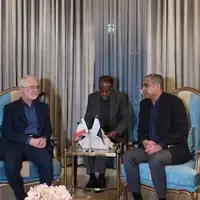
Austin’s last meeting was with Abu Dhab’s Crown Prince Mohammed Bin Zayed Al Nahyan during which the Defense Secretary reaffirmed “the importance of the US-UAE strategic partnership.” He also thanked the United Arab Emirates for hosting US troops.
The Secretary who attended the Manama Dialogue conference in Bahrain had a series of meetings with regional partners. During the conference he talked about Iran and tried to reassure regional alliesabout the Biden Administration’s determination not to allow Iran to acquire nuclear weapons.
Israel and America’s Arab allies are concerned about Iran’s growing nuclear program and its belligerent regional policies, while the United States continues to rely on diplomacy to reach a nuclear agreement with Tehran.
In a tweet at the end of his visit Austin said, “One of my core missions as SecDef is to deepen our partnerships. I want our partners to know they are important to us and that they will see a commitment from us for years to come.”

Promises by the government to deliver water to Iran’s Esfahan Province amid protests are fueling regional tensions between the wealthy region and its neighbors.
After a massive water protest Friday in the city of Esfahan, the capital of the province, its representatives in the parliament have demanded acceleration of government projects for transferring water from the neighboring province of Chahar Mahal and Bakhtiari.
Farmers in Esfahan Province have been protesting shortage of water for nearly two weeks now. On Friday thousands of residents of the provincial capital joined the farmers who have pitched tents in the dry bed of the city's Zayandeh Roud.
Authorities who blame this year's drought for the exacerbation of water shortage have kept promising to take action to resolve the long-standing problem and to compensate the farmers who have not been able to sow autumn crops.
The promises have not only failed to send the farmers and their supporters home, but have also given rise to dissatisfaction and protests elsewhere, namely the neighboring Chahar Mahal and Bakhtiari Province from where water should be diverted to Esfahan.
Videos posted on social media Sunday showed hundreds of people in the largely agricultural and less-developed Chahar Mahal and Bakhtiari marching Sunday in front of the Governor's Office in the provincial capital, Shahr-e Kord.
"No Water Can Be Taken from Chahar Mahal," protesters chanted in Shahr-e Kord and demanded the governor to respond to their calls. Protesters who have vowed to return Monday to continue their protest also chanted slogans against "cowardly authorities" and called on the people of neighboring Lorestan and Khuzestan provinces to support their cause.
The protest rally in Esfahan on Friday and Shahr-e Kord on Sunday are quite unique. This time, unlike any previous protests such as water crisis protests in Khuzestan in July, security forces did not visibly interfere and try to disperse the massive crowds. Also, for the very first time, the local state-run channels and the national news channel aired some live images of the demonstrations.
The recent water protests took place as many Iranians marked the second anniversary of the bloody November 2019 unrest. In 2019 protests that quickly spread across the country were heavy-handedly suppressed by the security forces who killed hundreds of unarmed people. After two years, no one has been accountable, and the protesters have been accused of serving foreign interests and destroying property.
The state media and hardliners this time have been referring to the protesters in Esfahan as "well-behaved". "Nobody called the protesters deviant and hostile this time," conservative Alef website noted Sunday in a commentary entitled "Lessons of the Protest Rally in Esfahan".
Many believe security forces are showing restraint for the fear of inciting a strong reaction by the people, still mourning the victims of the November 2019 protests. However, Journalist Hamid Mafi said in a Twitter post Sunday that satisfying 'the well-behaved' people of Esfahan at the cost of their neighbors could give rise to a series of protests in nearby provinces of Chahr Mahal and Bakhtiari, Lorestan, and Khuzestan. Such future protests will reveal the extent of the respect for the right to protest and authorities' tolerance, he wrote.

The UN Security Council and the United States have condemned the intrusion and seizure of the now-closed US Embassy in Yemen and the detention of its local staff.
A statement on Thursday approved by all 15 members of the UN's most powerful body called for "an immediate withdrawal of all Houthi elements from the premises" and "the immediate and safe release of those still under detention."
The US embassy in Sanaa has been closed since 2015.
The Security Council stressed that the Vienna convention prohibits any intrusion into diplomatic property as well as the "inviolability" and "immunity" of the premises from searches and requisition — and that property and archives of a diplomatic mission that has been temporarily closed "must be respected and protected."
The council's statement followed a demand on Nov. 17 by the United Nations for the release of two U.N. staffers detained earlier this month by the Yemen rebels.
Yemen has been convulsed by civil war since 2014, when the Iran-backed Houthis took control of the capital, Sanaa, and much of the northern part of the country, forcing the internationally recognized government to flee to the south, then to Saudi Arabia.
Report by AP

Keeping pets has become a symbol of affluence in Iran, can be dangerous, and should be prohibited, a member of parliament from Esfahan province has suggested.
In a phone interview with Didban-e Iran news website Saturday, Mohammad-Taghi Naghdali defended proposed legislation by claiming a dog had killed children in a Tehran park. But in fact a more real reason for Iran’s conservatives is that keeping dogs is a symbol of Westernization, which they try to prevent.
A bill entitled "Protection of the Public's Rights Against Animals" was put on parliament’s agenda this week with the backing of 75 lawmakers. It would make illegal the buying, selling and keeping “pets” – from dogs and cats to snakes, hamsters, and rabbits.
Naghdali, a mid-ranking cleric and representative of Khomeini Shahr, argued that dogs can cause "serious nuisance and bodily harm to people" when left unattended in shared areas of apartment blocks.
Although the bill names all kinds of pets, even including crocodiles and monkeys, the main concern of parliamentarians is dogs. In July, the Kayhan newspaper called dog walking in cities a "major problem" and urged the judiciary to keep dogs away from public spaces including streets and parks. Tehran City council subsequently banned animals from public places.
Keeping dogs, always common in Iran’s rural areas and on farms, has only in recent years become popular in urban areas as Iranians have kept them as pets, despite occasional police crackdowns, particularly when dogs are spotted in cars. Within Islam, dogs are considered impure and some countries have tight restrictions: Saudi Arabia justifies its strict rules against keeping dogs in terms of the dangers of dogs attacking people, especially children.
Cats have never been a problem and have always been a part of urban and rural life, but the Islamic Republic wants to ban keeping dogs at urban homes.
Iran’s proposed legislation envisages a cash fine of $900-$2,700, with the animal being impounded. It would also oblige estate agents to ban dogs in rental agreements within three months of the law’s passing, with similar fines for non-compliance. Anyone walking a pet in the street could face a three-month jail term, or the confiscation of their car for three months if taking their dog for a drive.
The proposed law is yet another encroachment on citizens’ private life and adds another restriction to a multitude of other bans, such as drinking alcohol, dating, appearing in public without “proper Islamic dress” for women, mixed-gender parties, and singing for women.
Even the conservative Asre-Iran website attacked the proposal November 17 as a waste of parliament’s time. "Who is going to protect people's livelihood?” it asked in a commentary. “Why don't you propose plans for protecting people's assets in the stock market? Or why are you not doing something to increase the value of the national currency?”


Hackers have disabled the website of a large Iranian airline, Mahan, on Sunday, sending messages to customers claiming they also accessed sensitive information.
A top Mahan Airlines manager confirmed the cyberattack but said this is not the first time hackers have disrupted its computer systems. The company also said all flight operations continue, but the state aviation organization
Meanwhile, a group called Hooshyarane Vatan (Observants of the Fatherland) send text messages to Mahan’s customers accusing the airline of being part of the Islamic Republic’s repressive machine that has killed thousands of protesters and innocent people.
The group also accused Mahan of being part of the Islamic Revolution Guard Corps Quds Force (QF) and claimed to have accessed documents proving that the company was part of IRGC’s “criminal activities”, including money laundering.
The United States sanctions Mahan in 2011 alleging that it served the Quds Force and transported weapons to Syria where Iran has supplied arms and fighters to President Bashar-Assad’s forces in the decade-long civil war.
The group also published texts in English on its Telegram channel, saying, “We’ve found Mahan does keep records of its suspicious business with QF under the name ‘Hamrah’, and that this business is managed by sardar (general) Golparast.” The group added that Golparast is also listed as the owner of Qeshm Fars Air which “is a known QF cover company, frequently used to transport munitions throughout the Middle East.”
Israel and the Islamic Republic conduct hacking operations against one another, but in the past two years, sabotage activities against Iran have expanded, with mysterious explosions and fires at sensitive nuclear, military and industrial sites.
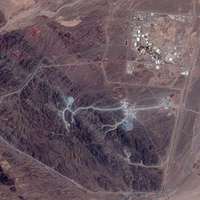
Iran’s Natanz uranium enrichment facility experienced two large explosions, one in 2020 and another earlier this year. Some believe that digital intrusion could be a factor in these successful operations widely attributed to Israel.
The Hooshyane Vatan, that seems to have revealed itself just days ago, in their statements frequently refer to Ahvaz, the capital of the oil-rich Khuzestan province and a favorite label by Iran’s Arab separatists and activists.

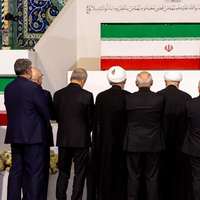
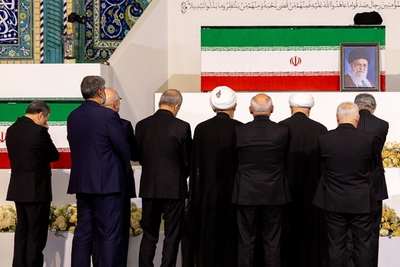
Iran’s first vice president said Sunday that the Islamic Republic has become so powerful no regional or world power can make a decision without Tehran.
Mohammad Mokhber claimed that before the 1979 revolution, Iran was not a player in the regional balance of forces, while now “the Islamic Republic has the first and the last word.”
Before 1979, Iran had the most modern army after Israel in the Middle East and was considered the gendarme of the region. After the fall of monarchy, the Soviet Union invaded Afghanistan in December 1979 and Iraq attacked Iran in September 1980, in what was seen as the result of a serious power vacuum in the region.
Mokhber once again claimed that the IRGC navy seized a Vietnamese-flagged tanker taken by the US Navy in October. The United States had dismissed Iran’s claim and said its navy only observed Iranian forces seizing the tanker in the Sea of Oman.
In other remarks, Mokhber appeared to concede that the centralized economic model of the Islamic Republic has been a failure. “We did not give control of the economy to the people, and we got into trouble,” but he insisted that the Revolutionary Guard’s paramilitary force Basij is the best vehicle to transfer control to the people.