Iran Says Success Of Nuclear Talks Depends On Removing US Sanctions

Iran’s chief nuclear negotiator Ali Bagheri-Kani says he has told foreign ambassadors that the success of nuclear talks will depend on lifting of US sanctions.
Iran’s chief nuclear negotiator Ali Bagheri-Kani says he has told foreign ambassadors that the success of nuclear talks will depend on lifting of US sanctions.
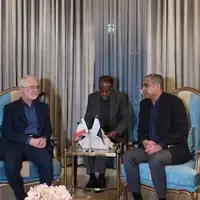
In a tweet Bagheri-Kani said he had meetings with ambassadors of other countries in Tehran, including envoys of Persian Gulf, Mediterranean and East European countries on Wednesday.
He told ambassadors that the success of the upcoming multilateral talks to resume in Vienna on November 29 “depends on other side’s firm determination and practical readiness to remove sanctions.”
Iran has toughened its position in recent weeks demanding that the negotiations focus on the US lifting of sanctions and has gone as far as saying there would be no new talks over nuclear issues and other issues.
Iran’s official government newspaper on Sunday put forth five demands for agreement during the talks, including reparations for imposing sanctions by the United States and a guarantee that Washington would never withdraw from a future agreement.
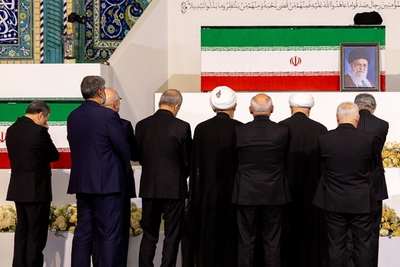


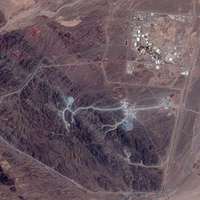


With Vienna talks on Iran’s 2015 nuclear deal resuming November 29, government newspaper Iran Daily has outlined Tehran’s tougher new position in five points.
Tehran's five demands represent an almost maximalist negotiating position that if it upholds could easily lead to a deadlock. Following each point in bold italics, Iran International presents a counter-point.
First, Iran not only will not allow any discussion on its missile program and regional conduct, but it will also refuse to have any negotiation over nuclear issues. “Iran will not enter into nuclear discussions, and it will thus block the West from tabling new issues,” the paper said.
Iran has stockpiled 113.8 kg of 20-percent and 17.7 kg of 60-percent enriched uranium, and it has deployed advanced centrifuges capable of much faster purification of the fissile material. It has gained knowledge and expertise it did not possess in 2015 when JCPOA went into effect. Without discussing such issues, talks cannot succeed.
Second, the United States as the party violating the Joint Comprehensive Plan of Action (JCPOA, the 2015 nuclear deal), is in the seat of the accused and it is not even a participant in the Vienna talks, Iran Daily said. The US government should express regret over its past mistakes and pay damages to Iran and try to regain trust. The US has not taken these steps and even President Joe Biden by renewing the US National Emergency with Respect to Iran has shown its lack of interest in rebuilding trust.
Biden administration officials, who will be present in Vienna and part of the process indirectly, have already said that while former president Donald Trump’s decision to leave the 2015 nuclear deal was wrong, it would be politically unsustainable for the new administration to make a formal statement and pay damages to Iran.
Third, as part of its confidence-building measures the United States should refrain from categorizing sanctions and should lift all sanctions imposed during former presidents Donald Trump and Barrack Obama that violated the JCPOA.
Some US sanctions relate to Iran’s nuclear program. Others are related to terrorism, money laundering, illegal arms transfers, and human rights. The US has said it is ready to lift oil and banking sanctions related to the nuclear issues, but that it would be politically untenable for the administration to lift all sanctions. While clear in many cases, what does and doesn’t violate the JCPOA is in some cases part of the talks.
Fourth, removing sanctions needs verification over time. Since Iran sustained damages with US withdrawal from JCPOA and reimposition of sanctions, it should have sufficient time to verify that it can sell its oil and repatriate the proceeds. Iran is ready to accept the role of a neutral group in verification.
While Iran is demanding verification on sanctions removal, it says it is not willing to discuss any nuclear issue. The West is interested in securing effective verification of Iran’s nuclear program and in holding talks for the post-JCPOA era, when Iran will be largely unrestricted in its nuclear capabilities.
Fifth, Iran demands guarantees that the US will not again withdraw from the JCPOA. Once the US returns to the agreement, it could as a JCPOA participant use the agreement’s ‘trigger mechanism’ in a more “mischievous way” against Iran.
Biden cannot under the US constitution guarantee that a future administration might not leave the JCPOA, which is an agreement and not a ‘binding’ treaty. A treaty would require a two-thirds majority in the US Senate, and would be unlikely in the case of the JCPOA, although perhaps possible if linked to restrictions in Iran’s missile program and regional role, which Tehran has ruled out.
US Defense Secretary Lloyd Austin Wednesday told reporters that Iran presents serious security and regional challenges that go beyond its nuclear program.
Speaking in Washington before his trip to the Middle East, Austin said “This trip comes at a time when Iran is stoking tensions in undermining stability in the region.”
The US defense chief also reiterated the Biden Administration pledge not to allow Iran to acquire nuclear weapons. “We remain deeply committed to preventing Iran from gaining nuclear weapons. No problem in Middle East gets easier solved with a nuclear-armed Iran, and that's why we fully support the president's efforts to achieve a new diplomatic agreement with Iran over its nuclear program.”
But Austin warned the Islamic Republic about threats it poses in the region. “I'm going to be very clear. We will defend ourselves and our partners and our interests against threats from Iran or its proxies,” he maintained.
Multilateral nuclear talks with Iran are scheduled to resume in Vienna on November 29 after Tehran walked away from negotiations in June. Meanwhile it has been enriching more uranium to higher purity, narrowing the window to accumulating enough fissile material for a bomb.
Rafael Grossi, head of the International Atomic Energy Agency (IAEA) will visit Iran Monday, state media said Wednesday, before the IAEA board meets November 24.
The reports cited Behrouz Kamalvandi, spokesman for the Atomic Energy Organization of Iran (AEOI). The visit would also come ahead of the planned resumption of talks in Vienna November 29 between Iran and world powers aimed at reviving Tehran’s 2015 nuclear agreement, the JCPOA (Joint Comprehensive Plan of Action) and as an IAEA report says Iran’s stock of uranium enriched to 60 percent has jumped nearly 80 percent in under three months.
Kamalvandi said Grossi would meet with Iran's Foreign Minister Hossein Amir-Abdollahian and AEOI chief Mohammad Eslami.
IAEA access to Iran’s nuclear program would be crucial in monitoring a revived JCPOA, but Grossi, along with Western states, has expressed growing concern since February 2020 when Iran reduced access to little more than required under the Nuclear Non-Proliferation Treaty (NPT).
IAEA full access
Grossi has also criticized as inadequate explanations given by Iran over traces of uranium found at two undeclared sites and relating to work carried out before 2003.
A more pressing issue for Grossi is restoring access to Iran’s Karaj plant under terms of a temporary arrangement first made in February. While IAEA inspectors have been allowed to service monitoring equipment elsewhere, Iran has barred this at Karaj on the grounds it is carrying out a security investigation after a June attack, widely attributed to Israel.
An IAEA report this week puts Iran’s stockpile of uranium enriched to 60 percent at 17.7kg, up from 10kg in September. While this is less than the 25kg claimed by nuclear spokesman Behruz Kamalvandi November 4, it represents a large increase in a level of enrichment close to the 90 percent regarded as ‘weapons grade.’
Tehran has also now 113.8kg enriched to 20 percent, up from 84kg in September. A purity of only 3.67 percent is allowed under the JCPOA.
It also emerged Wednesday, in an agency report, that Grossi wrote to Iran October 25 complaining over excessively invasive physical searches by security officials at nuclear sites.
If Grossi fails to make progress next week, the European JCPOA signatories – France, Germany, and the United Kingdom – may discuss with the United States options to raise Iran’s lack of cooperation at the IAEA board. Speculation they might do so at a board meeting in September waned once Grossi extended the temporary monitoring agreement, which the IAEA chief later insisted covered Karaj as well as other sites.
Reuters quoted a senior diplomat Wednesday that the IAEA, given its lack of access, did not know if Iran has resumed manufacturing advanced centrifuges – the devices used to enrich uranium – at Karaj, as was reported Tuesday by the Wall Street Journal citing “diplomats familiar with the activities.” The advanced centrifuges enable quicker and more efficient enrichment of uranium, thereby reducing the time it would take to enrich to 90 percent ‘weapons grade.’
Karaj parts installed at Ferdow
“According to one of the diplomats familiar with Iran’s program, Iran has installed the centrifuges whose key parts were produced at Karaj at Iran’s underground, heavily fortified, Fordow site,” the Journal reported. The diplomat quoted said there was no evidence the equipment had been diverted elsewhere but “as the number of unmonitored centrifuges increases, the likelihood for this scenario increases.”
The Vienna talks have been in abeyance since June when Iran stopped its participation. While the US has continued ‘maximum pressure’ sanctions introduced by previous president Donald Trump on leaving the JCPOA in 2018, Iran has continued to expand its nuclear program – notably in enriching uranium to 60 percent, far above the 3.67 percent allowed under the JCPOA, and in using advanced centrifuges banned under the deal.
The new government in Tehran, which includes critics of the JCPOA, has adopted a more assertive tone, suggesting that while Iran would like to see US sanctions lifted, a return to the nuclear deal is a lower priority that it was under the previous administration of President Hassan Rouhani.
United Against Nuclear Iran (UANI), an advocacy group has said it was the target of Iranian hackers, calling on the US impose sanctions on those responsible.
In a statement on Tuesday, UANI, based in the United States, said it suspected that APT35, also known as Charming Kitten, a well-known Iranian hacking group launched a series of cyberattacks, “Specifically targeting its leadership and members of its Advisory Board.”
UANI CEO Ambassador Mark D. Wallace was quoted as saying, “Those responsible managed to procure data outside of the public realm, impersonated our leadership in communications with former senior officials of the US government, and attempted to harvest Gmail credentials.”
He added that UANI took immediate action upon discovering these attacks “and has notified the relevant law enforcement authorities to request a criminal investigation.”
The group urged the authorities to investigate the incidents and for the US “to enhance its cyber security cooperation with its friends and allies. UANI further urges the Biden Administration to impose fresh economic sanctions against those responsible.”
UANI added that such attacks will not deter it “from achieving its goal of ensuring the regime fails in its pursuit of nuclear weapons, ends its support for terrorism, and stops its oppression of the Iranian people.”
US President Joe Biden and China's Xi Jinping discussed harmonizing their positions ahead of the Nov. 29 Iran nuclear talks, a top US official said on Tuesday.
Officials from Iran and the six nations that struck the pact - Britain, China, France, Germany, Russia and the United States - will meet in Vienna to see if Tehran and Washington can agree to resume compliance with the deal under which Iran curbed its nuclear program to gain relief from US, EU and UN sanctions.
In 2018 then-President Donald Trump withdrew the United States from the pact among the major powers and Iran restoring harsh US sanctions, prompting Tehran to begin violating its nuclear restrictions about a year later.
"The two presidents had the chance to talk about how we can align our perspectives heading into that meeting so that the P5+1 is united in dealing with Iran and trying to pave the way for a return to the (deal)," White House National Security Adviser Jake Sullivan said in a virtual think tank appearance.
While China favors reviving the agreement, it has tended to place the onus on the United States, rather than Iran, blaming Washington for having abandoned the deal and giving Tehran an economic lifeline by buying Iranian oil despite US sanctions.
Report by Reuters