Around 3,000 women allowed into stadium in Iran to watch soccer match. October 10, 2019
Iran’s soccer federation has denied reports that it had sent a proposal to parliament that women fans be allowed to enter stadiums to watch men’s games.
Earlier this week, media claimed the federation had suggested draft legislation to allow women to be spectators, after a 40-year ban. But the Iranian Student News Agency (ISNA) reported Saturday that the federation had denied these reports, which had cited the federation’s own officials.
It was not immediately clear whether the federation had back-pedalled due to political pressure from conservatives who oppose women at games.
Former president Mahmoud Ahmadinejad announced in 2006 that a ban on women’s attendance, introduced after the 1979 Revolution, would be lifted, but he backed down after objections from senior Muslim clerics.
FIFA, the international football or soccer federation, has been calling on Iran to relax the rule and allow women into stadiums. A select number of women were allowed to attend World Cup qualifying games in 2018.
But lack of further progress led to FIFA considering banning Iran from international games, which led the government to allow around 3,000 women − a small fraction of the attendance − to watch a game between Iran and Cambodia two years ago, in October 2019, exactly 38 years after women were first banned in October 1981.
Women soccer fans were encouraged that things were moving in the direction they wanted. But in restricting attendance at all sports, the Covid-19 pandemic also stopped the trend toward allowing women in Iran to attend games.
A strict version of Islamic and cultural tradition restricts women’s contact with men, and a sports stadium packed with male spectators and where woman watch men compete, alarms many conservative clerics.
But women know that before the 1979 revolution they were allowed to do many things they are barred from today, including not wearing hijab, riding a bicycle, even a motorcycle and holding high level government jobs.
But FIFA is likely to renew its pressure. Recently, Iran announced that all attendance was banned in an international match against South Korea in Tehran, but the people were allowed to watch the game in cinema theatres.
Ostensibly, the ban on stadium attendance was for the pandemic, but many pointed out that cinemas were just as conducive, if not more so, to spreading coronavirus.
A group of senior Iranian clerics in Qom in a meeting in February 2019
High-ranking ayatollahs and some officials in Iran have been issuing dire warnings about Iran’s economic crisis and the hardship people face as prices soar.
Grand Ayatollah Lotfollah Safi Golpayegai, a respected 104-year-old senior cleric, came under fire by an ultraconservative website for warning the parliament speaker that Iran must end its international isolation.
An Iranian analyst, Mehdi Mahdavi-Azad told Iran International that as Iranians get poorer many ordinary religious people fall below the poverty line and senior clerics feel the danger of their anger.
Judiciary Chief Gholamhossein Mohseni Ejei warned on Thursday, that low employment and decline in production is likely to lead to “social abnormalities.” Without elaborating further, Ejei warned that part of Iran's political, social and cultural problems is the result of economic retrenchment. However, he did not mention US sanctions, which are the immediate cause of the crisis.
Judiciary chief Ejei inspecting Tehran's Evin.
Ejei is the quintessential insider, loyal to Supreme Leader Ali Khamenei and presiding over one of the regime’s most hardliner and repressive machines.
Tehran has so far resisted reaching a quick deal over its nuclear program with the United States, which would lift the crippling sanctions. The resulting impasse has led to Iran's most serious economic crisis since the 1950s. Some economists have even warned that Iran might end up in a famine, like the one it experienced in early 20th century, if it fails to begin negotiations with the West.
Another high-ranking cleric, Expediency Council Chairman Sadegh Amoli Larijani said on Thursday that it is regrettable that many Iranians cannot afford to provide meat and fruit for their families."This is painful," conservative website Alef quoted him as saying.
Amoli-Larijani sitting next to Ali Khamenei. Undated
Speaking about rising prices and other economic problems that have made life difficult for Iranians, Larijani said: "The pressure being exerted on the people, particularly the underprivileged strata as a result of high inflation is a major source for concern."
Many foodstuffs are scarce, and their prices are constantly rising, and we should be thinking of a quick solution for families that cannot afford to buy meat or fruit, said Larijani, while calling on the government to make the necessary decisions to bring about a breakthrough. However, he also stopped short of advising the government to solve its disputes with the West.
Grand Ayatollah Safi Golpayegani
Earlier this week, during a meeting with Majles Speaker Mohammad Bagher Ghalibaf in Qom, Grand Ayatollah Safi Golpayegai, a former Guardian Council member got closer to the essence of the problem and demanded an end to Iran's international isolation. But possibly fearing repercussions in case his words were taken as opposition to Khamenei's policies, he did not mention the sanctions and the need for negotiations with the West.
Golpayegani told Qalibaf: "I am seriously concerned about the country's economic situation and the people's problems." The Grand Ayatollah added: "We should maintain relations with all of the countries of the world. It is not good to be sulking with many other countries. In order to restore the rights of the people and put an end to the current situation which the Iranians do not deserve, we should maintain relations with the world."
Subsequently, hardline news website Raja News, which is close to the ultraconservative party Paydari, harshly criticized Golpayegani and accused him of repeating former President Hassan Rouhani's "wrong arguments."
On Thursday, The Qom Seminary Teachers Association and Ayatollah Alavi Boroujerdi, a high ranking seminarian criticized Raja News and ruled out its argument as "rude," however, the website carried another article with the same tone repeating the same allegations.
Raja News is one of the main opponents of negotiations with the United States and other Western countries and has said in numerous articles during the past year that Iran should leave the nuclear deal (JCPOA).
The calls made by top clerics to solve economic problems could be their way of persuading Khamenei to agree to restart negotiations with the West without preconditions.
A conservative student union staged a rally in Tehran on Friday to protest an apparent ban on imams making corruption allegations against named individuals.
Members of the union, from two of Tehran's major universities gathered outside Tehran University where Friday prayers are held, carrying posters with slogans against Mohammad-Javad Hajali-Akbari, who chairs the Friday Prayer Policy-Making Council and who has suggested prayer leaders stick to ‘religious’ matters.
"Friday prayers will be pointless if the problems of people and the state are not discussed at Friday prayer gatherings and the sermons are dictated," one of the students’ posters read.
Another slogan urged Friday imams "to rise against poverty, corruption, and discrimination." The activists chanted "Friday prayers are not the place for conservatism" in reference to a recent remark by Hajali-Akbari, who has said Friday prayers were not an appropriate forum for "whistle-blowing."
The students accuse the council and Hajali-Akbari of "prudent silence against corruption" and a favoring a "neutral view" in sermons.
"Friday prayer will turn into grounds for sterilization of the Revolution if a person who is responsible for dictating policies to imams does not tailor their role to meet the fundamentals of the Revolution and its ideals," the union opined in a statement Friday.
Friday Prayer Policymaking Council (Showra-ye Siyasatgozari-ye A’emmeh-ye Jom‘eh) draws general guidelines, religious and political, for sermons delivered in more than 600 Friday congregations across Iran every week.
The government-funded council has a budget of 295 billion rials (nearly $7 million) for this year. Council members are appointed by the Supreme Leader Ali Khamenei,who ordered the body established in 1993.
Members of the Justice-Seeking Student Movement (Jonbesh-e Edalatkhah-e Daneshjouei) generally back Khamenei but say they are not attached to any political faction. They hold meetings and rallies in and outside universities, generally attend official rallies, and criticize authorities over various issues, including corruption.
The students' protest was rooted in opposition to the council sacking Saeed Hosseini-Lavasani, the Friday imam of Lavasan near Tehran, for making accusations over alleged landgrabs to build luxury holiday houses.
In a speech to imams in South Khorasan province Tuesday, Hajali-Akbari indirectly accused the imam of Lavasan and supporters of "staging a justice-seeking show and calling it rectitude.”
"This kind of behavior has nothing to do with the duties of Friday prayer imams," Hajali-Akbari noted, adding that both Iranian leaders, Ruhollah Khomeini and Khamenei, had banned corruption allegations against named individuals from Friday sermons.
"Thanks to Mr Hajali-Akbari who transparently and honestly said particulars of economic and financial corruption cases should not be discussed in Friday sermons and candidly stated the red lines,” Mahdi Dezfuli, filmmaker and supporter of the students, tweeted Friday. “It has now become clear that [claims of] fighting corruption were only meant to deceive the public and there is no will for that.”
Five days after an apparent cyberattack on a payment system at Iran’s 4,000 gas stations, full service has been restored in only half the locations.
On Tuesday, gas stations nationwide were disabled from accepting a special payment card for cheaper fuel issued to every Iranian. The disruption led to long lines at stations and higher cash prices for gasoline.
A top official said Saturday that around 2,000 pumping stations could again sell rationed gasoline, a slow process compared with promises on the day of the incident that the system would be fixed in one day.
The government has said that a cyberattack disabled the system, while experts say the payment system was not connected to the Internet. There is no independent confirmation of what caused the disruption.
The Iranian government and parliament, both dominated by hardliners, want to reduce fuel subsidies that makes Iranian gasoline the second cheapest in the world, after Venezuela. The price of one gallon has risen to more than 40 US cents from a subsidized rate of around 20 cents.
Although still unbelievably cheap, but the income of an average employee in Iran is around $150 a month.
Iranian hackers have attacked an Israeli data and internet company, five days after an apparent cyberattack disabled a payment system in Iran’s gas stations.
A hackers' group called Black Shadow announced on social media that they have seized a large trove of data from the company and its clients and asked them to pay a ransom if they do not want publication of the information.
The Jerusalem Post confirmedthat websites serviced by Cyberserve internet company are down as it refused an initial demand to pay ransom. The newspaper said that the group had attacked other Israeli companies in the past.
Around noon time on Tuesday, more than 4,000 gas stations in Iran experienced disruption of a payment system for cheaper, rationed gasoline that every Iranian has uses to receive a limited amount of cheap fuel every month. The disruption has been mostly resolved after three days, but Iran has not officially accused Israel, which in the past has targeted Iran with cyberattacks.
The latest attack by the Iranian group could be an attempt to show that Iran can respond to cyberattacks as the large-scale disruption at gas stations has hurt its image domestically.
People gathered at the tomb of Cyrus the Great. Undated
Iranian security officials uttered a sigh of relief probably as October 29 came to an end and the long autumn day in Dasht-I Murghab plunged into dusk quietly.
The day coincided with Cyrus the Great Day, the founder of Iran's ancient dynasty, the Achaemenids, whose empire-building in the 6th century BC was marked with respect for diversity and human rights. His empire expanded from Central Asia and the eastern wing of the Persian plateau and beyond to Mediterranean shores and North Africa.
Cyrus the Great (circa 600-530 BC) Day on October 29 this year was relatively uneventful. However, security measures were deliberately visible in Shiraz, the nearest big city to the monument that is the ancient King's tomb in Pasargadae, some 60 miles into the mainly arid plain northwest of the city. The date was chosen based on estimates that he captures Babylon on October 28 or 29 in 539 BC.
Security police were vigilant in Shiraz since Thursday, questioning anyone who looked like a tourist to make sure that they were not going to visit Pasargadae, said eyewitnesses in Shiraz.
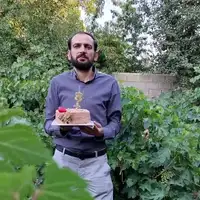
Friday morning, security forces arrested the parents of Navid Afkari, whose unfair trial and execution in 2019 caused havoc in Iran. The elderly parents were arrested with a birthday cake with the face of Cyrus the great painted on it with icing. Reports from Iran say they were released in less than two hours, after being warned to make sure that they will not be part of any demonstration to mark the royal birthday tow weeks before the anniversary of the 2019 protests during which security forces killed hundreds of peaceful demonstrators.
The edict of Cyrus the Great on protecting rights of all people discovered in present day Iraq
The reason for tight security measures in Shiraz and the road to Pasargadae was concern on the part of the authorities that like previous years, thousands would defy security measures and show up around the ancient King's tomb. The Islamic Republic has shunned Iran's long-standing history of thousands of years of monarchy as if it did not exist as an empire that ruled over most of the known world.
Another reason was that Prince Reza Pahlavi, the heir to Iran's monarchy, sent a message to the nation to mark the day. He called on Iranians: "Remember the name and memory of Cyrus the Great in any which way you can, wherever you are. Show the world that you are a united, freedom-loving and tolerant nation. Every one of you should represent the great ancient nation of Iran. The world should not identify Iran with the ruling criminal cult that is running the Islamic Republic."
The large gathering on October 29, 2016 at Cyrus' tomb
The current regime has been in denial of the popularity of Iran's monarchy and national heritage. Some religious zealots wanted to ruin the monuments in Pasargadae and Persepolis immediately after the 1979 Islamic Revolution, but people's resistance against fundamentalism did not allow them to do what they wanted.
Nonetheless, as recently as two weeks ago, President Ebrahim Raisi made a gaffe during a visit to Persepolis saying that the monuments were reminiscent of oppressor kings. He made the comment mindless of the fact that Cyrus the Great is internationally respected as a champion of human rights.
In a video posted on social media, Princess Ashraf Pahlavi, the twin sister of Shah Mohammad Reza Pahlavi, is seen donating some ancient works of art to the United Nations that testify to Iran's leading role as an advocate of human rights thousands of years ago.This was in sharp contrast to the anti-human rights image of the Islamic Republic most recently portrayed by the UN Rapporteur for Human Rights in Iran Javid Rehman.
Last week, when Cultural Heritage and Tourism Minister Ezzatollah Zarghami called for digging water wells around Cyrus the Great's tomb, an act that would harm the monument, social media users such as cultural activist Mohammad Bagher Tabatabai warned Zarghamithat "The tomb of Cyrus the Great has a place in the heart of every Iranian. You can never destroy it."
Outside Iran, former US deputy assistant secretary of state Len Khodorkovsky wrote in an October 29 tweet: "Cyrus the Great is a source of pride for the Iranian people. His legacy of openness and tolerance will outlast the corruption and brutality of the temporary regime in power today, and usher in a new Iranian renaissance. "
During the past years, particularly after the 1979 Islamic revolution and despite the Islamic Republic’s violent crackdown on pro-monarchy demonstrations, thousands of Iranians rushed to Pasargadae to pay tribute to the great ancient king. The celebration found epic dimensions since 2016. Since 2017, the Revolutionary Guard (IRGC) has deployed forces to the region and blocked all roads to Pasargadae to make sure that the celebrations were not going to happen. But still, hundreds of young men and women somehow managed to gather around the monument and sing patriotic hymns.
In the absence of reliable reports from Iran, particularly about events the government does not want to be highlighted, it is extremely difficult to verify the date and authenticity of pictures that show gatherings around the monument with some paying their respect to Cyrus by kissing his burial ground. The celebration this year may have not been as monumental as previous years, but Iranians trended Cyrus' name as hashtags in Persian and English in the king's remembrance day.