Iran says no possibility of talks with US for now
Iran’s foreign minister said on Sunday there is currently no possibility of resuming negotiations with the United States, citing what he described as a lack of constructive behavior from Washington.

Iran’s foreign minister said on Sunday there is currently no possibility of resuming negotiations with the United States, citing what he described as a lack of constructive behavior from Washington.
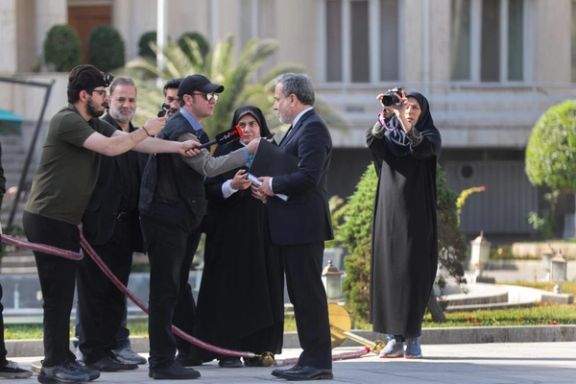
“There is at present no possibility of restarting talks with the United States,” Foreign Minister Abbas Araghchi told reporters on the sidelines of a cabinet meeting, according to state media.
Araghchi said Tehran was open in principle to discussions that would be “based on equality and serve the interests of both sides,” but added that “the attitude we see from the Americans does not indicate such readiness.”
Relations between Tehran and Washington have remained tense amid continued US sanctions and disputes over Iran’s nuclear program.
Araghchi has previously said that while diplomacy remains Iran’s preferred path, any new negotiations must take place on what he called “a foundation of mutual respect and balance.”
The foreign minister’s remarks came days after International Atomic Energy Agency (IAEA) chief Rafael Grossi said Iran retained enough highly enriched uranium and technical expertise to build nuclear weapons despite damage to several enrichment sites during Israeli and US strikes earlier this year.
Grossi said that while the June attacks on Natanz, Isfahan and Fordow had “severely damaged” Iran’s nuclear facilities, the country “still possesses the knowledge and material to manufacture a few nuclear weapons.”
He urged a “return to diplomacy,” warning that continued military escalation would erode chances of oversight and control.
In a separate interview with the Financial Times last week, Grossi said inspectors had been denied access to key sites since the June strikes, despite roughly a dozen inspection requests.
He cautioned that Tehran risked losing credibility under the Non-Proliferation Treaty (NPT) if it continued restricting access.
“You cannot say, ‘I remain within the NPT,’ and then not comply with obligations,” he said.
Tehran rejected Grossi’s remarks as “politicized and unfounded.”
Foreign Ministry spokesman Esmail Baghaei said the agency was “fully aware of the peaceful nature” of Iran’s nuclear program and accused it of giving Israel “a pretext for aggression.”

The new push for an electricity grid linking Iran, Russia and Azerbaijan grid promises closer energy integration but could leave Tehran more exposed to Moscow’s leverage as rival corridors threaten to dilute its regional role.
In mid-October 2025, Azerbaijan’s deputy prime minister announced the formal launch of an electricity-linkage project among the three countries.
The plan builds on Iran’s 2024 proposal to route Russian electricity through its territory to Persian Gulf Arab states, advancing earlier diplomatic pledges. Full integration is targeted by late 2025, alongside coordination with Armenia.
The initiative fits Russia’s push for southern energy routes under sanctions, but could undercut the strategic weight of the International North-South Transport Corridor (INSTC)—the trade artery linking India, Iran and Russia through Azerbaijan.
Shared leverage
A connected grid could deliver real economic and strategic gains.
By balancing supply and demand across borders, it might ease chronic blackouts—especially in Iran, where sanctions have crippled capacity.
Surplus electricity from Russia and Azerbaijan’s renewables could offset Iranian shortages, while shared infrastructure encourages cross-border power sales and investment.
For Iran, participation promises stability and regional relevance; for Russia, another path around Western-controlled networks; for Azerbaijan, a global profile built on “green power outreach.”
Iran’s balancing act
Integration could offer Tehran both relief and peril.
Years of underinvestment and gas dependency have left its grid aging and inefficient. Sanctions block access to capital and modern equipment, limiting meaningful expansion.
To benefit from the move and reduce vulnerability, Tehran needs to diversify its energy mix, curb waste and reform governance—meaning remove favoritism from energy planning and open the sector to transparent partnerships.
These are tall orders without which the project may only deepen Tehran’s reliance on Moscow.
Caspian crossroads
The grid plan also intersects with rival connectivity schemes.
The International North–South Transport Corridor (INSTC)—a 7,200-kilometer multimodal corridor linking Mumbai to St. Petersburg via Iran and Azerbaijan—has been a lifeline for sanction-hit Tehran, yet it faces chronic delays and funding gaps.
Meanwhile, the EU-backed Black Sea Energy Corridor, launched in 2022, will send 4 GW of Azerbaijani wind and solar power to Europe by 2032. Faster, cleaner and politically safer, it already attracts more Western financing.
If momentum shifts toward the Black Sea route, Iran could lose as much as $10–15 billion in potential transit fees and influence, reinforcing its peripheral role in regional trade.
The choice ahead
Moscow’s dominance—and its expanding 2025 alliance with Tehran—could give it decisive leverage over energy supply, echoing Gazprom’s tactics in Europe.
Western sanctions on both Moscow and Tehran could deter investment and drag Baku into secondary penalties.
Regional flashpoints—from Armenia-Azerbaijan tensions to Iran’s domestic volatility—add fragility. Environmental and technical challenges add further strain, chief among them: fluctuating Caspian water levels and climate stress on Iran’s water-energy nexus.
The Iran-Russia-Azerbaijan grid could make Tehran a regional electricity hub or entrench it as Moscow’s junior partner.
Two visions now compete around the Caspian: one driven by geopolitical necessity, the other by the global green transition. How Iran navigates between them will determine whether this bridge becomes a lifeline—or another bind.

Iran-backed militias in Iraq are looking to consolidate the grip they won by force of arms on the fragile country's politics with gains in parliamentary elections next month, experts told Eye for Iran podcast.
After a series of military and diplomatic setbacks, Tehran may hope their allies next door can preserve its influence via the ballotbox and protect a decades-old Iranian political investment in its neighbor.
Confident that US attacks "obliterated" Iranian nuclear sites in June amidst an Israeli military campaign, US President Donald Trump may be ignoring the potential threat Iran poses in Iraq according to historian Dr Shahram Kholdi.
“Iraq may become, in a very odd way, the Achilles heel of the Trump administration,” he told Eye for Iran.
Kholdi warned Tehran’s reconfigured influence could quietly undermine US gains against Iran in the region, adding that steering its militias into politics risks “recreating the Islamic Republic light version in Iraq, 2.0, that operates through bureaucracy rather than arms.”
The shift comes as Washington issues one of its strongest warnings yet, saying it will not recognize Iraq’s next government if any ministries are handed to armed factions linked to the Islamic Republic, a source in Iraq’s Kurdistan region told Iran International on Friday.
In a recent call with Iraq’s defense minister reported by Saudi daily Al-Sharq al-Awsat, US Secretary of War Pete Hegseth cautioned any interference by armed factions to unspecified future US military operations would provoke a sharp American response.
The minister, according to the report, described it as “a final notice,” reflecting US concern that Iran’s allies could use Iraq’s elections to entrench themselves in state institutions.
For Tehran, encouraging its proxies to enter politics provides a way to adapt without relinquishing its arms.
The Popular Mobilization Forces, an umbrella of Shi'ite militias funded through Iraq’s state budget, command vast patronage networks that already blur the line between governance and coercion. Bringing those networks formally into Iraq’s political system could allow Iran to project stability while maintaining influence behind the scenes.
“Iran has been severely weakened in the wake of the 12-day war,” said Jay Solomon, a journalist and author of The Iran Wars.
“What we see is an effort to maintain their proxies and stay below the radar but rebuild.” The approach, described by Solomon, reflects a shift from confrontation to consolidation, using political channels to preserve influence while avoiding direct conflict with the United States.
That calculation, according to Alex Vatanka, Director of the Iran Program at the Middle East Institute, shows how Iran’s leadership has learned to work within new limits.
“They want to rebuild as much as they can within limits. They probably have a much better sense of their limitations today than they did before this summer. But again, they do not want to have that open fight, certainly not on Iraqi soil.”
Two decades after the US invasion of Iraq, Washington faces a familiar dilemma: whether to tolerate a fragile partner shaped by Tehran’s influence or confront a more sophisticated phase of Iranian power consolidation.
Iran’s recalibration in Iraq, analysts on Eye for Iran said, is less a retreat than a pause for recovery, a reminder that even under pressure its power lies not in confrontation but in adaptation.
You can watch the full episode of Eye for Iran on YouTube or listen on a podcast platform of your choosing.

The US State Department on Friday condemned Iran's arrest of leading political prisoner Mostafa Tajzadeh who was on a furlough to attend his brother's funeral, urging Tehran to focus on improving its people's lives.
Iranian security forces on Tuesday raided Tajzadeh's daughter's home and arrested him without providing any explanation, former fellow inmate Mehdi Mahmoudian said on X.
"The re-arrest of Tajzadeh reflects the Islamic Republic’s blatant disregard for human dignity and justice," the State Department said in a statement on its Persian-language X account.
"It also shows that, for the Islamic Republic, suppressing dissent takes priority over addressing Iran’s deeper crises."
Tajzadeh is a reformist politician who served as deputy interior minister during the presidency of Mohammad Khatami from 1997 to 2005.
He has been imprisoned for 10 of the last 16 years, currently on charges including acting against the state, spreading falsehoods and propaganda.
Before being re-arrested, Tajzadeh attended the funeral of his brother and met several activists including Nobel Peace Prize laureate Narges Mohammadi in a move the State Department hailed as “a symbol of the resistance and courage of the Islamic Republic’s political dissidents.”
Mohammadi said on Tuesday that there was no prospect for reforming the country's Islamic theocracy and its downfall was assured.
“Reform has been dead for years. The time for reforms has long passed. The real main struggle is between the realistic survivalists and those seeking the end of religious despotic regime,” Mohammadi posted on X.
In July, Tajzadeh warned Supreme Leader Ali Khamenei to pivot or resign.
"In this critical situation, Mr. Khamenei has no option but to apologize to the Iranian people and accept fundamental reforms in line with national demands, including by forming a constituent assembly based on completely free and fair elections," he said, "or to resign and step down."
In recent years, the pursuit of reform has shifted toward regime change, as seen in the 2017-18 and 2022 Woman, Life, Freedom uprisings, with many people viewing the system as irreformable.

US President Donald Trump has rolled over an annual declaration of a US national emergency on Iran according to a statement published on Friday on the Federal Register.
The national emergency was announced on November 14, 1979 when radical students in Tehran seized the US embassy and took hostage dozens of diplomats, staff and guards. Trump's move marks the 46th time it has been renewed.
The decision by then-president Jimmy Carter was meant “to deal with the unusual and extraordinary threat to the national security, foreign policy and economy of the United States constituted by the situation in Iran.”
In renewing the national emergency Trump said in a statement: "Our relations with Iran have not yet normalized, and the process of implementing the agreements with Iran, dated January 19, 1981, is ongoing."
On that date, Iran and the United States agreed to the Algiers Accords, an understanding brokered by the North African nations for the two enemies to resolve the hostage standoff.
"For this reason, the national emergency declared on November 14, 1979, and the measures adopted on that date to deal with that emergency, must continue in effect beyond November 14, 2025," Trump added. "Therefore... I am continuing for 1 year the national emergency with respect to Iran declared in Executive Order 12170."
In addition to the 1979 declaration, a separate national emergency was declared on March 15, 1995, addressing Iran's actions related to terrorism and weapons proliferation. This emergency has also been renewed annually, with the 30th extension made by the Trump administration on March 7, 2025.
After taking office for his second term in January, Trump reimposed his so-called maximum pressure campaign on Iran. The two sides then held five rounds of nuclear talks before a 12-day war between Iran and Israel in June, which culminated in US airstrikes on three Iranian nuclear sites.
Negotiations have since stalled over uranium enrichment, with Western powers insisting Iran end domestic enrichment and Tehran refusing.
Last month, Iranian Supreme Leader Ali Khamenei described negotiations with the United States as “useless and harmful” and declared any talks with Washington forbidden.
In a speech this week he praised the 1979 hostage taking as a formative moment in the Islamic Revolution and its mission to eject the United States military from the region and defeat its ally Israel.

Iran has approached Washington to ask whether US sanctions could be lifted, US President Donald Trump told the leaders of the C5+1 Central Asian countries at the White House on Thursday.
“Iran has been asking if the sanctions could be lifted. Iran has got very heavy US sanctions, and it makes it really hard for them to do what they'd like to be able to do. And I'm open to hearing that, and we'll see what happens, but I would be open to it,” Trump said.
Earlier this week, Iran’s Supreme Leader Ali Khamenei said cooperation between the two countries was impossible as long as Washington continued to support Israel, maintain military bases, and interfere in the Middle East.
“As long as America supports the Zionist regime and interferes in the region, cooperation with it is neither rational nor possible,” Khamenei said on Monday.
Trump also said that the United States directed Israel’s first strike on Iran during the June conflict. “Israel attacked first. That attack was very, very powerful. I was very much in charge of that,” Trump told reporters late on Thursday.
“When Israel attacked Iran first, that was a great day for Israel because that attack did more damage than the rest of them put together.”
After taking office for his second term in January, Trump reimposed his maximum pressure campaign on Iran, a policy aimed at preventing Tehran from developing a nuclear weapon. In June, the United States bombed Iranian nuclear sites, further straining ties between the two countries.
The two sides held five rounds of nuclear talks before a 12-day war between Iran and Israel in June. Negotiations have since stalled over uranium enrichment, with Western powers insisting Iran end enrichment on its own soil, a demand Tehran has rejected.
Last month, Khamenei described negotiations with the United States as “useless and harmful” and declared any talks with Washington forbidden. Foreign Minister Abbas Araghchi also said no direct dialogue had taken place, adding that Tehran would discuss only nuclear matters and would never negotiate on regional issues.